

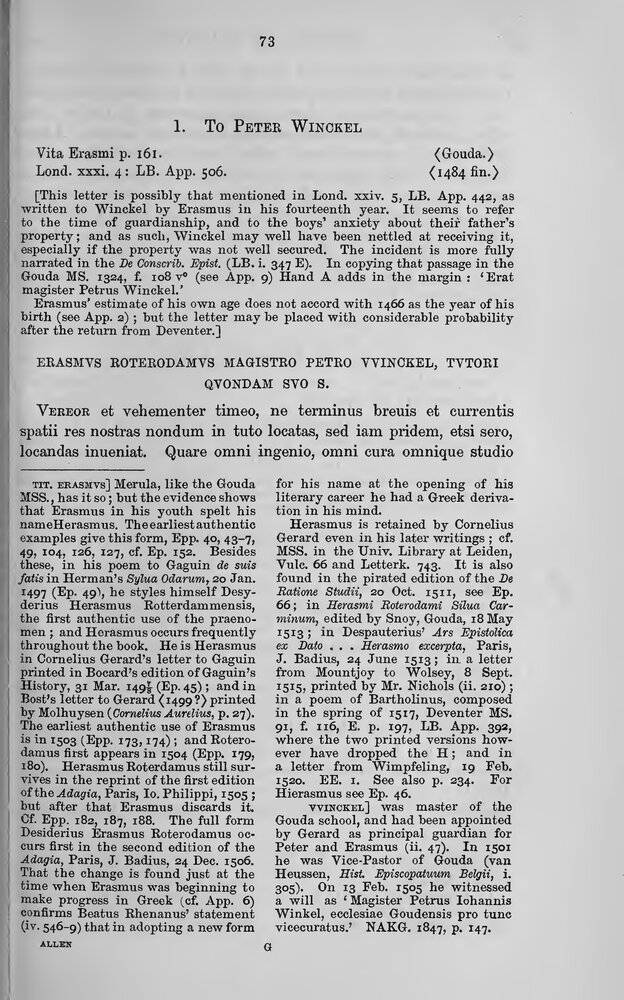
[This letter is possibly that mentioned in Lond. xxiv. 5, LB. App. 442, as written to Winckel by Erasmus in his fourteenth year. It seems to refer to the time of guardianship, and to the boys' anxiety about their father's property; and as such, Winckel may well have been nettled at receiving it, especially if the property was not well secured. The incident is more fully narrated in the De Conscrib. Epist. (LB. i. 347 E). In copying that passage in the Gouda MS. 1324, f. 108 v° (see App. 9) Hand A adds in the margin: 'Erat magister Petrus Winckel.' Erasmus' estimate of his own age does not accord with 1466 as the year of his birth (see App. 2); but the letter may be placed with considerable probability after the return from Deventer.]
Erasmus expresses urgent concern about the security of his and his brother's inheritance, fearing that their property remains at risk and requires immediate attention. He urges his former guardian Peter Winckel to act diligently to prevent financial loss and mentions that Christian has not yet returned some books.
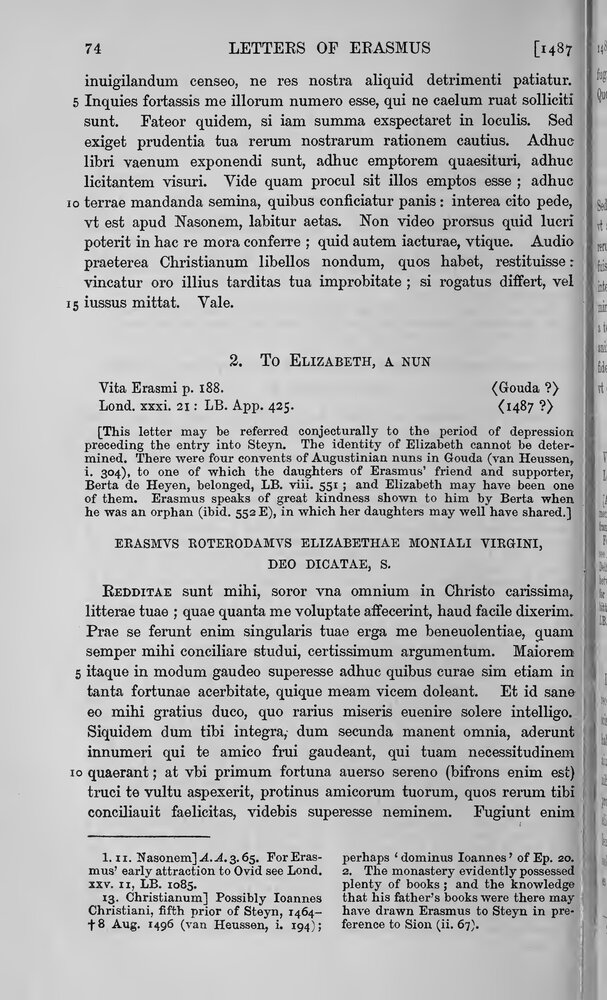
Erasmus of Rotterdam to Master Peter Winckel, his former tutor, greetings. I fear and am intensely anxious that the brief and swiftly passing limit of time may find our affairs not yet secured in a safe place, though they ought to have been settled long ago, even if belatedly. Therefore I judge that we must watch over them with all our ability, all our care, and all our diligence, lest our business suffer any harm. Perhaps you will think me one of those who worry that the sky may fall. I admit I would be, if the final sum were already sitting in my coffers. But your prudence will demand that our affairs be managed more cautiously. The books still need to be put up for sale; we still have to seek a buyer; we still must see one making a bid. Consider how far off it is that they have been bought; the seeds from which bread is to be produced must still be entrusted to the earth. Meanwhile, with swift foot, as Ovid says, life slips away. I see absolutely no benefit that delay can bring in this matter; but what loss it may cause—certainly. Moreover, I hear that Christian has not yet returned the pamphlets he has: I beg that his slowness be overcome by your persistence; if when asked he delays, let him send them when commanded. Farewell.