
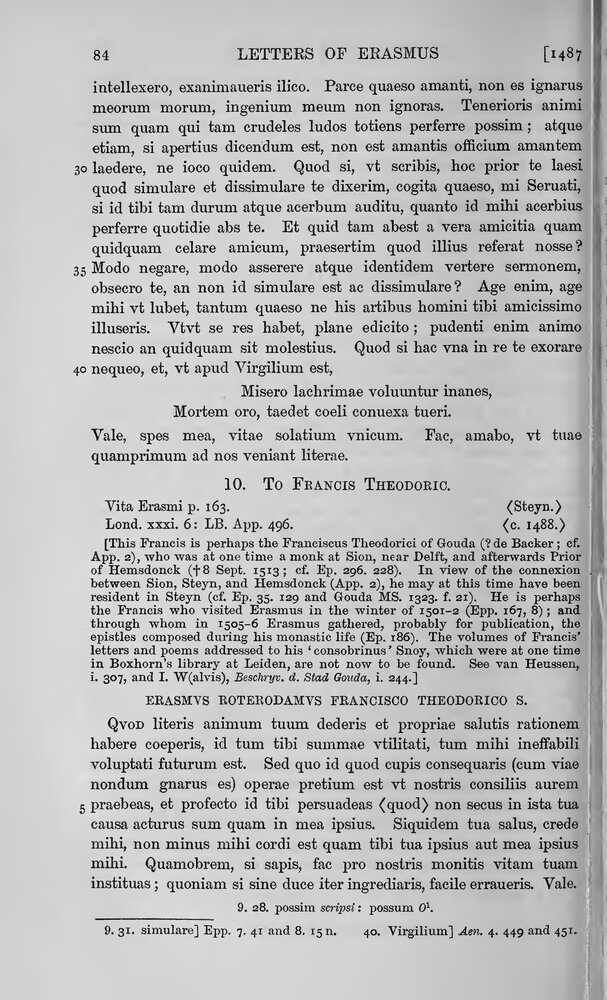
[This Francis is perhaps the Franciscus Theodorici of Gouda (? de Backer; cf. App. 2), who was at one time a monk at Sion, near Delft, and afterwards Prior of Hemsdonck (+8 Sept. 1513; cf. Ep. 296. 228). In view of the connexion between Sion, Steyn, and Hemsdonck (App. 2), he may at this time have been resident in Steyn (cf. Ep. 35. 129 and Gouda MS. 1323. f. 21). He is perhaps the Francis who visited Erasmus in the winter of 1501-2 (Epp. 167, 8); and through whom in 1505-6 Erasmus gathered, probably for publication, the epistles composed during his monastic life (Ep. 186). The volumes of Francis' letters and poems addressed to his 'consobrinus' Snoy, which were at one time in Boxhorn's library at Leiden, are not now to be found. See van Heussen, i. 307, and I. W(alvis), Beschryv. d. Stad Gouda, i. 244.]
Erasmus expresses his delight that Francis has begun to focus on his studies and spiritual welfare, offering his guidance to help Francis navigate this path successfully. He emphasizes that he will advise Francis with the same care as he would for himself, warning that proceeding without guidance would lead to error.
Erasmus of Rotterdam to Francis Theodoricus, Greetings. That you have devoted your mind to literature and have begun to take thought for your own well-being will be of the greatest advantage to you and of inexpressible pleasure to me. But so that you may achieve what you desire (since you are not yet acquainted with the way), it is worthwhile for you to lend an ear to our counsels, and you must indeed persuade yourself that I shall act in your cause no differently than in my own. For your welfare, believe me, is no less dear to my heart than your own is to you or mine is to me. Wherefore, if you are wise, arrange your life according to our admonitions; since if you set out on the journey without a guide, you will easily go astray. Farewell.