

Erasmus writes to his friend Servatius Rogerus expressing deep pain over their broken friendship and Servatius's rejection of him. He reflects on the importance of friendship in human life and tries to console Servatius about some unspecified offense or injury that has troubled him. Erasmus encourages Servatius to overcome his melancholy, focus on literary studies, and find comfort in their mutual friend Gulielmus.
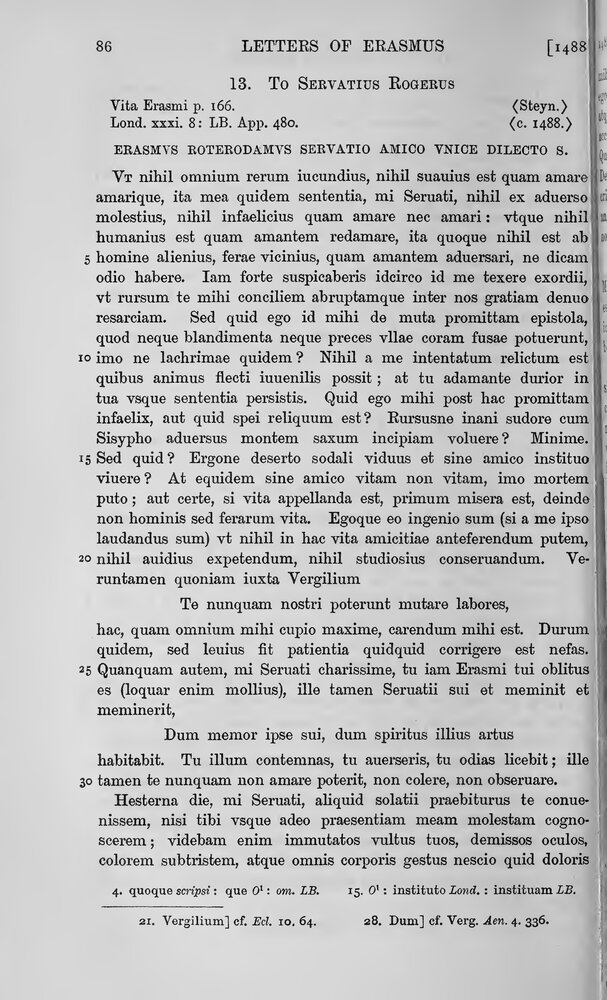
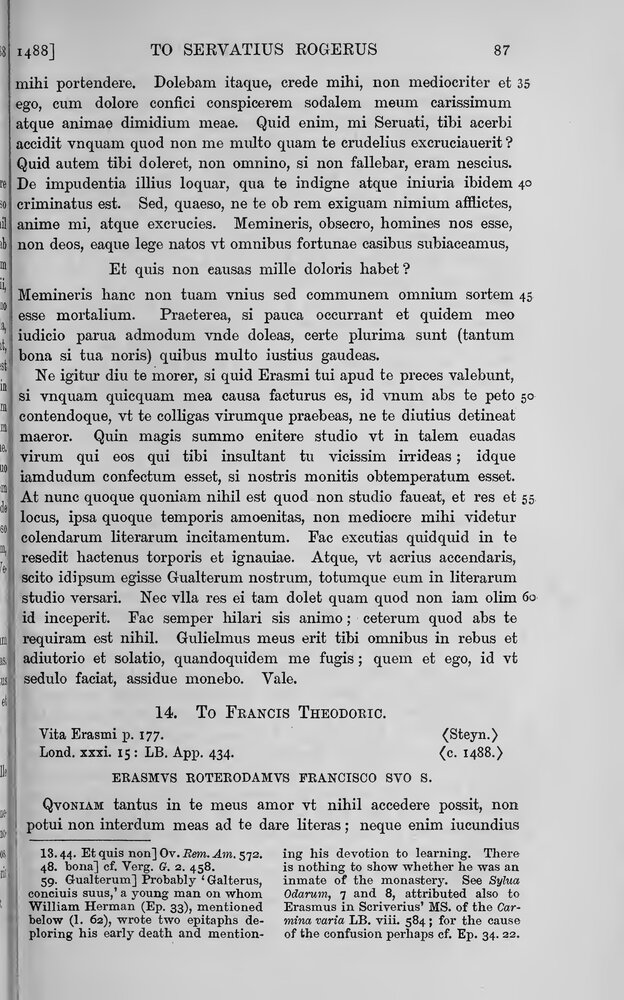
Erasmus of Rotterdam to Servatius, his uniquely beloved friend, greetings. Just as nothing in all the world is more pleasant, nothing sweeter than to love and to be loved, so in my opinion, my Servatius, nothing on the contrary is more troublesome, nothing more unhappy than to love and not be loved. And as nothing is more humane than to love in return one who loves you, so too nothing is farther from a man, closer to a wild beast, than to oppose one who loves you, not to say to hold him in hatred. Now perhaps you will suspect that I weave this introduction for this reason: to reconcile you to me again and to repair anew the friendship broken between us. But why should I promise this to myself from a mute letter, when neither caresses nor any prayers poured out in person could do it, indeed, not even tears? Nothing has been left untried by me by which a youthful spirit could be swayed; but you, harder than adamant, persist in your opinion. What, unhappy as I am, shall I promise myself after this, or what hope remains? Shall I begin again with futile sweat, like Sisyphus, to roll the stone up the mountain? By no means. But what then? Shall I therefore, deserted by my companion, bereft and without a friend, resolve to live? But indeed I consider life without a friend not life, but death; or certainly, if it must be called life, it is first miserable, and secondly, it is the life not of a man but of wild beasts. And I am of such a nature (if I may be praised by myself) that I think nothing in this life is to be preferred to friendship, nothing to be sought more eagerly, nothing to be preserved more zealously. Nevertheless, since, in the words of Virgil, "Our labors will never be able to change you," I must do without this friendship, which of all things I desire for myself the most. It is hard indeed, but whatever it is a sin to correct is made lighter by patience. Although, however, my dearest Servatius, you have now forgotten your Erasmus (for I will speak more gently), he nevertheless remembers his Servatius and will remember him, "While he himself is mindful of his own being, while his spirit inhabits his limbs." You may scorn him, you may turn away from him, you may hate him; he, however, will never be able not to love you, not to cherish you, not to respect you. Yesterday, my Servatius, I would have come to you to offer some comfort, did I not know my presence to be so utterly troublesome to you; for I saw your changed countenance, your downcast eyes, your rather sad color, and all the bearing of your body portended to me I know not what sorrow. I was grieving, therefore, believe me, not a little, and I too, since I saw my dearest companion and half of my own soul being consumed with sorrow. For what, my Servatius, has ever happened to you that was bitter, which did not torment me much more cruelly than you? What, moreover, was causing you grief, I was not entirely unaware of, if I am not mistaken. I will speak of the impudence of that man, with which he accused you there unworthily and unjustly. But, I pray you, do not afflict and torment yourself too much over a trivial matter, my soul. Remember, I beg you, that we are men, not gods, and born under such a law that we are subject to all the chances of fortune. "And who does not have a thousand causes for sorrow?" Remember that this is not your lot alone, but the common lot of all mortals. Besides, if a few things occur, and indeed in my judgment very small ones, from which you grieve, certainly there are very many things (if only you would recognize your own blessings) over which you could much more justly rejoice. Therefore, not to detain you long, if the prayers of your Erasmus have any weight with you, if you are ever going to do anything for my sake, this one thing I ask and beg of you: that you pull yourself together and show yourself a man, and do not let sorrow detain you any longer. Rather, strive with the utmost zeal to become such a man that you may in turn laugh at those who insult you; and this would have been accomplished long ago, if our advice had been obeyed. But even now, since there is nothing that does not favor study—both the circumstance and the place, even the very pleasantness of the season—it seems to me no small incentive for the cultivation of letters. See that you shake off whatever torpor and idleness has remained in you until now. And, that you may be more keenly spurred on, know that our Walter has done this very thing, and he is wholly engaged in the study of letters. And nothing grieves him so much as that he did not begin this long ago. See that you are always of cheerful mind; for the rest, I ask nothing of you. My William will be for you in all things both a helper and a comfort, since you flee from me; I will also assiduously urge him to do this diligently. Farewell.