

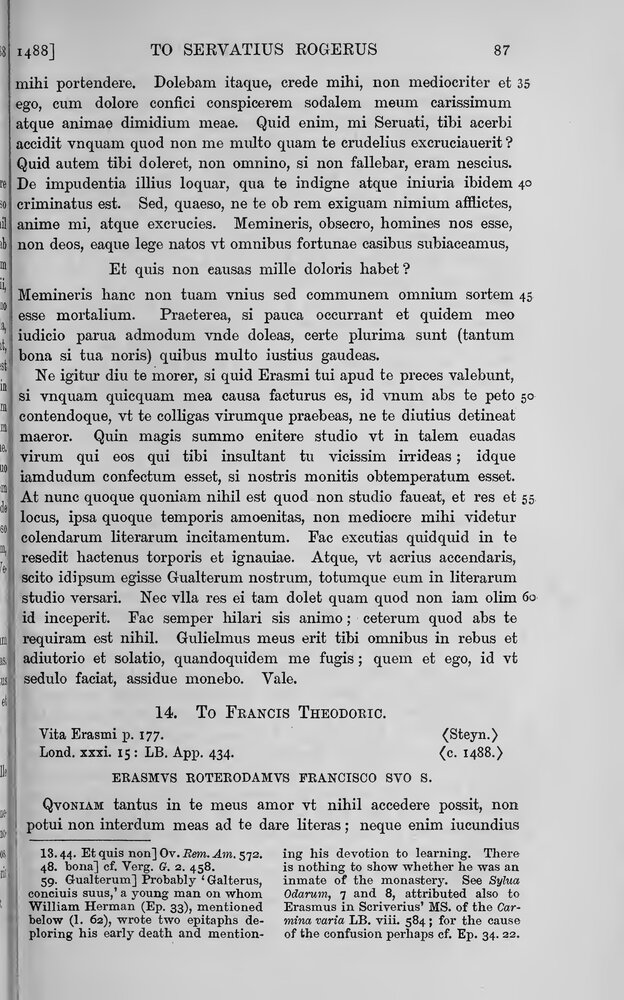
erasmvs roterodamvs francisco svo s.


14. to francis theodoric

c. 1488, Steyn


1
QVONIAM tantus in te meus amor vt nihil accedere possit, non
potui non interdum meas ad te dare literas; neque enim iucundius
vllum amicitiae officium esse puto quam hac scribendi inter se
vicissitudine vti. Quod itaque, mi Francisce charissime, diligentius
5
contuenti mihi subtristis iam dudum frons tua apparet, nescio quid
mali portendit. Solet enim plerumque internus animi dolor in
vultum erumpere, mentisque habitus in fronte non aliter quam
in speculo relucere. Intelligo itaque non obscure (quid id sit
incertus) certe aliquid esse quod tibi doleat, quod te excruciet. Et
10
hercule, mi Francisce, (fidem habe mihi) dolet et mihi dolor tuus,
nec vllus mihi potest esse laetitiae locus, vbi te moerore confectum
aspicio. Quid autem sit quod te male habet, vt mihi indices, te
etiam atque etiam rogo. Si quid mea poterit opera, te aut re aut
certe consilio iuuero. Quod si a me doloris tui orta est causa, dabo
15
operam vt per me quamprimum corrigatur itidem. Quaeso te,
animae dimidium meae, ne te in re mediocri tam dire excrucies.
Virum te praebe, excute quidquid in te est mollioris animi. Hoc
pacto et tibi consulueris et profecto me tui amantissimum hilarem
laetumque reddideris.


Associated Sources

1.
'Opus Epistolarum Des. Erasmi Roterodami', ed. P. S. Allen, 11 vols (Oxford: Clarendon Press, 1906), vol. 1, epistle 14.
3.
'The correspondence of Erasmus: letters 1 to 141, 1484 to 1500', tr. R. A. B. Mynors and D. F. S. Thomson, annot. Wallace K. Ferguson, 'Collected Works of Erasmus', ed. A. Dalzell, et al. (Toronto: University of Toronto Press, 1974), vol. 1, epistle 14.
4.
'La Correspondance d'Erasme. Traduite et annotée d'après l'Opus epistolarum de P. S. Allen, H. M. Allen et H. W. Garrod', ed. Alois Gerlo, et al., 12 vols (Brussels: University Press, 1967), vol. 1: 1484–1514, epistle 14.
5.
'De correspondentie van Desiderius Erasmus: Brieven 1–141', tr. M. J. Steens (Rotterdam: Donker, 2004), vol. 1, epistle 14.
Text has not been meticulously cleaned. You will find splits and errors, especially in Greek text. Refer to the originals or other sources for exact wording. Translation is done by AI, so do not regard it as authoritative! See About for more.

Commentary

M.J. Steens

Link to commentary

AI Summary

Erasmus writes to his dear friend Francis Theodoric expressing concern about his friend's apparent sadness and troubled appearance. He urges Francis to share what is troubling him and offers his help either through action or counsel, promising to remedy the situation if he is the cause of the distress. Erasmus emphasizes that his own happiness depends on Francis's well-being and encourages him to show strength of character.

Translations

AI Deepseek

Erasmus of Rotterdam to his friend Francis, greetings. Since my love for you is so great that nothing can be added to it, I could not refrain from sending you my letters from time to time; for I think no duty of friendship is more pleasant than to use this mutual exchange of writing. Therefore, my dearest Francis, as I observe more carefully, your brow, which has long seemed somewhat sad to me, portends some misfortune. For internal grief of the soul usually bursts forth upon the countenance, and the disposition of the mind shines forth in the brow just as in a mirror. And so I understand clearly (though uncertain what it is) that there is certainly something that pains you, that torments you. And by Hercules, my Francis (believe me), your pain pains me too, nor can there be any place for joy in me when I see you consumed by sorrow. But I earnestly ask you to tell me what it is that troubles you. If my efforts can accomplish anything, I will help you either in deed or certainly with advice. But if the cause of your sorrow arose from me, I will take care that it is corrected by me as soon as possible. I beg you, half of my soul, do not torment yourself so grievously over a matter of little importance. Show yourself a man, cast off whatever softer spirit is in you. In this way you will have taken care of yourself and will certainly have made me, who loves you most dearly, cheerful and happy.

M.J. Steens