

Erasmus writes to his friend Servatius Rogerus, expressing frustration at Servatius's lack of effort in pursuing literary studies despite favorable conditions. He uses classical references and the fable of the peasant calling on the gods to emphasize that personal effort is essential for success, urging Servatius to abandon excuses, write more frequently, and dedicate himself to learning. Erasmus offers his guidance and encourages Servatius to seek advice from mutual friends if needed.
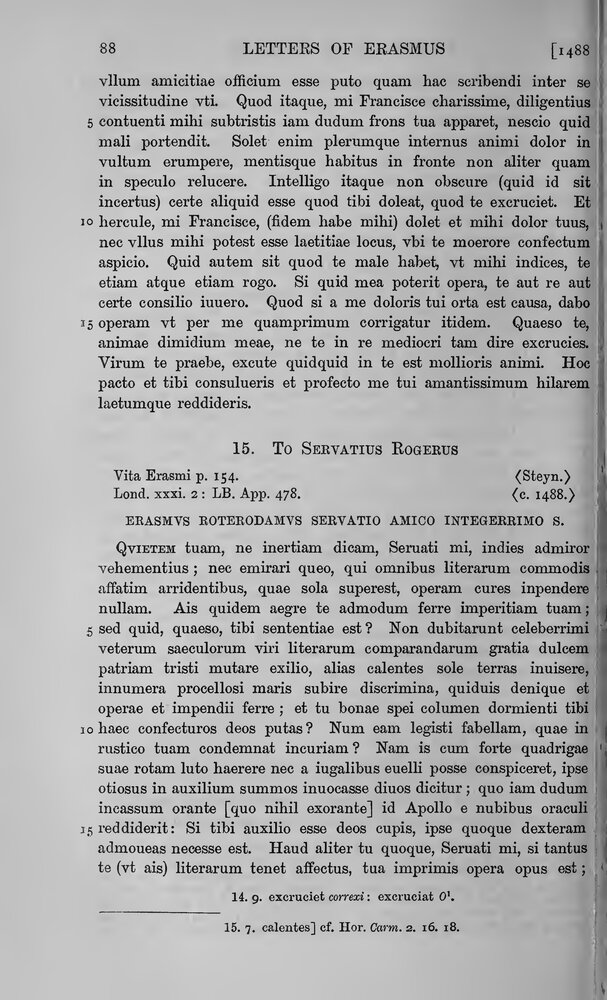
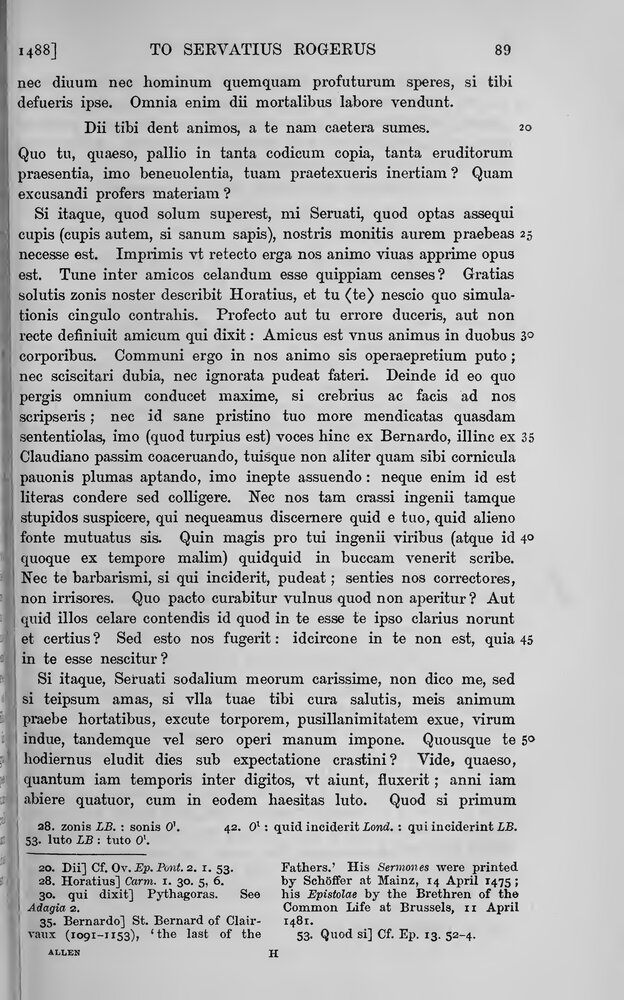
Erasmus of Rotterdam to his most upright friend Servatius, greetings. I marvel more and more each day at your tranquility, my Servatius, or should I call it idleness; and I cannot wonder enough how, when all the advantages of literature smile upon you so abundantly, you take care to devote no effort to the one thing that remains. You say, indeed, that you are quite troubled by your own lack of learning; but what, I ask, is your plan? The most celebrated men of ancient times did not hesitate to exchange their sweet homeland for a sad exile for the sake of acquiring literature, to visit other lands warmed by a different sun, to undergo countless dangers of the stormy sea, and finally to bear any amount of toil and expense; and do you, a pillar of good hope, think the gods will accomplish this for you while you sleep? Have you not read that little fable which condemns your own negligence in the rustic? For when he happened to see that a wheel of his wagon was stuck in the mud and could not be pulled out by the draft animals, he himself, idle, is said to have called upon the highest gods for help; when he had been praying for a long time in vain, Apollo from the clouds gave this oracle: If you wish the gods to help you, you yourself must also lend a hand. In just the same way, you too, my Servatius, if such a great love of literature holds you (as you say), your own work is especially needed; and you should not hope that any god or man will be of use, if you fail yourself. For the gods sell all things to mortals for labor. May the gods give you the spirit; the rest you will take from yourself. With what excuse, I ask, amidst such an abundance of books, such a presence of learned men, nay, such goodwill, will you cloak your idleness? What reason for excusing yourself do you bring forward? If therefore, my Servatius, which is the only thing left, you desire to attain what you wish for (and you do desire it, if you are in your right mind), you must lend an ear to our advice. First of all, it is extremely necessary that you live with your mind open towards us. Do you think anything should be hidden among friends? Our Horace describes the Graces as having loosened their belts, and you bind yourself with some girdle of pretense. Truly, either you are led by error, or he did not rightly define a friend who said: A friend is one soul in two bodies. It would be worthwhile, therefore, I think, for you to be of a common mind with us; neither be ashamed to inquire about doubtful matters, nor to confess ignorance. Furthermore, it will be most conducive to the goal you are pursuing if you write to us more frequently than you do; and certainly not in your former manner, patching together some begged little sentiments, or rather (what is more shameful) words, heaping them up from here out of Bernard, from there out of Claudian, and fitting them to your own not otherwise than the jackdaw fitting the peacock's feathers to itself, or rather, sewing them on ineptly: for that is not to compose literature, but to collect it. Nor should you suspect us of being so dull-witted and stupid that we cannot discern what is from your own spring and what you have borrowed from another's. Rather, according to the strength of your own talent (and I would prefer that too, extemporaneously), write whatever comes to mind. And do not be ashamed of a barbarism, if one should occur; you will find us correctors, not mockers. How will a wound be cared for that is not opened? Or why do you strive to hide from those men that which they know more clearly and more certainly to be in you than you yourself do? But suppose it escapes us: is it therefore not in you, because it is not known to be in you? If therefore, Servatius, dearest of my companions, (I do not say if you love me, but) if you love yourself, if you have any care for your own well-being, give your mind to my exhortations, shake off your sluggishness, cast off faint-heartedness, put on manhood, and finally, even late, set your hand to the work. For how long will today deceive you with the expectation of tomorrow? See, I ask, how much time has already flowed through your fingers, as they say; four years have now passed, while you are stuck in the same mud. But if from the first you had complied with our advice, you would have already grown into such a man that you could not only equal us in learning but even in turn instruct us. Nevertheless, I do not think one should despair even now; by persistent work what is lost of time must be recovered. You are still, of course, unharmed, nay, still in the green of youth, > And warm blood leaps around your heart. Therefore, before nimble youth flees, strive now to prepare for yourself that in which you may rejoice as an old man: > Now build a spirit that will last, and instruct your character, > That alone remains with you to the final pyre. How this is to be accomplished, we will consider afterwards. In the meantime, you diligently take care that your letter comes to me as soon as possible, a messenger of your mind, which should not be uncertain. Or certainly, if you judge me unworthy of your familiarity (I do not contend, indeed), only flee me in such a way that you do not flee past your own well-being; then commit your mind and trust your plans even to William, who cares for your interests no less than his own. Furthermore, if you think anything can be provided by my effort, you will find me in all things no less prepared than well-disposed. Farewell.