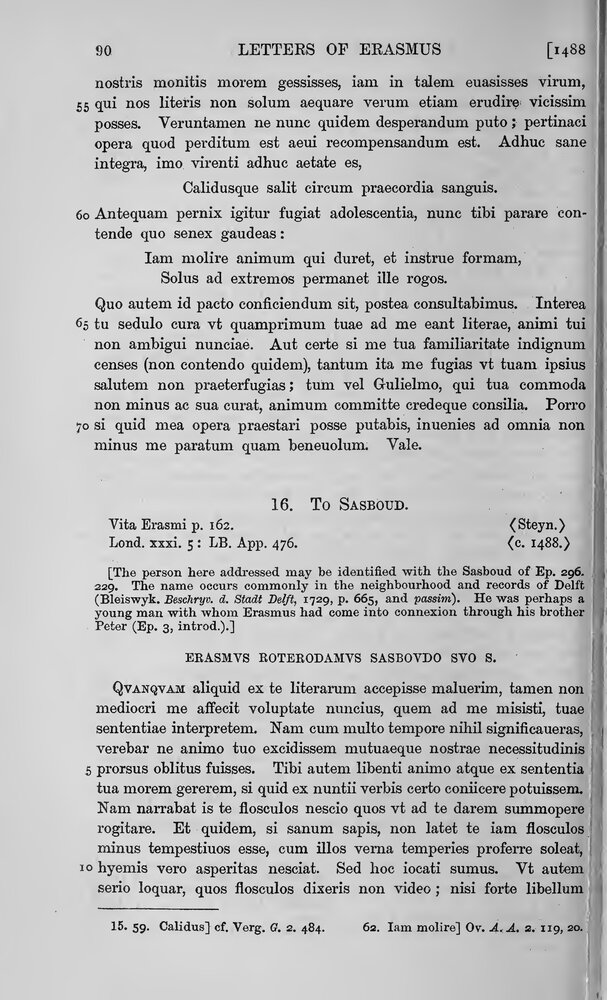
[The person here addressed may be identified with the Sasboud of Ep. 296. The name occurs commonly in the neighbourhood and records of Delft (Bleiswyk. Beschryv. d. Stadt Delft, 1729, p. 665, and passim). He was perhaps a young man with whom Erasmus had come into connexion through his brother Peter (Ep. 3, introd.).]
Erasmus writes to his friend Sasboud expressing concern about their interrupted correspondence and addressing a misunderstanding about a book of 'flowers' (likely literary excerpts) that Sasboud claimed Erasmus sold him. He urges Sasboud to prioritize literary studies over other pursuits like painting, warning that neglecting education in youth leads to regret in old age, and encourages moderation in youthful passions.
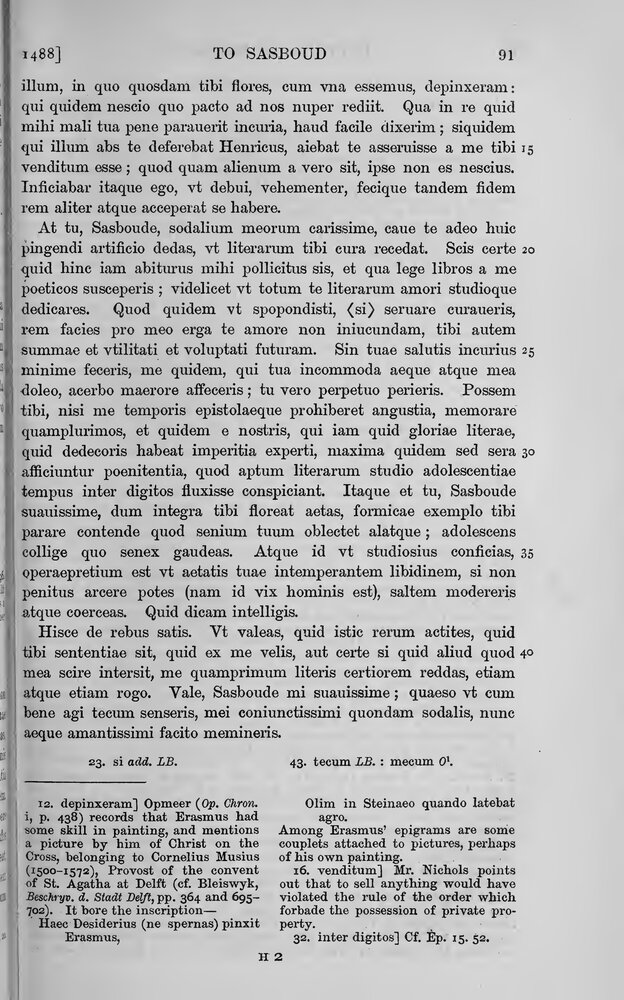
Erasmus of Rotterdam to his Sasbodus, Greetings. Although I would have preferred to receive some letters from you, nevertheless the messenger you sent me as an interpreter of your opinion affected me with no ordinary pleasure. For since you had sent no word for a long time, I was afraid I had slipped from your mind and you had utterly forgotten our mutual bond of friendship. And I would gladly and according to your wish have obliged you, if I could have inferred anything for certain from the messenger's words. For he related that you were earnestly asking me to give you some little flowers, whatever they might be. And indeed, if you are in your right mind, it does not escape you that little flowers are rather unseasonable now, since the spring warmth usually brings them forth, but the harshness of winter does not know them. But I have said this in jest. To speak seriously, I do not see what you mean by 'little flowers'; unless perhaps you mean that little book in which I had sketched out for you certain flowers when we were together: which indeed has recently returned to me by some means or other. In this matter, I could hardly say what trouble your near carelessness almost prepared for me; since Henry, the man who was bringing it from you, said that you had asserted it had been sold to you by me; a thing which, how far it is from the truth, you yourself are not unaware. I therefore denied it, as I ought, vehemently, and at last made him believe the matter was otherwise than he had understood it. But you, Sasbodus, dearest of my companions, take care not to devote yourself so much to this art of painting that your concern for letters falls away. You certainly know what you promised me when you were about to leave here, and on what condition you received the poetic books from me; namely, that you would devote yourself entirely to the love and pursuit of letters. If you take care to keep this promise, as you pledged, you will do a thing not unpleasant for my affection towards you, and which will be of the greatest both use and pleasure to you. But if, careless of your own welfare, you fail to do so, you will afflict me, who grieve over your misfortunes as much as my own, with bitter sorrow; but you yourself will have perished utterly. I could recount to you, were I not prevented by the constraint of time and the letter, very many, and indeed from among our own, who, having now experienced what glory letters bring, and what disgrace ignorance holds, are afflicted with the greatest, but too late, repentance, because they see that the time of youth, suited for the study of letters, has slipped through their fingers. And so you too, sweetest Sasbodus, while your age flourishes unimpaired, strive like the ant to prepare for yourself what may delight and nourish your old age; gather in youth that in which you may rejoice as an old man. And that you may accomplish this more zealously, it is worthwhile that you moderate and restrain the intemperate desire of your age, if you cannot utterly shut it out (for that is scarcely human). You understand what I mean. Enough on these matters. I ask you again and again to inform me by letter as soon as possible about your health, what you are doing there, what your opinion is, what you wish from me, or certainly if there is anything else which it concerns me to know. Farewell, my sweetest Sasbodus; I beg that when you feel things are going well with you, you will remember me, your once most intimate companion, now no less affectionately loving.