

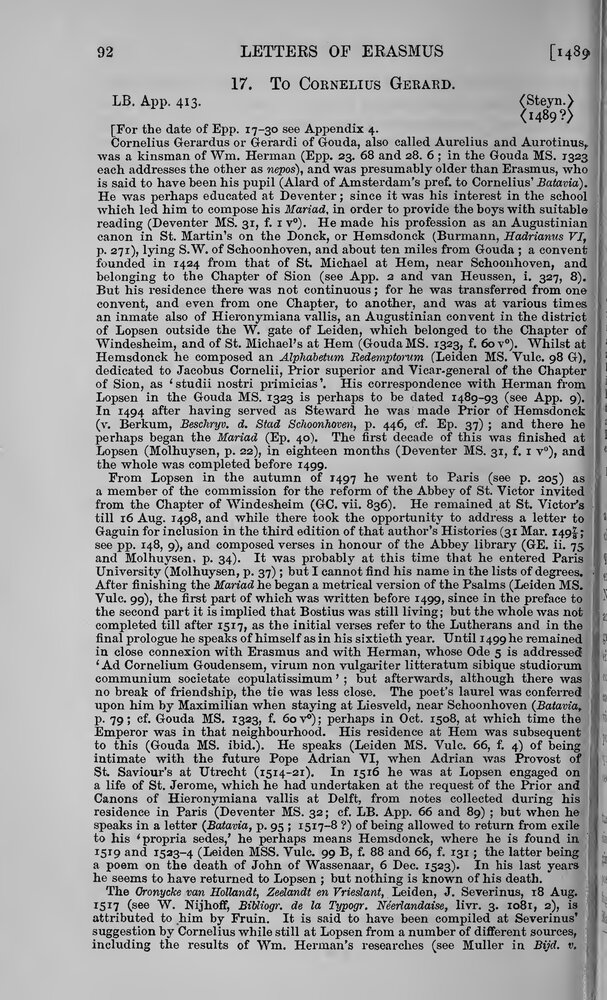
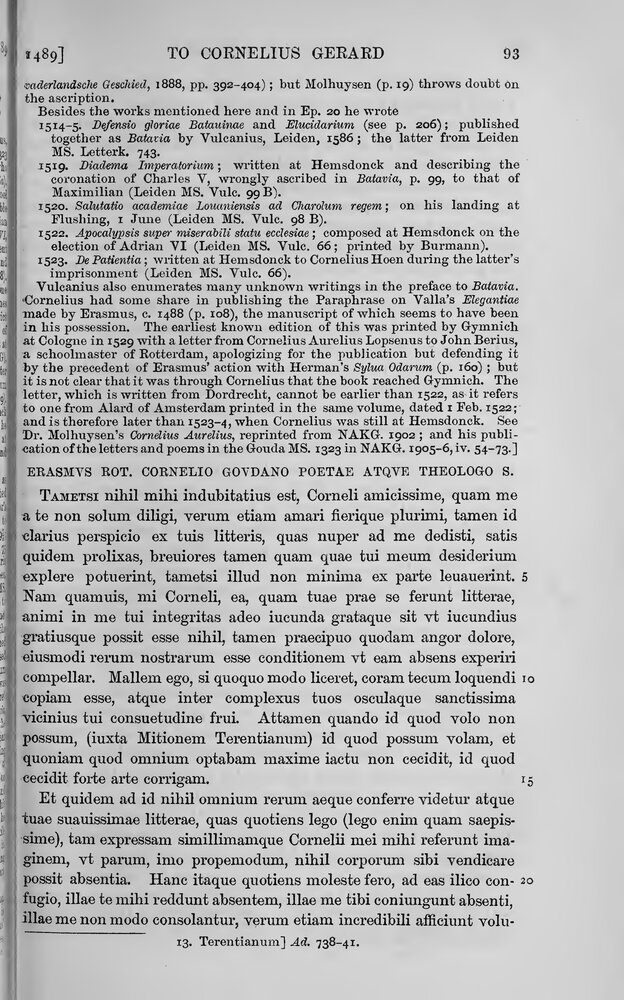
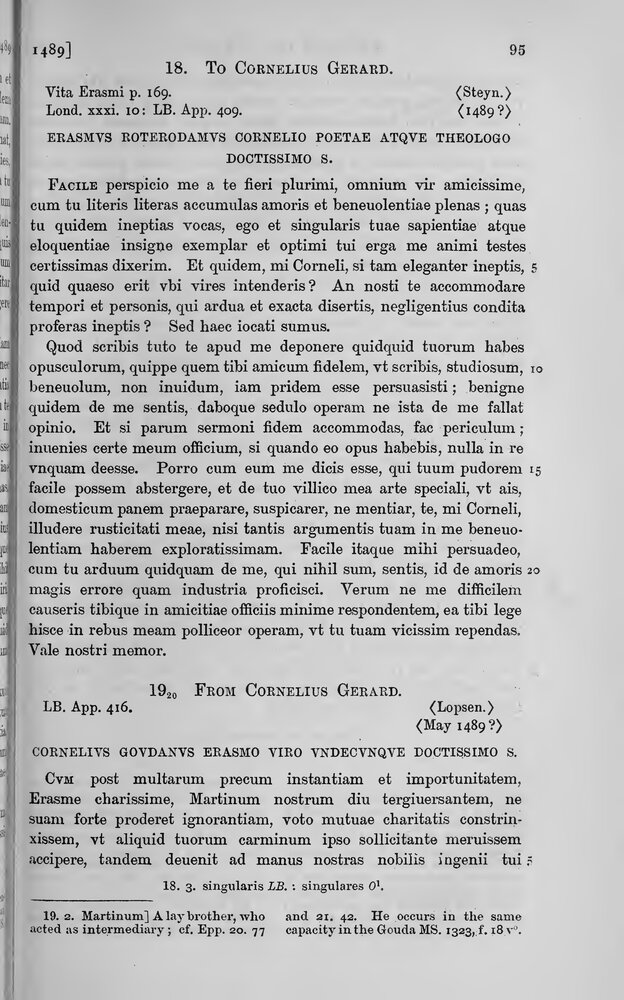
Cornelius Gerardus or Gerardi of Gouda, also called Aurelius and Aurotinus, was a kinsman of Wm. Herman (Epp. 23. 68 and 28. 6; in the Gouda MS. 1323 each addresses the other as nepos), and was presumably older than Erasmus, who is said to have been his pupil (Alard of Amsterdam's pref. to Cornelius' Batavia). He was perhaps educated at Deventer; since it was his interest in the school which led him to compose his Mariad, in order to provide the boys with suitable reading (Deventer MS. 31, f. 1 vº). He made his profession as an Augustinian canon in St. Martin's on the Donck, or Hemsdonck (Burmann, Hadrianus VI, p. 271), lying S.W. of Schoonhoven, and about ten miles from Gouda; a convent founded in 1424 from that of St. Michael at Hem, near Schoonhoven, and belonging to the Chapter of Sion (see App. 2 and van Heussen, i. 327, 8). But his residence there was not continuous; for he was transferred from one convent, and even from one Chapter, to another, and was at various times an inmate also of Hieronymiana vallis, an Augustinian convent in the district of Lopsen outside the W. gate of Leiden, which belonged to the Chapter of Windesheim, and of St. Michael's at Hem (Gouda MS. 1323, f. 60 vº). Whilst at Hemsdonck he composed an Alphabetum Redemptorum (Leiden MS. Vulc. 98 G), dedicated to Jacobus Cornelii, Prior superior and Vicar-general of the Chapter of Sion, as studii nostri primicias'. His correspondence with Herman from Lopsen in the Gouda MS. 1323 is perhaps to be dated 1489-93 (see App. 9). In 1494 after having served as Steward he was made Prior of Hemsdonck (v. Berkum, Beschryv. d. Stad Schoonhoven, p. 446, cf. Ep. 37); and there he perhaps began the Mariad (Ep. 40). The first decade of this was finished at Lopsen (Molhuysen, p. 22), in eighteen months (Deventer MS. 31, f. 1 vº), and the whole was completed before 1499. From Lopsen in the autumn of 1497 he went to Paris (see p. 205) as a member of the commission for the reform of the Abbey of St. Victor invited from the Chapter of Windesheim (GC. vii. 836). He remained at St. Victor's till 16 Aug. 1498, and while there took the opportunity to address a letter to Gaguin for inclusion in the third edition of that author's Histories (31 Mar. 149; see pp. 148, 9), and composed verses in honour of the Abbey library (GE. ii. 75 and Molhuysen, p. 34). It was probably at this time that he entered Paris University (Molhuysen, p. 37); but I cannot find his name in the lists of degrees. After finishing the Mariad he began a metrical version of the Psalms (Leiden MS. Vulc. 99), the first part of which was written before 1499, since in the preface to the second part it is implied that Bostius was still living; but the whole was not completed till after 1517, as the initial verses refer to the Lutherans and in the final prologue he speaks of himself as in his sixtieth year. Until 1499 he remained in close connexion with Erasmus and with Herman, whose Ode 5 is addressed 'Ad Cornelium Goudensem, virum non vulgariter litteratum sibique studiorum communium societate copulatissimum'; but afterwards, although there was no break of friendship, the tie was less close. The poet's laurel was conferred upon him by Maximilian when staying at Liesveld, near Schoonhoven (Batavia, p. 79; cf. Gouda MS. 1323, f. 60 v°); perhaps in Oct. 1508, at which time the Emperor was in that neighbourhood. His residence at Hem was subsequent to this (Gouda MS. ibid.). He speaks (Leiden MS. Vulc. 66, f. 4) of being intimate with the future Pope Adrian VI, when Adrian was Provost of St. Saviour's at Utrecht (1514-21). In 1516 he was at Lopsen engaged on a life of St. Jerome, which he had undertaken at the request of the Prior and Canons of Hieronymiana vallis at Delft, from notes collected during his residence in Paris (Deventer MS. 32; cf. LB. App. 66 and 89); but when he speaks in a letter (Batavia, p. 95; 1517-8?) of being allowed to return from exile to his 'propria sedes,' he perhaps means Hemsdonck, where he is found in 1519 and 1533-4 (Leiden MSS. Vulc. 99 B, f. 88 and 66, f. 131; the latter being a poem on the death of John of Wassenaar, 6 Dec. 1523). In his last years he seems to have returned to Lopsen; but nothing is known of his death. The Oronycke van Hollandt, Zeelandt en Vrieslant, Leiden, J. Severinus, 18 Aug. 1517 (see W. Nijhoff, Bibliogr. de la Typogr. Néerlandaise, livr. 3. 1081, 2), is attributed to him by Fruin. It is said to have been compiled at Severinus' suggestion by Cornelius while still at Lopsen from a number of different sources, including the results of Wm. Herman's researches (see Muller in Bijd. v. C a e N a 323 ho a). ool ble an ent nd 8), One es ict of at G), om ck he at nd as ted or's to es IS 00 170 Yas re C en ng 0 OD * 489] TO CORNELIUS GERARD 93 vaderlandsche Geschied, 1888, pp. 392-404); but Molhuysen (p. 19) throws doubt on the ascription. Besides the works mentioned here and in Ep. 20 he wrote 1514-5. Defensio gloriae Batauinae and Elucidarium (see p. 206); published together as Batavia by Vulcanius, Leiden, 1586; the latter from Leiden MS. Letterk. 743. 1519. Diadema Imperatorium; written at Hemsdonck and describing the coronation of Charles V, wrongly ascribed in Batavia, p. 99, to that of Maximilian (Leiden MS. Vulc. 99 B). 1520. Salutatio academiae Louaniensis ad Charolum regem; on his landing at Flushing, I June (Leiden MS. Vulc. 98 B). 1522. Apocalypsis super miserabili statu ecclesiae; composed at Hemsdonck on the election of Adrian VI (Leiden MS. Vulc. 66; printed by Burmann). 1523. De Patientia; written at Hemsdonck to Cornelius Hoen during the latter's imprisonment (Leiden MS. Vulc. 66). I Vulcanius also enumerates many unknown writings in the preface to Batavia. Cornelius had some share in publishing the Paraphrase on Valla's Elegantiae made by Erasmus, c. 1488 (p. 108), the manuscript of which seems to have been in his possession. The earliest known edition of this was printed by Gymnich at Cologne in 1529 with a letter from Cornelius Aurelius Lopsenus to John Berius, a schoolmaster of Rotterdam, apologizing for the publication but defending it by the precedent of Erasmus' action with Herman's Sylua Odarum (p. 160); but it is not clear that it was through Cornelius that the book reached Gymnich. The letter, which is written from Dordrecht, cannot be earlier than 1522, as it refers to one from Alard of Amsterdam printed in the same volume, dated 1 Feb. 1522; and is therefore later than 1523-4, when Cornelius was still at Hemsdonck. See Dr. Molhuysen's Cornelius Aurelius, reprinted from NAKG. 1902; and his publication of the letters and poems in the Gouda MS. 1323 in NAKG. 1905-6, iv. 54-73.
Erasmus expresses deep affection and gratitude to his friend Cornelius Gerard, emphasizing how Gerard's letters bring him comfort and joy despite their physical separation. He praises Gerard's eloquence, kindness, and friendship, comparing their bond to famous classical pairs like Nisus and Euryalus. Erasmus also mentions their mutual friend William Herman and assures Gerard of his unwavering loyalty and willingness to serve him in any way.
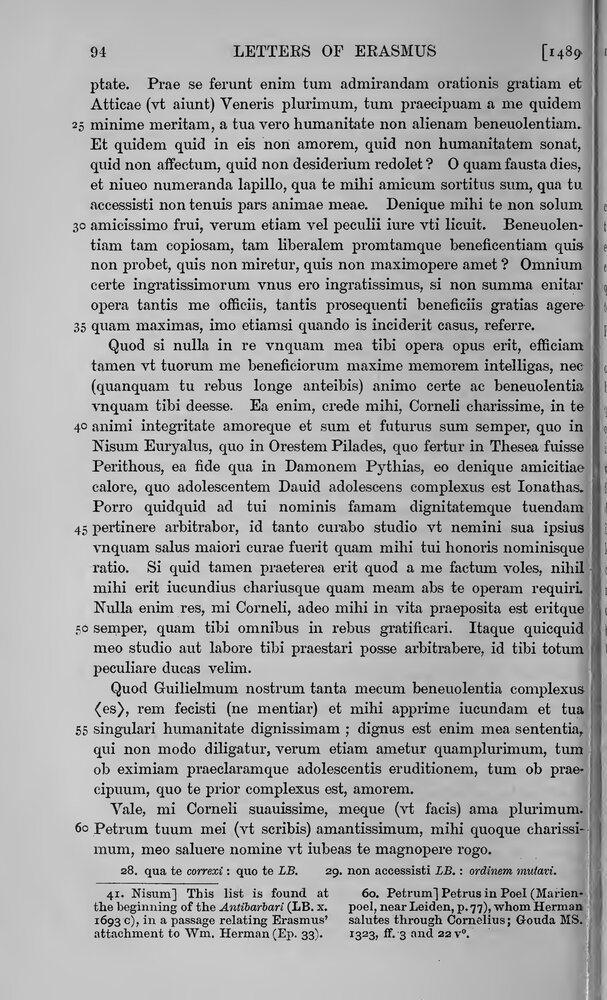
ERASMUS OF ROTTERDAM TO CORNELIUS GODDANUS, POET AND THEOLOGIAN, GREETINGS. Although nothing is more certain to me, dearest Cornelius, than that I am not only esteemed but truly loved and held in the highest regard by you, nevertheless I perceive this more clearly from your letter, which you recently sent me—quite lengthy indeed, yet shorter than what could have satisfied my longing for you, although it did relieve that longing in no small part. For although, my Cornelius, the complete sincerity of your affection toward me, which your letter displays, is so pleasant and welcome that nothing could be more delightful or gratifying, yet I am tormented by a peculiar anguish and grief that the condition of my affairs is such that I am forced to experience this while absent. I would prefer, if it were possible in any way, to have the opportunity to speak with you face to face, and amidst your embraces and most sacred kisses to enjoy your companionship more closely. Yet since I cannot have what I wish (in the words of Terence's Mitio), I shall wish for what I can, and since what I most desired of all has not fallen to my lot, I shall skillfully correct by art what chance has allotted. And indeed, nothing seems to contribute so much to this end as your most delightful letters, which, as often as I read them (and I read them as frequently as possible), bring back to me so vivid and lifelike an image of my Cornelius that physical absence can claim little—indeed, almost nothing—for itself. Therefore, whenever I feel this absence painfully, I immediately take refuge in them; they restore you to me in your absence, they unite me with you though absent, they not only console me but even fill me with incredible pleasure. For they display both a marvelous grace of expression and much of the Attic Venus (as they say), as well as a singular goodwill—certainly not at all deserved by me, yet not unworthy of your humanity. And indeed, what in them does not breathe love, what does not sound of kindness, what does not smell of affection, what does not savor of longing? O how blessed was that day, to be marked with a white stone, on which I gained you as a friend, on which you approached me as no small part of my soul. Finally, I have been permitted not only to enjoy you as a most devoted friend but even to use you as my own by right of possession. Such abundant goodwill, such generous and ready beneficence—who would not approve, who would not admire, who would not deeply love it? Truly, I would be the most ungrateful of all ingrates if I did not strive with the utmost effort to give the greatest thanks for such great services, such great benefits bestowed—nay, even to repay them if ever such an opportunity should arise. But if you shall never have need of my service in anything, I shall still ensure that you understand me to be most mindful of your kindnesses, and (although you will far surpass me in deeds) I shall certainly never fail you in spirit and goodwill. For with that sincerity of heart and love, believe me, dearest Cornelius, I am and always shall be toward you—with that devotion which Euryalus had for Nisus, which Pylades had for Orestes, which Pirithous is said to have had for Theseus; with that faithfulness which Pythias had for Damon; and finally, with that warmth of friendship with which the young Jonathan embraced the young David. Furthermore, whatever I shall judge to pertain to upholding the renown and dignity of your name, I shall attend to with such zeal that no one ever cared more for his own safety than I shall for the consideration of your honor and name. If, however, there is anything else you may wish to have done by me, nothing will be more pleasant and dear to me than that my service be requested by you. For nothing in life, my Cornelius, is or ever shall be of higher priority to me than to gratify you in all things. Therefore, whatever you shall judge can be provided to you by my zeal or labor, I would wish you to consider it entirely your own. That you have embraced our William with such great goodwill toward me is something (to tell the truth) both exceedingly pleasant to me and most worthy of your singular kindness; for in my opinion he is worthy not only of being esteemed but even of being loved as much as possible, both on account of his exceptional and brilliant learning as a youth and on account of the special affection with which he first embraced you. Farewell, my most delightful Cornelius, and love me (as you do) most greatly. I earnestly ask that you bid your Peter, most affectionate toward me (as you write) and also most dear to me, to greet me in my name. *Written at [place not specified in the text]*