

Erasmus responds to Cornelius Gerard's letter, expressing appreciation for his friend's affection and literary talents while modestly deflecting the praise. He assures Gerard of his faithful friendship and willingness to help, while humorously questioning some of Gerard's flattering descriptions of his abilities. The letter emphasizes mutual friendship and the reciprocal nature of their relationship.
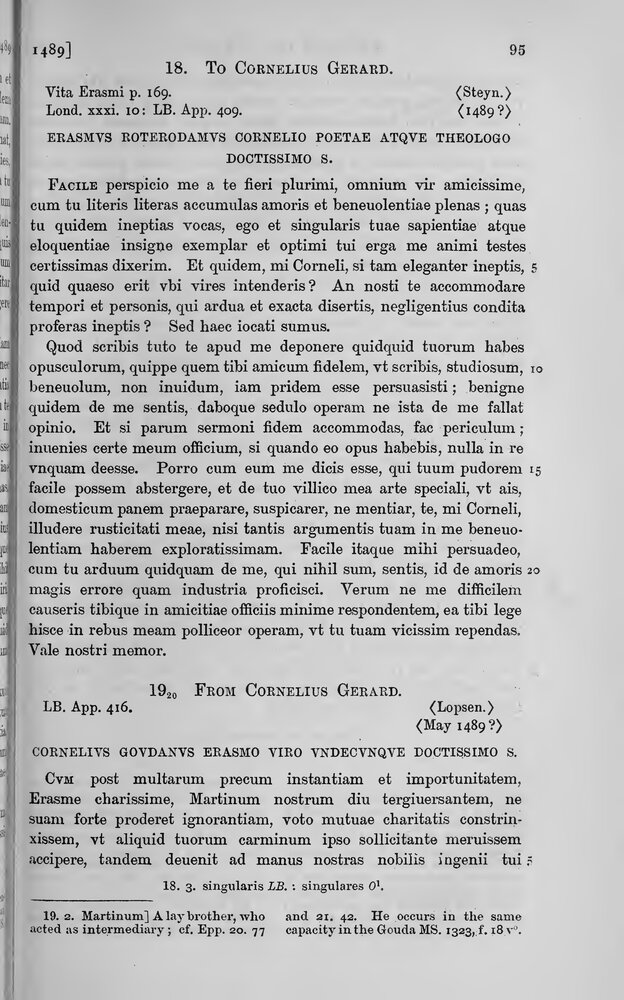
ERASMUS OF ROTTERDAM TO CORNELIUS, MOST LEARNED POET AND THEOLOGIAN, GREETINGS. I readily perceive that you hold me in highest esteem, dearest friend of all men, since you heap letter upon letter filled with affection and goodwill—letters which you call trifles, but which I would call both a remarkable example of your singular wisdom and eloquence and the most certain testimony of your excellent disposition toward me. And indeed, my Cornelius, if you write trifles so elegantly, what, pray, will result when you apply your full powers? Do you not know how to suit the occasion and the persons, since you produce demanding and polished works for the learned, but offer carelessly composed pieces as trifles? But this I say in jest. As for your writing that you may safely entrust to me whatever little works you have, since you long ago convinced yourself that I am, as you write, a faithful friend to you—zealous, well-disposed, and free from envy—you certainly think generously of me, and I shall diligently take care that this opinion of me does not prove mistaken. And if you place little trust in words, make the trial; you will surely find that my service, should you ever have need of it, will never be lacking in any matter. Furthermore, when you say that I am one who could easily wipe away your modesty and, by my special art as you put it, prepare domestic bread from your steward, I would suspect—not to lie—that you are mocking my simplicity, my Cornelius, did I not hold your goodwill toward me as most assured by such strong proofs. Therefore, I easily persuade myself that when you think something highly of me, who am nothing, this springs more from a mistake of affection than from careful judgment. But lest you complain that I am difficult and respond poorly to the duties of friendship, I promise you my assistance in these matters on this condition: that you in return render me your own. Farewell, and remember me.