

Cornelius Gerard writes to Erasmus expressing his admiration for Erasmus' poem on the contempt of poetry, which he received after much effort. He mentions that he has transformed Erasmus' poem into a dialogue format with some metrical changes to make it more accessible for singing. Cornelius requests Erasmus to review his own work 'De Morte' and emphasizes their mutual friendship and scholarly collaboration.
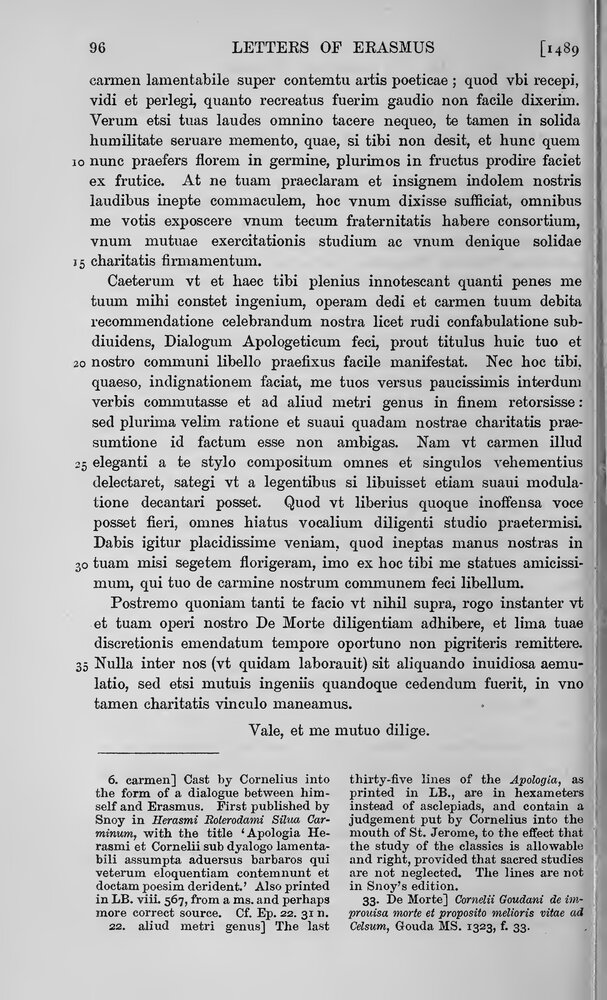
CORNELIUS GODDANUS TO ERASMUS, A MAN MOST LEARNED IN EVERY RESPECT, GREETINGS. When after many urgent and persistent entreaties, dearest Erasmus, I had at last constrained our friend Martin—who had long been hesitant, lest he perhaps betray his own ignorance—by the desire of mutual affection, so that I might receive something of your poems at his instigation, there finally came into our hands that lamentable poem of your noble genius concerning the contempt for the art of poetry. When I received, saw, and read it through, I could not easily say with how much joy I was refreshed. But although I cannot remain entirely silent about your praises, remember nonetheless to keep yourself in solid humility, which, if it does not desert you, will cause not only this flower you now display in bud, but very many fruits to spring forth from the branch. Yet, lest I inappropriately stain your outstanding and remarkable talent with my praises, let it suffice to have said this one thing: I entreat with all my prayers to have with you a single fellowship of brotherhood, a single zeal for mutual exercise, and finally, a single foundation of solid affection. Furthermore, so that it may also become more fully known to you how highly I value your genius, I have taken pains and, dividing your poem with our admittedly crude conversation to be celebrated with due recommendation, I have made an Apologetic Dialogue, just as the title prefixed to this little book, common to you and me, readily shows. And let this, I ask, cause you no indignation—that I have sometimes altered your verses with very few words and turned them to a different kind of metre at the end; but I wish you to be in no doubt that this was done for the greatest reason and with a certain sweet presumption of our affection. For, so that this poem, composed by you in an elegant style, might delight each and every one more intensely, I strove that it could, if it pleased, also be sung by readers with a sweet modulation. And so that this could be done more freely and with an unimpeded voice, I carefully omitted all hiatus of vowels. You will therefore grant pardon very calmly that I have sent my clumsy hands into your flowering field; nay, from this you will reckon me your most devoted friend, who has made our common little book from your poem. Finally, since I value you as beyond all else, I earnestly ask that you also apply your diligence to our work *On Death*, and that you not be reluctant to send it back, corrected by the file of your discretion, at a suitable time. Let there never be any envious rivalry between us (as a certain person has laboured to create), but even if we must sometimes yield to each other's talents, let us remain bound in the one bond of affection. Farewell, and love me in return.