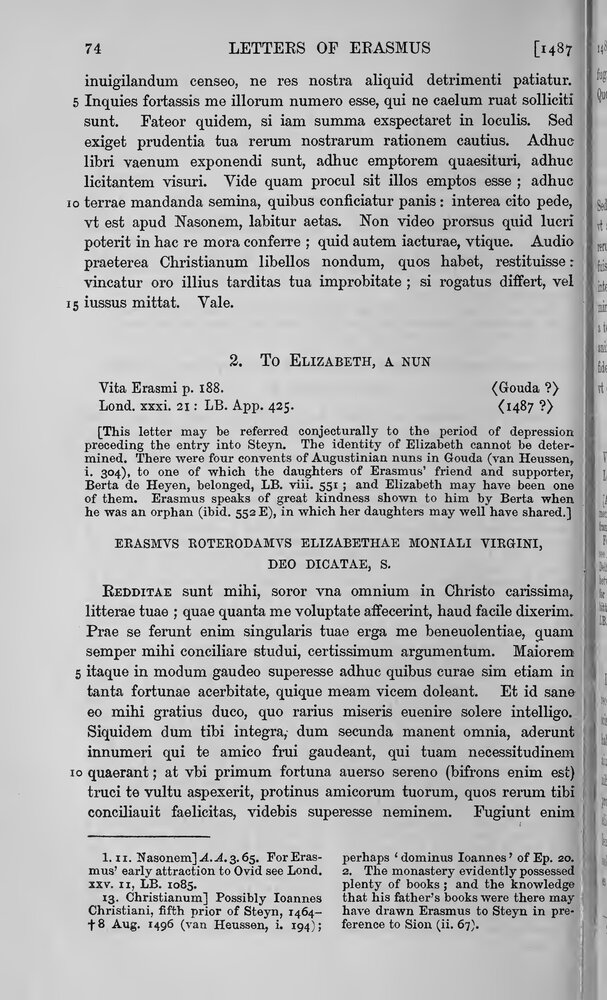
[This letter may be referred conjecturally to the period of depression preceding the entry into Steyn. The identity of Elizabeth cannot be determined. There were four convents of Augustinian nuns in Gouda (van Heussen, i. 304), to one of which the daughters of Erasmus' friend and supporter, Berta de Heyen, belonged, LB. viii. 551; and Elizabeth may have been one of them. Erasmus speaks of great kindness shown to him by Berta when he was an orphan (ibid. 552 E), in which her daughters may well have shared.]
Erasmus expresses deep gratitude to Elizabeth for her continued friendship and support during his difficult circumstances, noting how rare such loyalty is when fortune turns against someone. He contrasts the fair-weather friends who abandon one in adversity with Elizabeth's steadfast affection. Erasmus promises to reciprocate her kindness through love and correspondence, vowing never to be outdone in goodwill.
**Erasmus of Rotterdam to Elizabeth, a Virgin Nun, Dedicated to God, Greetings.** Your letter has been delivered to me, my sister in Christ, dearest of all; how much pleasure it brought me, I could scarcely say. For it presents the most certain proof of your singular goodwill towards me, which I have always striven to earn. I therefore rejoice exceedingly that there still remain those for whom I am a concern, even amidst such bitter misfortune, and who grieve on my behalf. And I indeed count this all the more pleasing to me, the more rarely I understand such things are accustomed to happen to the wretched. For while your affairs remain sound and prosperous, there will be countless people who rejoice to enjoy your friendship and who seek your intimacy; but as soon as Fortune, with her serene face averted (for she is two-faced), looks upon you with a grim countenance, you will immediately see that none of those friends, whom prosperity won for you, remain. For they flee as prosperity flees; as Fortune changes her state, they themselves change their minds. This, certainly, that poet aptly and learnedly sang for us, who said: > Lo, I, once fortified by not a few friends, > While a favorable breeze filled my sails: > As the wild seas swelled with the stormy wind, > On a shattered ship I am left in the midst of the waters. But that you, my most beloved Elizabeth, are not in their number, I now perceive more clearly than the sun, as they say; for I understand that you alone, in this great tumult of all my affairs, in these great misfortunes of my lot, have remained and always were left to me, you who have never suspended your love for me. Wherefore, if in the zeal of my duties I cannot compete with you on equal terms, yet in the mutual exchange of love and letters you shall never surpass me. And if you will not be far ahead in material circumstances, I certainly shall not allow myself to be the lesser in spirit and good will. And if you do not trust my words, put it to the test; I will bring it about, if I have any power, that you understand how highly I value you. Farewell always.