

Erasmus expresses joy at receiving Cornelius Gerard's poetry and discusses their literary exchange. He reflects on their friendship, emphasizing mutual affection and intellectual companionship despite potential disagreements. The letter also touches on literary criticism and mentions Gerard's works that Erasmus has read.
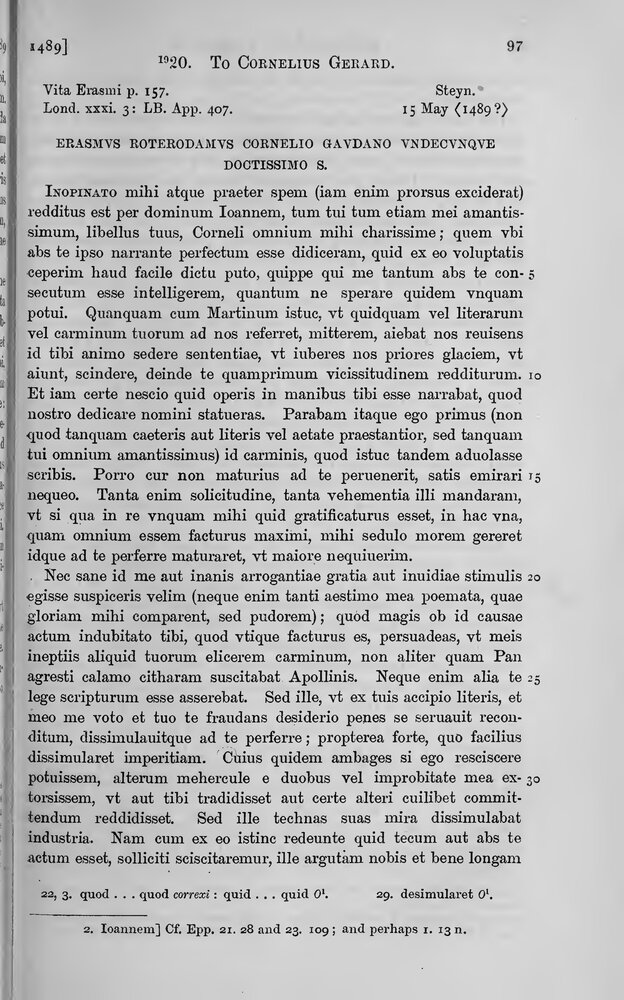
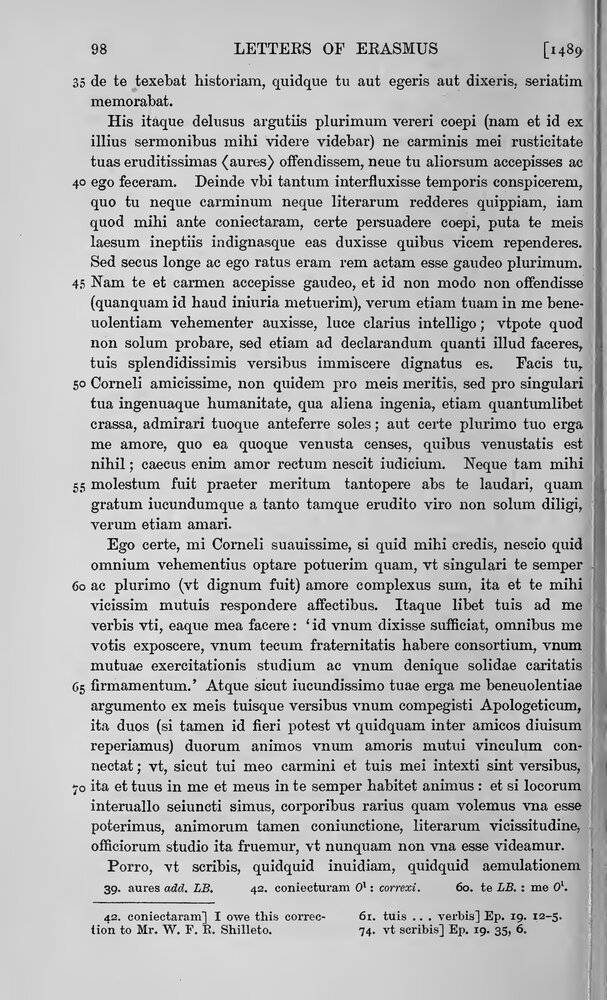
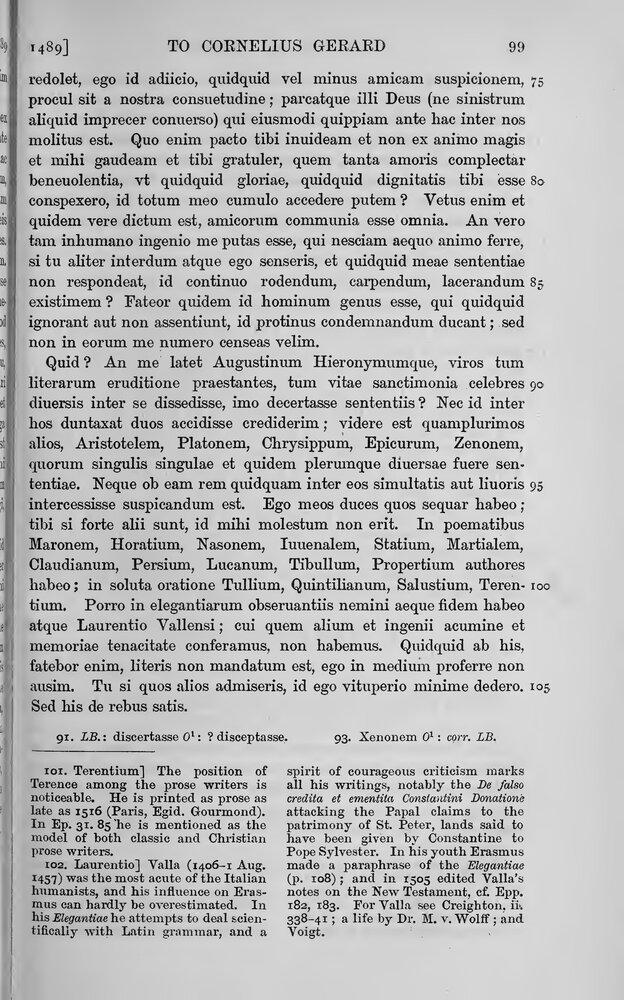
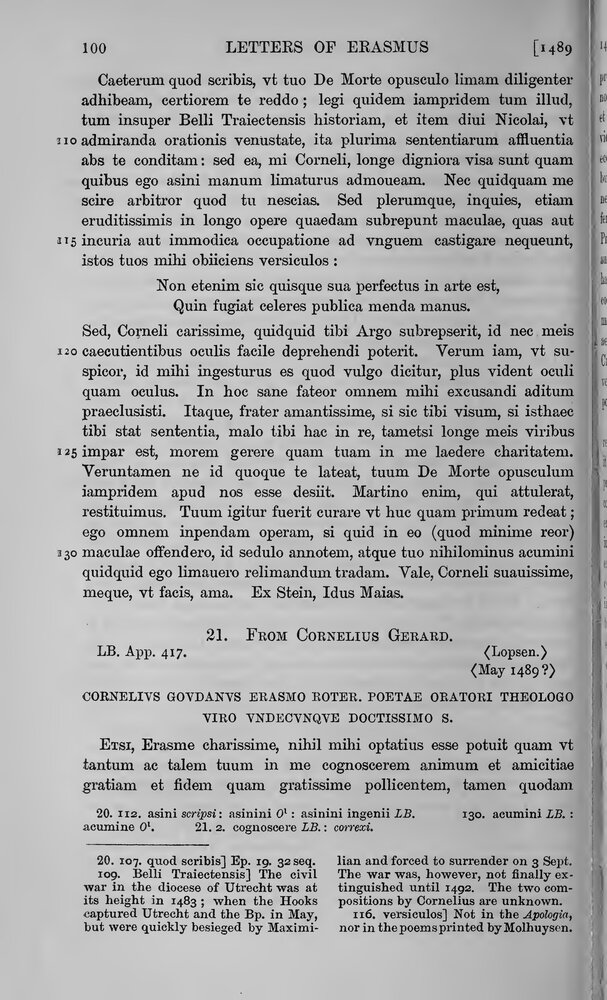
Erasmus of Rotterdam to Cornelius Gerard, Most Learned in All Respects, Greetings. Your little book, my dearest Cornelius, has been unexpectedly and beyond hope (for I had entirely given up on it) returned to me through Master John, who is most devoted to both you and me. When I learned from your own narration that it was completed, I think it is hardly easy to say what pleasure I derived from it, since I understood that I had obtained from you as much as I could never even have hoped for. Although when I sent Martin to you to bring back anything of your writings or poems to us, he said upon his return that it was settled in your mind that you wanted us to break the ice first, as they say, and then you would return the favor as soon as possible. And indeed he was already telling me that you had some work in hand which you had decided to dedicate to my name. So I was preparing to be the first (not as being superior to others in letters or age, but as the one who loves you most of all) to send that poem which you write has finally flown to you. Furthermore, I cannot sufficiently wonder why it did not reach you sooner. For I had entrusted it to him with such care, such urgency, that if ever he was going to oblige me in anything, in this one matter, which I would make of the greatest importance, he would diligently comply with my wish and hasten to deliver it to you, as I could not have done more. And indeed I would wish you not to suspect that I acted either out of empty arrogance or the goads of envy (for I do not value my poems so highly as to gain glory from them, but rather shame); you may be firmly convinced, as indeed you will be, that it was done more for this reason: that by my trifles I might elicit something of your poems, just as Pan with his rustic pipe roused the lyre of Apollo. For he asserted that you would not write under any other condition. But he, as I gather from your letter, cheating both my wish and your desire, kept it hidden with himself and pretended not to deliver it to you; perhaps for this reason, that he might more easily conceal his own lack of skill. If I could have found out about his evasions, by Hercules, I would have wrested one of two things from him by my own persistence: that he either hand it over to you or at least entrust it to someone else to be delivered. But he concealed his tricks with remarkable diligence. For when I anxiously inquired of him upon his return from there what had transpired between you or from you, he wove for us a clever and quite long story about you, and recounted in order what you had done or said. Deceived by these cunning tricks, I began to fear greatly (for I seemed to perceive this also from his talk) that by the rusticity of my poem I had offended your most learned ears, or that you had taken it differently than I intended. Then, when I saw that so much time had passed without you sending back any poem or letter, I began to be convinced of what I had previously conjectured: namely, that you had been offended by my foolishness and deemed it unworthy of a return favor. But I rejoice exceedingly that the matter turned out far otherwise than I thought. For I rejoice that you received the poem, and I understand as clearly as day that it not only did not offend (though I had not feared that without reason), but even greatly increased your goodwill towards me; especially since you deigned not only to approve it, but also to mix it with your most splendid verses to show how highly you valued it. You act, my dearest Cornelius, not indeed according to my merits, but according to your singular and innate humanity, with which you are accustomed to admire and prefer the talents of others, however crude; or certainly due to your great love for me, by which you even consider charming those things which have no charm; for blind love knows no right judgment. Nor was it so troublesome to me to be praised by you so greatly beyond my merit, as it was gratifying and pleasant to be not only esteemed but even loved by such a great and learned man. I certainly, my sweetest Cornelius, if you believe me at all, could not have wished anything more earnestly than that, just as I have always embraced you with singular and very great (as was fitting) love, so you too would respond to me with mutual affection. And so I am pleased to use your words to me and make them my own: 'Let it suffice to have said this one thing: I beseech with all my prayers to have with you one fellowship of brotherhood, one shared pursuit of mutual exercise, and finally one foundation of solid affection.' And just as you have joined together from my verses and yours one Apologetic as a most delightful proof of your goodwill towards me, so may one bond of mutual love connect two souls (if indeed it can be that we find anything divided between friends); so that, just as your verses are interwoven with my poem and mine with yours, so your spirit may always dwell in me and mine in you: and if we are separated by distance, we may be together in body less often than we wish, yet by the union of our spirits, the exchange of letters, and the zeal of our duties, we may so enjoy it that we seem never to be apart. Furthermore, as you write, whatever smacks of envy, whatever of rivalry—I add, whatever even of less friendly suspicion—let it be far from our intercourse; and may God spare (lest I invoke some evil by a misinterpreted word) him who has previously attempted anything of that sort between us. For how could I envy you and not rather rejoice sincerely both for myself and congratulate you, whom I embrace with such great loving goodwill that whatever glory, whatever dignity I perceive in you, I consider it all added to my own store? For it is an old and indeed true saying, that all things are common among friends. Or do you think me of such an inhuman nature that I do not know how to bear with equanimity if you sometimes think differently than I, and that I consider whatever does not correspond to my opinion must immediately be gnawed at, criticized, torn apart? I confess there is a type of person who thinks that whatever they do not know or agree with should be condemned at once; but I would wish you not to count me among their number. What? Am I unaware that Augustine and Jerome, men outstanding both in literary erudition and celebrated for the sanctity of their lives, disagreed, indeed contended, with differing opinions? Nor do I believe this happened only between these two; one can see very many others—Aristotle, Plato, Chrysippus, Epicurus, Zeno—each of whom had their own and often different opinions. Nor should we suspect that any grudge or envy arose between them on that account. I have my guides whom I follow; if you happen to have others, that will not trouble me. In poetry I have as authorities: Virgil, Horace, Ovid, Juvenal, Statius, Martial, Claudian, Persius, Lucan, Tibullus, Propertius; in prose: Cicero, Quintilian, Sallust, Terence. Furthermore, in matters of elegant usage I trust no one as much as Lorenzo Valla; whom for acuteness of intellect and tenacity of memory we have no other to compare. Whatever is not found in their writings—for I will admit it—I would not dare to bring forward publicly. If you admit others, I will by no means hold it as a fault. But enough on these matters. As for your writing that I should carefully apply the file to your little work 'On Death,' I inform you: I read some time ago both that and moreover the history of the War of Utrecht, and likewise that of St. Nicholas, composed by you with such admirable elegance of style and such abundant richness of thought: but these, my Cornelius, seemed far too worthy for me to apply my ass's file to them. Nor do I think I know anything that you do not know. But, you will say, even the most learned often have certain blemishes creep into a long work, which they cannot perfectly polish out due to carelessness or excessive busyness—throwing back at me those little verses of yours: 'For not so perfect is anyone in his art, That a public fault escapes swift hands.' But, dearest Cornelius, whatever may have crept past your Argus-eyes cannot easily be detected by my bleary ones. But now, I suspect, you are about to burden me with what is commonly said: eyes see more than one eye. In this, I confess, you have blocked every path of excuse for me. And so, most loving brother, if it seems so to you, if this is your settled opinion, I prefer in this matter, though it is far beyond my powers, to comply with your wish than to injure your affection for me. However, lest this also escape you, your little work 'On Death' has for some time now ceased to be with us. For we returned it to Martin, who had brought it. It will therefore be your task to see that it returns here as soon as possible; I will devote all effort, if I find any blemish in it (which I hardly expect), to mark it diligently, and nevertheless submit whatever I polish for re-polishing to your own keen judgment. Farewell, sweetest Cornelius, and love me, as you do. From Stein, the Ides of May.