

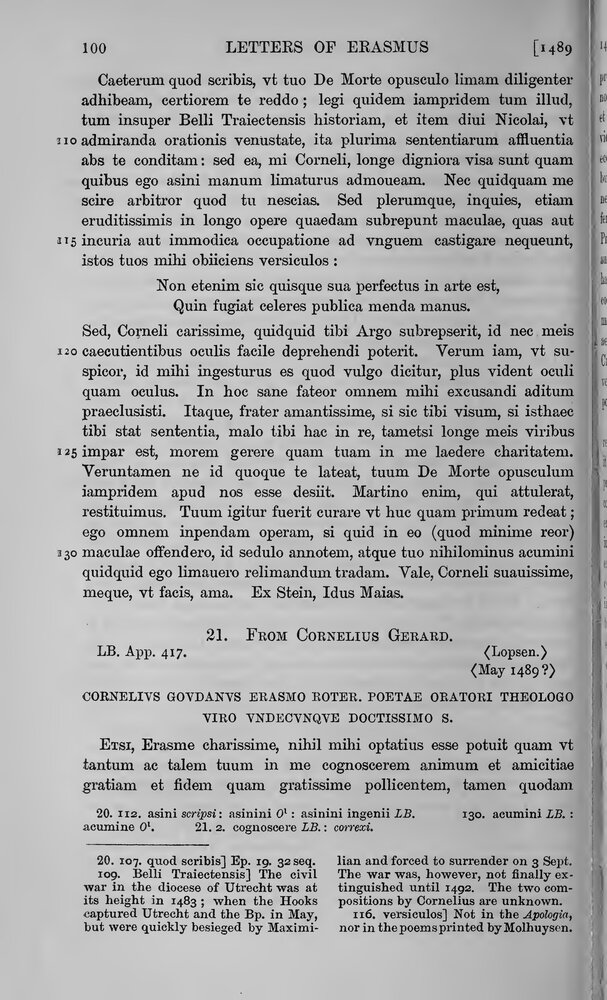
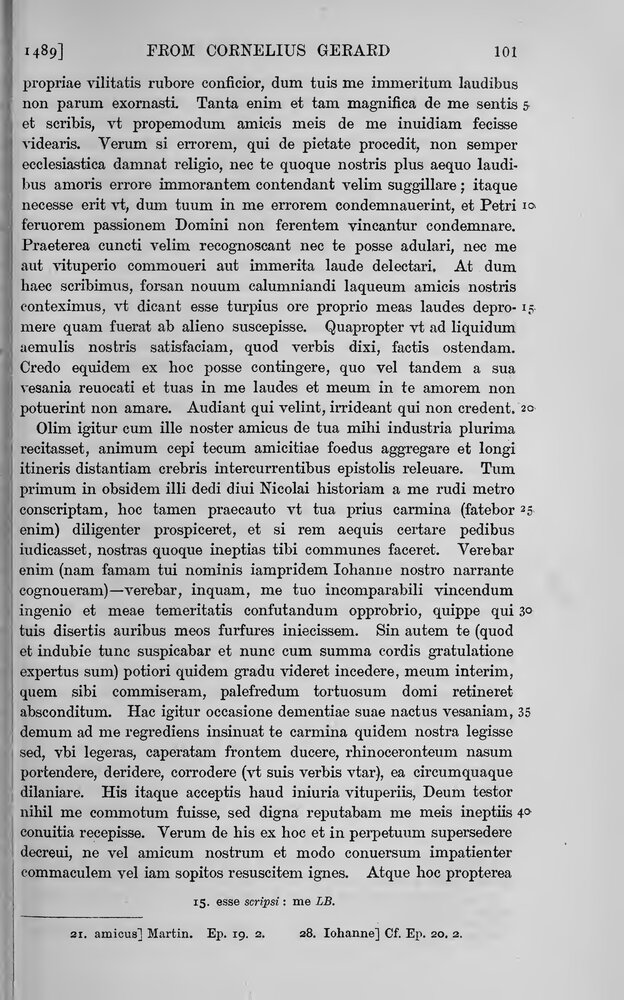
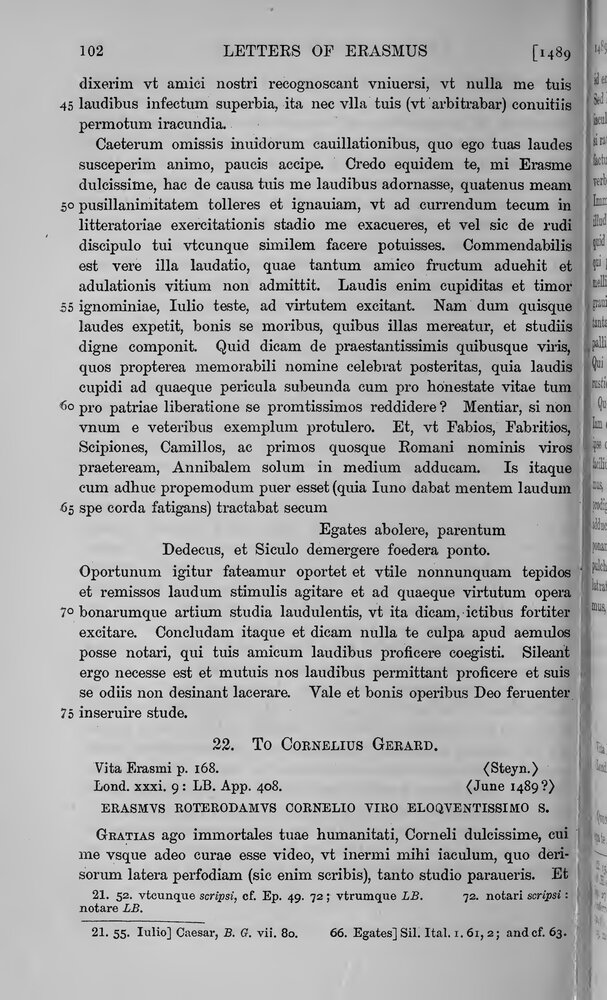
Cornelius Gerard responds to Erasmus's praise, expressing humility and concern that such commendation might provoke envy among friends. He reflects on their literary exchange, recalling how he initially hesitated to share his own work due to Erasmus's superior talent, and defends the value of praise as a motivator for virtue and intellectual pursuit.
CORNELIUS OF GOUDA TO ERASMUS OF ROTTERDAM, POET, ORATOR, THEOLOGIAN, A MAN MOST LEARNED IN EVERY RESPECT, GREETINGS. Although, dearest Erasmus, nothing could have been more desirable to me than to recognize such a great and such a disposition in you towards me, and a grace and faithfulness of friendship most gratefully promised, nevertheless I am overcome by a certain blush of my own insignificance, while you have adorned me, undeserving, with no small amount of your praises. For you think and write such great and magnificent things about me that you seem almost to have created envy among my friends towards me. But if the error which proceeds from piety is not always condemned by ecclesiastical religion, I would not wish them to reproach you either for lingering in an error of love with praises beyond what is just. And so it will be necessary that, when they have condemned your error concerning me, they are overcome and forced to condemn even Peter's fervor, which could not bear the Lord's passion. Furthermore, I would wish all to recognize that you cannot flatter, nor am I moved by censure or delighted by undeserved praise. But while I write this, perhaps I weave a new snare of calumny for our friends, so that they might say it is more shameful to put forth my own praises from my own mouth than it had been to receive them from another's. Wherefore, to satisfy our rivals to the utmost clarity, what I have said in words, I will show in deeds. I indeed believe that from this it can happen that, called back at last from their own madness, they will not be able to help but love both your praises of me and my love for you. Let those who wish hear it; let those who will not believe mock it. Therefore, some time ago when that friend of ours had recited very many things to me about your diligence, I conceived a plan to join a pact of friendship with you and to lessen the distance of the long journey by frequent letters running between us. Then I first gave to him, as a pledge, the history of Saint Nicholas, written by me in unpolished verse, with this condition, however, that he should first carefully look over your poems (for I will confess it) and if he judged my matter could compete on equal footing, he should also make my triflings common to you. For I feared (for I had already learned of the fame of your name some time ago from our friend John)—I feared, I say, that I would be vanquished by your incomparable genius and confuted by the disgrace of my own rashness, I who had thrown my chaff before your learned ears. But if, on the other hand, he saw you (which I then undoubtedly suspected and now have experienced with the greatest joy of heart) walking indeed on a higher step, he should meanwhile keep hidden at home my poor nag, which I had entrusted to him, with its crooked legs. Seizing upon this occasion for his own madness, at length returning to me, he insinuates that you had indeed read my poems but, where you had read them, you knitted your brow, thrust out a rhinoceros-like nose, derided, gnawed at (to use his words), tore them to pieces all around. Having received these reproaches, not without cause, I call God to witness that I was not at all disturbed, but I considered that I had received insults worthy of my triflings. But concerning these matters, from this time forth and forever, I have decided to refrain, lest I either impatiently stain our friend, and a recent convert, or rekindle fires now put to sleep. And I have said this for this reason: so that all our friends may recognize that just as no pride has infected me from your praises, so also no anger moved me by your (as I thought) reproaches. Furthermore, putting aside the cavils of the envious, hear in a few words with what spirit I received your praises. I indeed believe, my sweetest Erasmus, that you adorned me with your praises for this reason: so that you might remove my faint-heartedness and sloth, so that you might sharpen me for running with you in the stadium of literary exercise, and thus you might have been able to make something somehow similar to yourself out of a rough disciple. Truly, that praise is commendable which brings so much benefit to a friend and which does not admit the vice of flattery. For the desire for praise and the fear of disgrace, as Julius [Caesar?] testifies, excite to virtue. For while each person seeks praises, he fits himself out worthily with good morals, by which he may merit them, and with such great studies. What shall I say about all the most outstanding men, whom posterity celebrates with a memorable name for this reason: because, desirous of praise, they rendered themselves most ready to undergo every danger, both for the honesty of life and for the liberation of their country? I would be lying if I did not bring forth one example from the ancients. And, to pass over the Fabii, Fabricii, Scipios, Camilli, and all the first men of the Roman name, let me bring forward Hannibal alone. And so when he was still almost a boy (because Juno, wearying hearts with the hope of praises, gave him the mind), he pondered with himself: *To blot out the Aegates, his parents' disgrace, and to sink the treaties in the Sicilian sea.* We must confess it therefore fitting and useful sometimes to goad the lukewarm and sluggish with the spurs of praises and to rouse them bravely to every work of virtue and study of the good arts with, so to speak, praise-filled blows. I will conclude, therefore, and say that you can be marked with no fault by rivals, you who have compelled a friend to advance by your praises. Let them be silent, therefore, they must; and let them permit us to advance by mutual praises, and let them not cease to tear themselves apart with their own hatreds. Farewell, and strive to serve God fervently with good works.