
erasmvs roterodamvs cornelio viro eloqventissimo s.


22. to cornelius gerard

June 1489?, Steyn


1
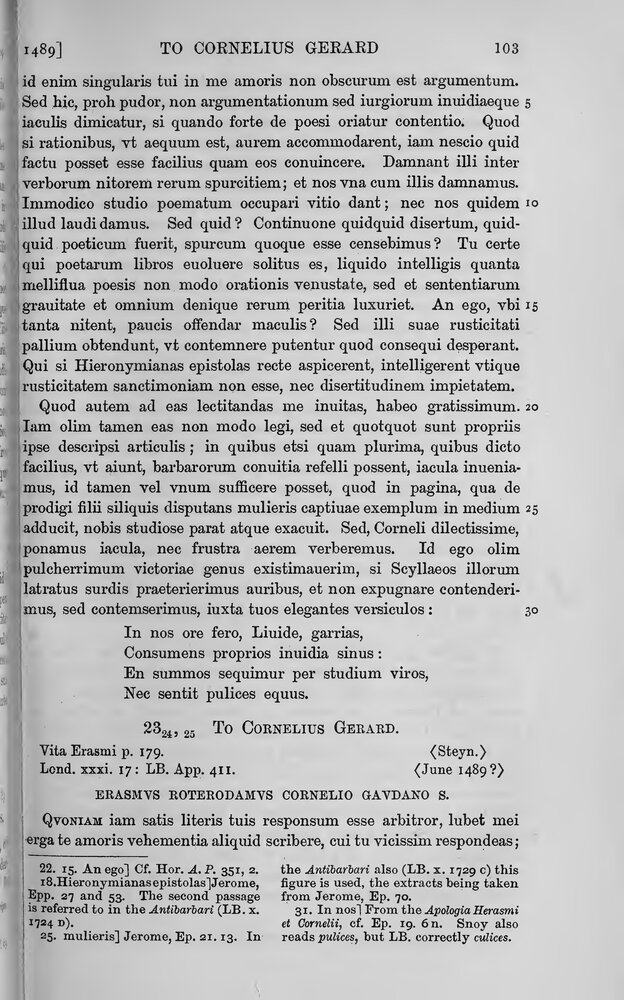
GRATIAS ago immortales tuae humanitati, Corneli dulcissime, cui
me vsque adeo curae esse video, vt inermi mihi iaculum, quo deri-
sorum latera perfodiam (sic enim scribis), tanto studio paraueris. Et
id enim singularis tui in me amoris non obscurum est argumentum.
5
Sed hic, proh pudor, non argumentationum sed iurgiorum inuidiaeque
iaculis dimicatur, si quando forte de poesi oriatur contentio. Quod
si rationibus, vt aequum est, aurem accommodarent, iam nescio quid
factu posset esse facilius quam eos conuincere. Damnant illi inter
verborum nitorem rerum spurcitiem; et nos vna cum illis damnamus.
10
Immodico studio poematum occupari vitio dant; nec nos quidem
illud laudi damus. Sed quid? Continuone quidquid disertum, quid-
quid poeticum fuerit, spurcum quoque esse censebimus? Tu certe
qui poetarum libros euoluere solitus es, liquido intelligis quanta
melliflua poesis non modo orationis venustate, sed et sententiarum
15
grauitate et omnium denique rerum peritia luxuriet. An ego, vbi
tanta nitent, paucis offendar maculis? Sed illi suae rusticitati
pallium obtendunt, vt contemnere putentur quod consequi desperant.
Qui si Hieronymianas epistolas recte aspicerent, intelligerent vtique
rusticitatem sanctimoniam non esse, nec disertitudinem impietatem.
20
Quod autem ad eas lectitandas me inuitas, habeo gratissimum.
Iam olim tamen eas non modo legi, sed et quotquot sunt propriis
Tipse descripsi articulis; in quibus etsi quam plurima, quibus dicto
facilius, vt aiunt, barbarorum conuitia refelli possent, iacula inuenia-
mus, id tamen vel vnum sufficere posset, quod in pagina, qua de
25
prodigi filii siliquis disputans mulieris captiuae exemplum in medium
adducit, nobis studiose parat atque exacuit. Sed, Corneli dilectissime,
ponamus iacula, nec frustra aerem verberemus. Id ego olim
pulcherrimum victoriae genus existimauerim, si Scyllaeos illorum
latratus surdis praeterierimus auribus, et non expugnare contenderi-
30
mus, sed contemserimus, iuxta tuos elegantes versiculos:
In nos ore fero, Liuide, garrias,
Consumens proprios inuidia sinus:
En summos sequimur per studium viros,
35
Nec sentit pulices equus.


Associated Sources

2.
'Opus Epistolarum Des. Erasmi Roterodami', ed. P. S. Allen, 11 vols (Oxford: Clarendon Press, 1906), vol. 1, epistle 22.
3.
'The correspondence of Erasmus: letters 1 to 141, 1484 to 1500', tr. R. A. B. Mynors and D. F. S. Thomson, annot. Wallace K. Ferguson, 'Collected Works of Erasmus', ed. A. Dalzell, et al. (Toronto: University of Toronto Press, 1974), vol. 1, epistle 22.
4.
'La Correspondance d'Erasme. Traduite et annotée d'après l'Opus epistolarum de P. S. Allen, H. M. Allen et H. W. Garrod', ed. Alois Gerlo, et al., 12 vols (Brussels: University Press, 1967), vol. 1: 1484–1514, epistle 22.
5.
'De correspondentie van Desiderius Erasmus: Brieven 1–141', tr. M. J. Steens (Rotterdam: Donker, 2004), vol. 1, epistle 22.
Text has not been meticulously cleaned. You will find splits and errors, especially in Greek text. Refer to the originals or other sources for exact wording. Translation is done by AI, so do not regard it as authoritative! See About for more.

Commentary

M.J. Steens

Link to commentary

AI Summary

Erasmus thanks Cornelius Gerard for his support and defends poetry against critics who equate eloquence with impurity. He argues that poetry contains valuable wisdom and rhetorical beauty, dismissing detractors as envious and rustic. Erasmus advocates ignoring such critics rather than engaging in futile disputes, citing Jerome's letters as evidence that eloquence and piety are compatible.

Translations

AI Deepseek

I give immortal thanks to your kindness, dearest Cornelius, since I see that you care for me so greatly that you have zealously procured for me, unarmed as I am, a javelin with which I may pierce the sides of my mockers (for so you write). For this indeed is no obscure proof of your singular affection toward me. But here—alas for shame!—the battle is fought not with arguments but with the javelins of quarrels and envy, whenever by chance a dispute about poetry arises. Yet if they would lend an ear to reason, as is just, I know not what could be easier than to refute them. They condemn, amid verbal elegance, a foulness of subject matter; and we condemn it together with them. They find fault with being excessively absorbed in the study of poems; nor indeed do we praise that. But what then? Shall we therefore judge that whatever is eloquent, whatever is poetic, must also be foul? You certainly, who are accustomed to unroll the books of poets, clearly understand with how much honey-sweetness poetry abounds, not only in charm of expression but also in weightiness of thought and, finally, in knowledge of all things. Shall I, when so many things shine forth, be offended by a few blemishes? But they cloak their own boorishness, so that they may be thought to despise what they despair of attaining. If they would rightly consider the letters of Jerome, they would surely understand that boorishness is not sanctity, nor eloquence impiety. Moreover, as to your urging me to read those letters, I am most grateful. Yet I have long since not only read them, but have also copied out with my own hand, in their distinct sections, as many as exist. And although in them we may find very many javelins with which the abuse of the barbarians could be refuted more easily than said, as the saying goes, yet this one point alone could suffice: on the page where, discussing the husks of the prodigal son, he brings forward the example of the captive woman, he carefully prepares and sharpens it for us. But, most beloved Cornelius, let us lay aside our javelins and not beat the air in vain. I should long since have considered it the finest kind of victory if we pass by with deaf ears the Scyllan barkings of those men, and strive not to conquer them but to hold them in contempt—in keeping with your elegant little verses: *With savage mouth, O Envious One, you chatter against us,* *Consuming your own vitals with envy:* *Lo, we follow the greatest men through zeal,* *Nor does the horse feel the fleas.*

M.J. Steens