

cornelivs govdanvs erasmo viro vndecvnqve doctissimo s.


24. from cornelius gerard

July 1489?, Lopsen


1
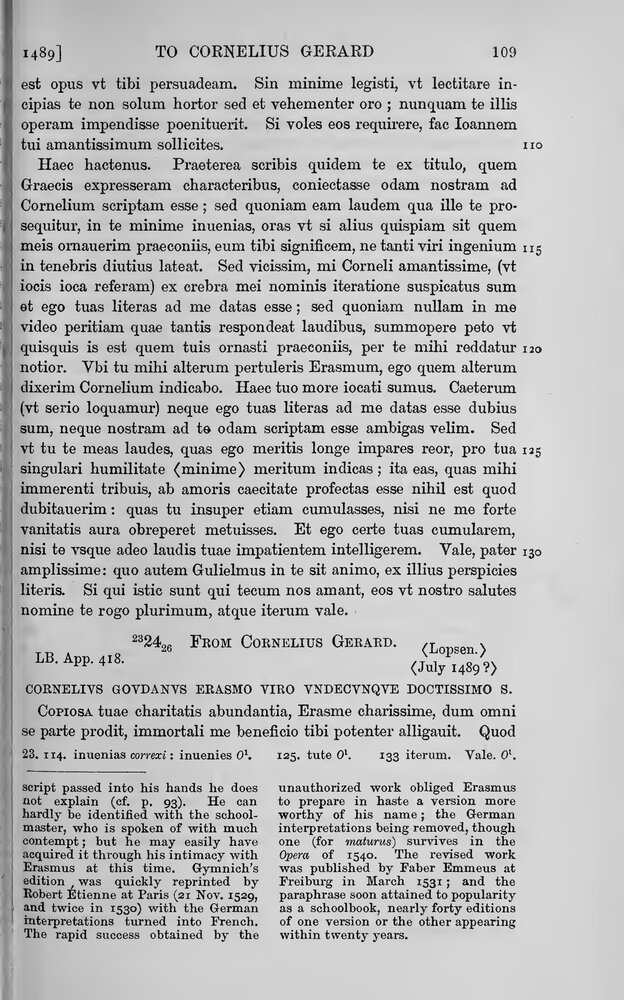
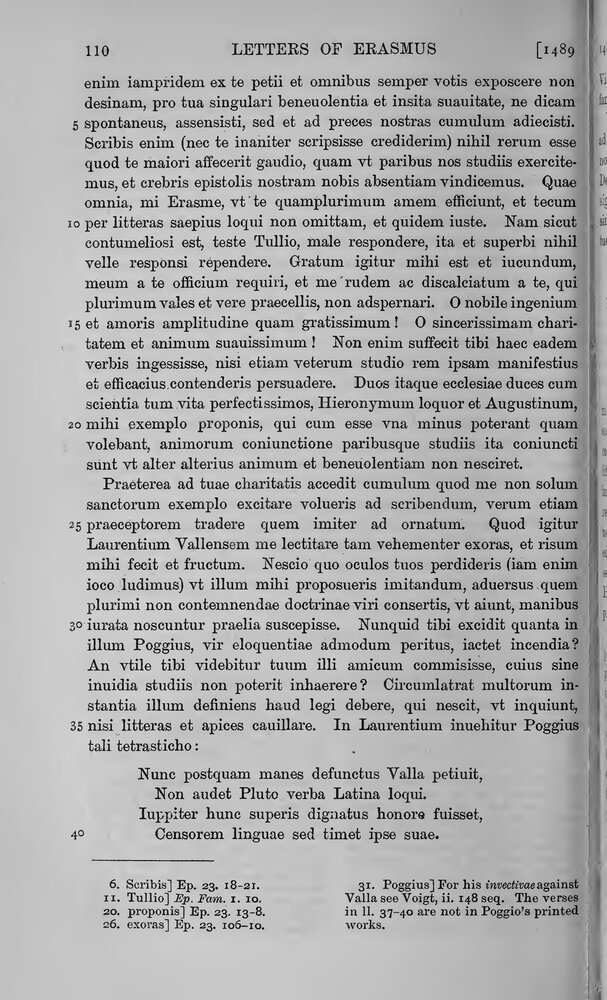
COPIOSA tuae charitatis abundantia, Erasme charissime, dum omni
se parte prodit, immortali me beneficio tibi potenter alligauit. Quod
enim iampridem ex te petii et omnibus semper votis exposcere non
desinam, pro tua singulari beneuolentia et insita suauitate, ne dicam
5
spontaneus, assensisti, sed et ad preces nostras cumulum adiecisti.
Scribis enim (nec te inaniter scripsisse crediderim) nihil rerum esse
quod te maiori affecerit gaudio, quam vt paribus nos studiis exercite-
mus, et crebris epistolis nostram nobis absentiam vindicemus. Quae
omnia, mi Erasme, vt te quamplurimum amem efficiunt, et tecum
10
per litteras saepius loqui non omittam, et quidem iuste. Nam sicut
contumeliosi est, teste Tullio, male respondere, ita et superbi nihil
uelle responsi répendere. Gratum igitur mihi est et iucundum,
meum a te officium requiri, et me rudem ac discalciatum a te, qui
plurimum vales et vere praecellis, non adspernari. O nobile ingenium
15
et amoris amplitudine quam gratissimum! O sincerissimam chari-
tatem et animum suauissimum! Non enim suffecit tibi haec eadem
verbis ingessisse, nisi etiam veterum studio rem ipsam manifestius
et efficacius contenderis persuadere. Duos itaque ecclesiae duces cum
scientia tum vita perfectissimos, Hieronymum loquor et Augustinum,
20
mihi exemplo proponis, qui cum esse vna minus poterant quam
volebant, animorum coniunctione paribusque studiis ita coniuncti
sunt vt alter alterius animum et beneuolentiam non nesciret.
Praeterea ad tuae charitatis accedit cumulum quod me non solum
sanctorum exemplo excitare volueris ad scribendum, verum etiam
25
praeceptorem tradere quem imiter ad ornatum. Quod igitur
Laurentium Vallensem me lectitare tam vehementer exoras, et risum
mihi fecit et fructum. Nescio quo oculos tuos perdideris (iam enim
ioco ludimus) vt illum mihi proposueris imitandum, aduersus quem
plurimi non contemnendae doctrinae viri consertis, vt aiunt, manibus
30
iurata noscuntur praelia suscepisse. Nunquid tibi excidit quanta in
illum Poggius, vir eloquentiae admodum peritus, iactet incendia?
An vtile tibi videbitur tuum illi amicum commisisse, cuius sine
inuidia studiis non poterit inhaerere? Circumlatrat multorum in-
stantia illum definiens haud legi debere, qui nescit, vt inquiunt,
35
nisi litteras et apices cauillare. In Laurentium inuehitur Poggius
tali tetrasticho:
Nunc postquam manes defunctus Valla petiuit,
Non audet Pluto verba Latina loqui.
40
Iuppiter hunc superis dignatus honore fuisset,
Censorem linguae sed timet ipse suae.
Vide ergo si me recte illi commiseris, quem tanquam hominem
famosum et mordacem totus persequitur orbis.
45
Verum haec interim iocati sumus. Porro quantum ex eius libris
ad tuam commonitionem fructum cepi, tuo iudicio (si tamen arrogans
non videor) et ex hoc iam currenti stylo facillime deprehendes.
Denique quam gratissimum mihi fuerit quod doctores tuos mihi
50
significas, non facile dixerim. Manifestas enim ex hoc sincerissimam
sine omni inuidia charitatem, et (quod paucissimorum est) secretorum
tuorum mihi communem tecum) facere gaudes supellectilem. Vale.


Associated Sources

2.
'Opus Epistolarum Des. Erasmi Roterodami', ed. P. S. Allen, 11 vols (Oxford: Clarendon Press, 1906), vol. 1, epistle 24.
3.
'The correspondence of Erasmus: letters 1 to 141, 1484 to 1500', tr. R. A. B. Mynors and D. F. S. Thomson, annot. Wallace K. Ferguson, 'Collected Works of Erasmus', ed. A. Dalzell, et al. (Toronto: University of Toronto Press, 1974), vol. 1, epistle 24.
4.
'La Correspondance d'Erasme. Traduite et annotée d'après l'Opus epistolarum de P. S. Allen, H. M. Allen et H. W. Garrod', ed. Alois Gerlo, et al., 12 vols (Brussels: University Press, 1967), vol. 1: 1484–1514, epistle 24.
5.
'De correspondentie van Desiderius Erasmus: Brieven 1–141', tr. M. J. Steens (Rotterdam: Donker, 2004), vol. 1, epistle 24.
Text has not been meticulously cleaned. You will find splits and errors, especially in Greek text. Refer to the originals or other sources for exact wording. Translation is done by AI, so do not regard it as authoritative! See About for more.

Commentary

M.J. Steens

Link to commentary

AI Summary

Cornelius Gerard writes to Erasmus expressing deep gratitude for his friendship and intellectual engagement, particularly appreciating Erasmus's encouragement to correspond frequently and study together. He discusses Erasmus's recommendation to study Lorenzo Valla, humorously noting the controversy surrounding Valla while acknowledging the value of his works. The letter reflects their scholarly bond and shared enthusiasm for classical learning and theological figures like Jerome and Augustine.

Translations

AI Deepseek

CORNELIUS GOUDA TO ERASMUS, A MAN MOST LEARNED IN EVERY RESPECT, GREETINGS. The overflowing abundance of your affection, dearest Erasmus, while revealing itself in every part, has powerfully bound me to you with an immortal kindness. For what I long since requested from you and shall never cease to demand with all my prayers, you have assented to out of your singular goodwill and innate sweetness—not to say spontaneous readiness—but you have even added a crowning touch to our entreaties. For you write (nor do I believe you have written idly) that nothing has given you greater joy than that we should engage in shared studies and redeem our absence from one another with frequent letters. All these things, my Erasmus, cause me to love you exceedingly, and I shall not fail to speak with you more often through letters, and indeed justly so. For as it is the mark of an insolent man, according to Cicero, to answer poorly, so too is it the mark of a proud man to be unwilling to return any reply. Therefore, it is pleasing and delightful to me that my duty is required by you, and that I, unskilled and barefoot, am not scorned by you, who are most capable and truly excel. O noble genius, most pleasing in the amplitude of your love! O most sincere affection and most delightful spirit! For it was not enough for you to have heaped these same praises in words, unless you also strove to persuade me of the matter itself more clearly and effectively through the study of the ancients. Thus you set before me as an example two most perfect leaders of the Church in both knowledge and life—I speak of Jerome and Augustine—who, though they could not be together as much as they wished, were so joined by a union of spirits and shared studies that each was fully aware of the other’s mind and goodwill. Moreover, to the summit of your affection is added this: that you have wished not only to rouse me by the example of the saints to write, but also to furnish a master for me to imitate for elegance of style. Therefore, your earnest entreaty that I read Lorenzo Valla has both amused me and borne fruit. I know not what has become of your eyes (for now we jest in play) that you have set him before me to imitate, against whom very many men of no contemptible learning are known to have undertaken sworn battles, as they say, with joined hands. Has it escaped you what conflagrations Poggio, a man quite skilled in eloquence, has hurled against him? Or will it seem useful to you to have entrusted your friend to one whose studies he will be unable to follow without incurring envy? The persistent barking of many surrounds him, declaring that he ought not to be read—one who knows not, as they say, except to quibble over letters and pen-strokes. Poggio inveighs against Lorenzo with this tetrastich: *Now after the departed Valla sought the shades, Pluto does not dare to speak Latin. Jupiter would have deemed him worthy of honor among the celestials, But he himself fears him as a censor of his own tongue.* See, therefore, whether you have rightly entrusted me to him, whom the whole world pursues as a notorious and biting man. But we have jested about these matters for now. Furthermore, how much fruit I have gathered from his books at your admonition, you shall most easily perceive by your own judgment (if I do not seem arrogant) and even from this swiftly running pen of mine. Finally, how very pleasing it was to me that you point out your teachers to me, I cannot easily say. For by this you reveal a most sincere affection without any envy, and (a thing of the very few) you rejoice to make me a sharer with you in the store of your secrets. Farewell.

M.J. Steens