Cornelius Gerard defends his earlier claim that Hieronymus Balbus is the best contemporary poet who imitates the ancients, explaining his criteria for judging poetry based on classical principles of 'faciem' (form) and 'sententiam' (meaning). He argues that Balbus excels in both aspects and compares favorably to ancient poets like Ovid, while also praising Erasmus's own poetic works and expressing admiration for his literary talents.
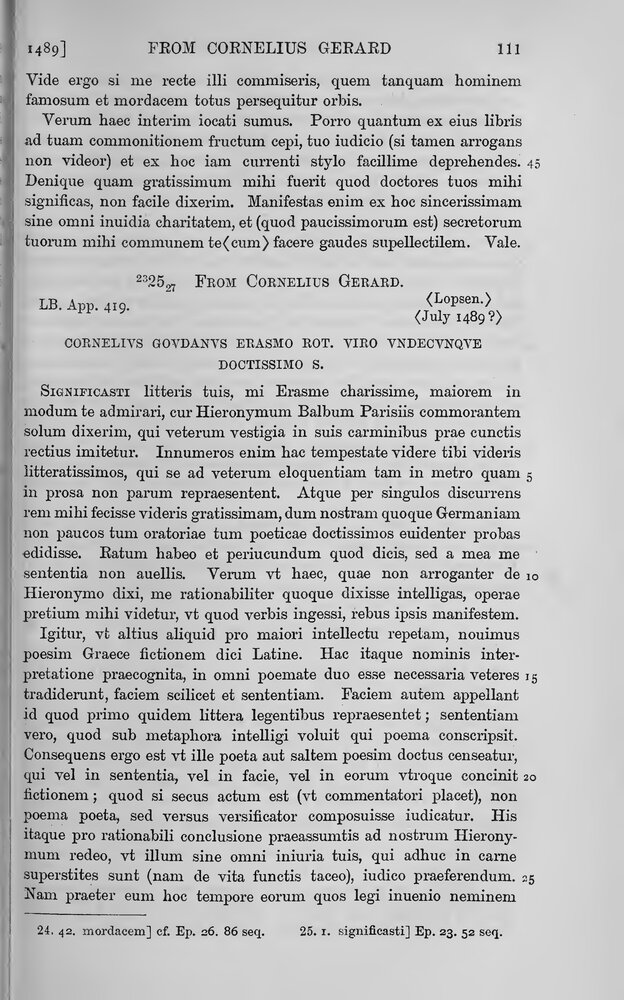
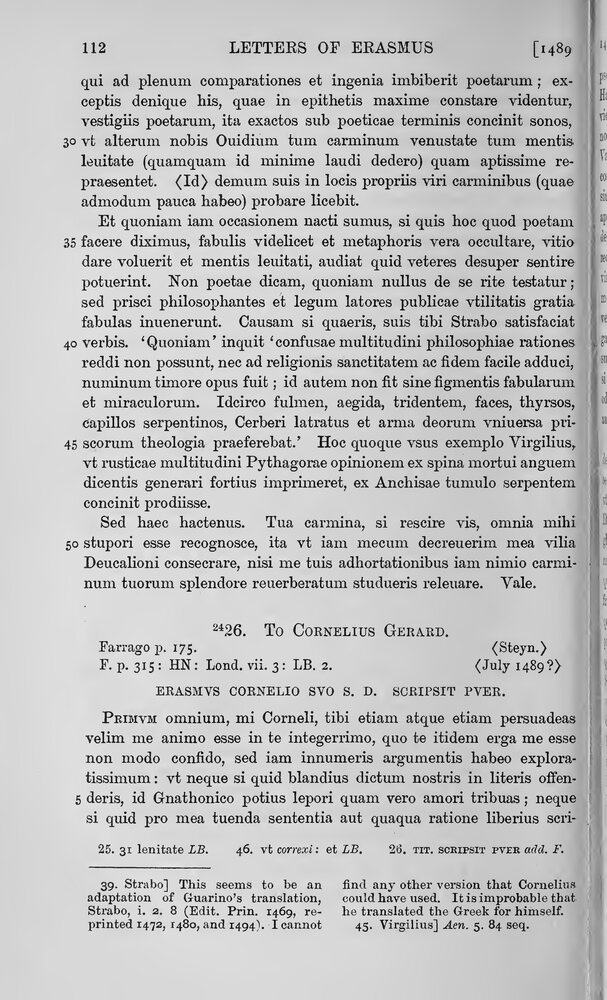
CORNELIUS GOUDA TO ERASMUS OF ROTTERDAM, THE MOST LEARNED MAN IN ALL RESPECTS, GREETINGS. You indicated in your letter, my dearest Erasmus, that you greatly wonder why I said that Hieronymus Balbus, residing in Paris, alone follows the footsteps of the ancients in his poems more correctly than all others. For you seem to see innumerable very learned men in this age who represent the eloquence of the ancients not a little, both in verse and in prose. And running through them individually, you seem to have done me a most pleasing thing, while you also clearly prove that our Germany too has produced not a few men most learned in both oratory and poetry. I hold what you say as valid and most delightful, but you will not tear me from my opinion. But so that you may understand that I also spoke reasonably, and not arrogantly, about Hieronymus, it seems to me worthwhile to demonstrate by the facts themselves what I have put forward in words. Therefore, so that I may trace something from a deeper point for greater understanding, we know that 'poesy' in Greek is called 'fiction' in Latin. With this interpretation of the name thus established beforehand, the ancients have handed down that in every poem two things are necessary: namely, the 'face' and the 'thought'. Now, they call 'face' that which the letter first presents to readers; but 'thought', that which the writer of the poem wished to be understood beneath the metaphor. It follows, therefore, that he is considered a poet, or at least skilled in poesy, who harmonizes with fiction either in the thought, or in the face, or in both of them; but if it has been done otherwise (as pleases the commentator), he is judged to have composed not a poem as a poet, but verses as a versifier. With these things thus assumed as a reasonable conclusion, I return to our Hieronymus, so that I judge him, without any injury to those of yours who are still surviving in the flesh (for I am silent about those who have departed life), to be preferred. For besides him, at this time, I find no one among those I have read who has imbibed to the full the comparisons and the genius of the poets; and finally, excepting those traces of the poets which seem to consist chiefly in epithets, he so precisely harmonizes his sounds within the bounds of poesy, that he most fittingly represents to us another Ovid, both in the charm of his poems and in the levity of his mind (although I would by no means count that as praise). This, finally, will be possible to prove in their proper places from the man's poems (of which I have very few). And since we have now obtained the opportunity, if anyone should wish to fault this thing which we have said a poet does—namely, to conceal truth with fables and metaphors—and attribute it to levity of mind, let him hear what the ancients from on high were able to think. I will not speak of the poets, since no one gives proper testimony about himself; but the early philosophers and lawmakers invented fables for the sake of public utility. If you seek the cause, let Strabo satisfy you with his own words. "Since," he says, "the reasoned arguments of philosophy cannot be rendered to the confused multitude, nor can they be easily led to the sanctity and faith of religion, there was need for the fear of deities; but this is not accomplished without the fabrications of fables and miracles. For this reason, the primitive theology used to put forward the thunderbolt, the aegis, the trident, the torches, the thyrsi, the snaky hair, the barking of Cerberus, and all the weapons of the gods." Using this example also, Virgil, so that he might more forcefully impress upon the rustic multitude the opinion of Pythagoras—who said that a snake is generated from the spine of a dead man—sings that a snake came forth from the tomb of Anchises. But enough of this. As for your poems, if you wish to know, recognize that they are all a marvel to me, so much so that I have already decided with myself to consecrate my own worthless things to Deucalion, unless you strive to lift me up—now utterly dazzled by the excessive splendor of your poems—with your encouragements. Farewell.