

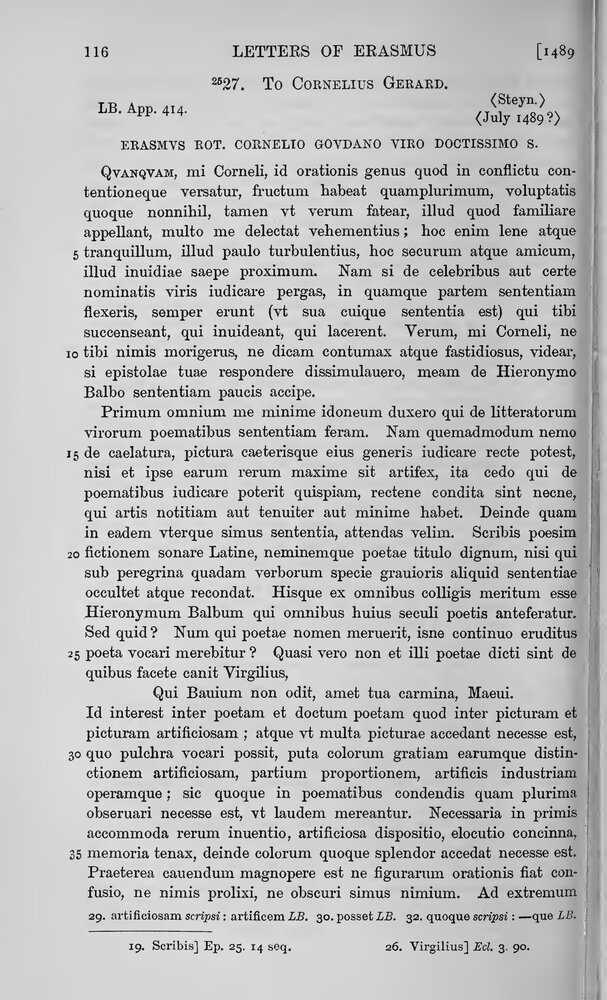
Erasmus writes to his friend Cornelius Gerard to defend his admiration for Lorenzo Valla against critics, arguing that Valla's sharp criticism of medieval scholars was justified and necessary for the revival of classical learning. He emphasizes that truth-telling often provokes hostility but is essential for intellectual progress, and encourages Gerard to continue studying Valla's works despite potential backlash from traditionalists.
Erasmus to his Cornelius, Greetings. The boy wrote this. First of all, my dear Cornelius, I would wish you to persuade yourself again and again that my mind is most sincere towards you, a state which I not only trust is likewise in you towards me, but have now, by countless proofs, ascertained to be most thoroughly the case. So that if you find anything rather flattering said in our letters, you should attribute it to genuine affection rather than to Gnathonic wit; and if I have written anything rather freely in defense of my own opinion or for any reason whatsoever, you should not suspect that my love for you has grown cold, let alone perished. I have said this not because I now see you disagreeing with my view in any matters, but so that, if ever any such thing should occur, I might wish a safeguard to be in place for our mutual goodwill. Indeed, concerning what you write about our Valla, I interpret it in such a way that I believe you wrote not from your heart but from a set purpose; either to exercise your stylistic ability on a paradoxical thesis, or to supply me with material for writing, and so that, just as in Plato, Glauco, having disparaged justice, provokes Socrates to defend it, you might entice me to the defense of Valla, by recounting with what unworthy abuse the most stupid initiates of barbarism rage against a most learned man. This indeed can easily be gathered from this very argument, that you confess you have not only read Valla frequently, but have even imitated him: and even if you deny it, the elegance of your style and phrasing proclaims it loudly. Therefore, whoever he is, who, like a pig in filth, so a friend to ignorance, thinks it glorious and splendid if he, himself ignorant of all good things, pursues the most learned men with envy, hatred, and abuse: let him hear, if he wishes, in a few words, how greatly he is a fool. First, it is fitting for each person to measure himself by his own virtues, not by the opinion of others, and one must observe not how much he is valued by fame—than which nothing is more deceptive—but how he conducts himself. Otherwise, to whom will it not happen that he suddenly, as if become another person, disagrees with himself? This man makes me learned, that one unlearned; this one honest, that one dishonest; to some I am rather boastful, to others again rather fastidious; finally, in this one's eyes I am handsome, in that one's, ugly. What Proteus would I not surpass, or what monster would I finally become, if I were to be whomever it pleased the people to make me? Indeed, just as whatever is greatly approved by the multitude ought to be suspect; so, to be strongly displeasing to the common crowd is a prejudice in favor of a recommendation of probity. Moreover, it will sometimes happen that by the judgment of the same man I am now white, now black. Stesichorus makes Helen ugly; soon, deprived of his sight, he makes her the most beautiful of all; and meanwhile nothing was added to or taken from Helen's beauty. Therefore, they accomplish nothing who object that the name of Laurentius is ablaze with heavy envy among very many; for outstanding virtue has always been liable to this evil. Laurentius does not please many: but whom? Doubtless those whom more refined letters do not please. Here someone will say, "Should we disregard the whisperings of the common crowd, but what of the sort of man Poggio depicted, a man neither inelegant nor unlearned?" Poggio was hated, but by one man; and Poggio was of such a mind that he preferred to be considered most learned rather than to be made more learned. I would allow him to be placed among the learned in such a way that he is not entirely alien to the company of the unlearned; indeed, he was more naturally fluent than erudite, and had more loquacity than eloquence. Finally, Poggio reviles Laurentius, but openly, as a dishonest man, openly as an enemy. Thus Cicero displeased Sallust and Asinius, thus Virgil and Livy displeased Caligula, thus Jerome displeased Rufinus. Furthermore, by what means Laurentius brought upon himself such great envy, it is easy to show. For that Sosia in Terence said cleverly, "Complaisance makes friends, truth hatred." But on the contrary, that parasite Gnatho, who had prescribed for himself to agree to everything, to deny if anyone denies, to praise if he praises, and to turn these very things again to the opposite, if it pleases, how easily he procured the favor of all, so that he not without cause judged it to be the most profitable trade of all. Most different from this character is Demea, while, not yet skilled in city life, he strives to be a friend of truth, he so gains no friends for himself, that, with even his own sons fleeing, he begins to live deserted and bereft. So much is truth a biting and unpleasant thing to the common crowd. Therefore, our Laurentius, if he had preferred to keep silent about the ignorance of the unlearned rather than to expose it, would be held charming and agreeable; now, since he brought it about that the false veneer of the ill-gotten glory of certain men was stripped away, so that they ceased to be thought what they were not, offended, they all sharpen their venom against him. But as for the fact that he sometimes touches even the learned, when did Athens, or Italy, the conqueror of Athens, ever see anyone so learned that nothing escaped him? And just as we are all prone to error by our very nature, so we sin much more freely if authors for the error are not lacking, especially if authority and the splendor of a name commend them. Moreover, it is the character of the unskilled, that if anything is rightly said by authors, they pass it by, no differently than, as in the Fables, the Aesopian cock did the discovered jasper; on the contrary, if anything of errors, they eagerly pluck it for the defense of their own error; for which reasons it was not necessary to conceal even the errors of the greatest men. Whom shall we free from all error, if Cicero slips in the elegance of the Roman language? But if Poggio had preferred to confess his faults frankly and correct them rather than to defend them shamelessly (he would have preferred it, however, if he had wished to perform the duty of a prudent man), he would certainly have judged Laurentius worthy of both honor and gratitude for his correct admonition, so far was he from thinking he ought to be torn to pieces. Driven by these reasonings, certain men flee to that as a last defense: "Even if he justly reproved illustrious men," they say, "nevertheless he did it more bitingly than is fair." I for my part do not see what he said more bitingly against these men, unless perhaps they will think those men should be called illustrious, whom I judge to be the leaders or chief men of barbarism: Papias, Hugutio, Eberhardus, the Catholicon, John Garland, Isidore, and others unworthy even to be named: or certainly unless they call it more biting for this very reason, that he reproved them. But let it be, he was more biting than fair: did he therefore speak falsely, because he spoke the truth more bitingly? Is that biting quality so hateful to us, that from hatred of it we detest so many things worthy and necessary to be known? Do we think nothing should be forgiven to him who has been useful in so many ways? Pardon is given to a caterer, if among many sumptuous dishes some food happens to be a little burnt or not very successfully seasoned. If, with the enemy threatening the walls very closely and the whole people destroyed by dire calamity and desperation for safety, someone should, beyond hope, present himself, who at the peril of his own head drives off the enemy, restores his country to liberty, what glory, what goodwill will not be eagerly bestowed upon him by all? Will he be made hateful to us, if he is a little too fond of drink? Will however slight a fault erase the memory of such a great benefit? And who is of so mean a spirit, whose breast is enclosed within such narrow confines of envy, that he does not both praise Valla magnificently and love him as much as possible; who with such great diligence, such great zeal, such great efforts refuted the ineptitudes of the unlearned, rescued letters, almost buried, from destruction, restored Italy to the ancient splendor of eloquence, and also brought it about that henceforth the learned are forced to speak more circumspectly? To him, therefore, my dear Cornelius, unless perhaps you fear lest a biting man tear you to pieces, you may safely entrust yourself, if not without envy, which is accustomed to accompany arduous and magnificent endeavors, yet in my opinion with the greatest both utility and glory. Therefore, since you are doing this, I ask you again and again to do it more and more. You will feel no small amount of polish accrue to your writings, unless perhaps you are preparing these things for Batavians alone. Farewell. [In the year 1490]