

erasmvs roterodamvs cornelio poetae ac theologo s. p.


28. to cornelius gerard

1489?, Steyn


1
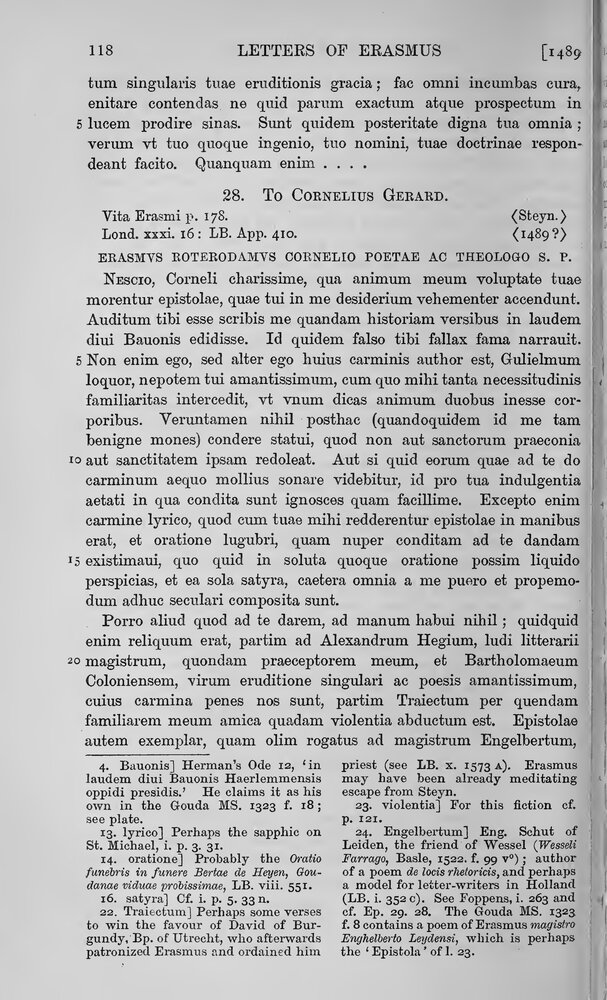
NESCIO, Corneli charissime, qua animum meum voluptate tuae
morentur epistolae, quae tui in me desiderium vehementer accendunt.
Auditum tibi esse scribis me quandam historiam versibus in laudem
diui Bauonis edidisse. Id quidem falso tibi fallax fama narrauit.
5
Non enim ego, sed alter ego huius carminis author est, Gulielmum
loquor, nepotem tui amantissimum, cum quo mihi tanta necessitudinis
familiaritas intercedit, vt vnum dicas animum duobus inesse cor-
poribus. Veruntamen nihil posthac (quandoquidem id me tam
benigne mones) condere statui, quod non aut sanctorum praeconia
10
aut sanctitatem ipsam redoleat. Aut si quid eorum quae ad te do
carminum aequo mollius sonare videbitur, id pro tua indulgentia
aetati in qua condita sunt ignosces quam facillime. Excepto enim
carmine lyrico, quod cum tuae mihi redderentur epistolae in manibus
erat, et oratione lugubri, quam nuper conditam ad te dandam
15
existimaui, quo quid in soluta quoque oratione possim liquido
perspicias, et ea sola satyra, caetera omnia a me puero et propemo-
dum adhuc seculari composita sunt.
Porro aliud quod ad te darem, ad manum habui nihil; quidquid
enim reliquum erat, partim ad Alexandrum Hegium, ludi litterarii
20
magistrum, quondam praeceptorem meum, et Bartholomaeum
Coloniensem, virum eruditione singulari ac poesis amantissimum,
cuius carmina penes nos sunt, partim Traiectum per quendam
familiarem meum amica quadam violentia abductum est. Epistolae
autem exemplar, quam olim rogatus ad magistrum Engelbertum,
25
virum vita venerabilem, misi, ad te dare curaui, si forte te inter-
cessore aliquam ex eo vicissitudinem accipere merear, quam hactenus
snequiui. Nec ob eam
Nec ob eam rem tantum mihi virum aut fastus aut
arrogantiae nomine suspectum habeo, sed amicorum meorum
30
loquaces linguas, quae meam apud illum famam quam inimicissime
commacularunt. Tuae igitur humanitatis, Corneli optime, fuerit,
me illi apud quem plurimum habes autoritatis rursum reconciliare.
Id si feceris, rem facies et mihi gratissimam et a tua benignitate
non alienam. Vale et
35
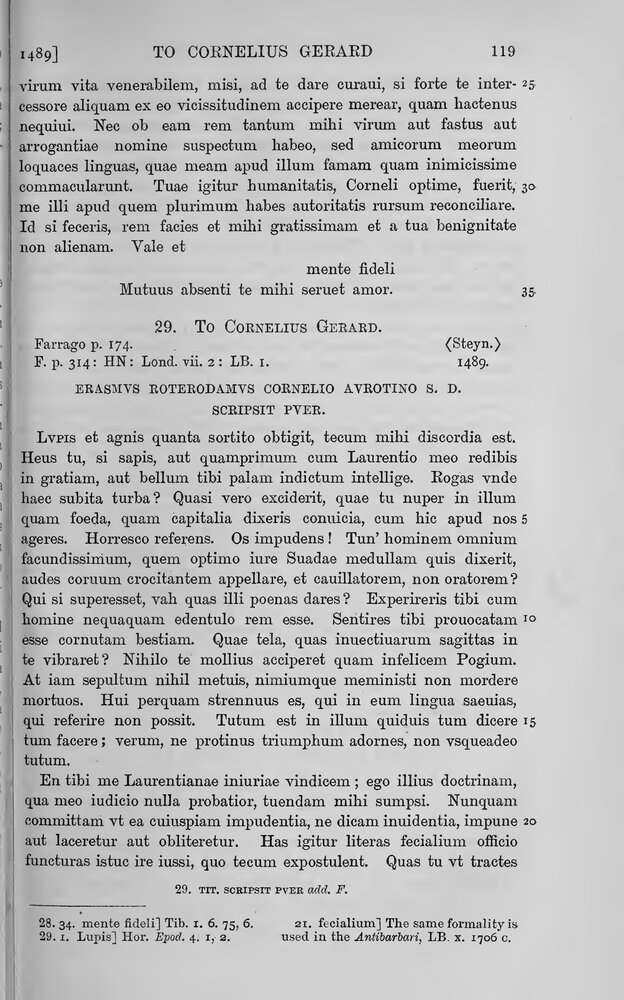
mente fideli
Mutuus absenti te mihi seruet amor.
.


Associated Sources

2.
'Opus Epistolarum Des. Erasmi Roterodami', ed. P. S. Allen, 11 vols (Oxford: Clarendon Press, 1906), vol. 1, epistle 28.
3.
'The correspondence of Erasmus: letters 1 to 141, 1484 to 1500', tr. R. A. B. Mynors and D. F. S. Thomson, annot. Wallace K. Ferguson, 'Collected Works of Erasmus', ed. A. Dalzell, et al. (Toronto: University of Toronto Press, 1974), vol. 1, epistle 28.
4.
'La Correspondance d'Erasme. Traduite et annotée d'après l'Opus epistolarum de P. S. Allen, H. M. Allen et H. W. Garrod', ed. Alois Gerlo, et al., 12 vols (Brussels: University Press, 1967), vol. 1: 1484–1514, epistle 28.
5.
'De correspondentie van Desiderius Erasmus: Brieven 1–141', tr. M. J. Steens (Rotterdam: Donker, 2004), vol. 1, epistle 28.
Text has not been meticulously cleaned. You will find splits and errors, especially in Greek text. Refer to the originals or other sources for exact wording. Translation is done by AI, so do not regard it as authoritative! See About for more.

Commentary

M.J. Steens

Link to commentary

AI Summary

Erasmus writes to his friend Cornelius Gerard, correcting a rumor that he wrote a poem in praise of Saint Bavo, clarifying that it was actually written by their mutual friend William. He discusses his literary works, including a lyric poem and funeral oration, and asks Gerard to help reconcile him with Master Engelbert, whose opinion of Erasmus has been damaged by gossip from other friends.

Translations

AI Deepseek

Erasmus of Rotterdam to Cornelius the Poet and Theologian, Greetings. I know not, dearest Cornelius, with what pleasure your letters detain my mind, though they vehemently kindle in me a longing for you. You write that you have heard I have published a certain history in verse in praise of Saint Bavo. Indeed, false rumor has reported this to you erroneously. For it is not I, but my other self, who is the author of this poem—I speak of William, your most affectionate grandson, with whom I share such a bond of intimacy that you would say one soul inhabits two bodies. Nevertheless, hereafter (since you advise me so kindly) I have resolved to compose nothing which does not either savor of the praises of the saints or of sanctity itself. Or if any of the poems which I send to you should seem somewhat too gentle in tone, you will, with your indulgence, most readily pardon the age in which they were composed. For, excepting a lyric poem, which was in my hands when your letter was returned to me, and a funeral oration, which I thought should be sent to you recently, so that you may clearly perceive what I can do even in prose, and that one satire, all the rest were composed by me as a boy and almost while I was still a layman. Furthermore, I had nothing else at hand to send to you; for whatever remained was partly taken to Alexander Hegius, schoolmaster and once my teacher, and to Bartholomew of Cologne, a man of singular learning and a great lover of poetry, whose poems are in our possession, and partly it was carried off to Utrecht by a certain friend of mine with a kind of friendly violence. But a copy of the letter which I once sent, when asked, to Master Engelbert, a man venerable in life, I have taken care to send to you, in case by your intercession I might perhaps deserve to receive some reciprocal favor from him, which I have not obtained so far. Nor is it for that reason alone that I hold the man suspect on account of either haughtiness or arrogance, but also because of the talkative tongues of my friends, which have most hostilely stained my reputation with him. It will therefore be a mark of your kindness, excellent Cornelius, to reconcile me once more to him, with whom you have very great influence. If you do this, you will perform an act most pleasing to me and not unworthy of your benevolence. Farewell. And may mutual love preserve you, absent, for me in faithful mind.

M.J. Steens