
erasmvs roterodamvs cornelio avrotino s. d.


29. to cornelius gerard

1489, Steyn


1
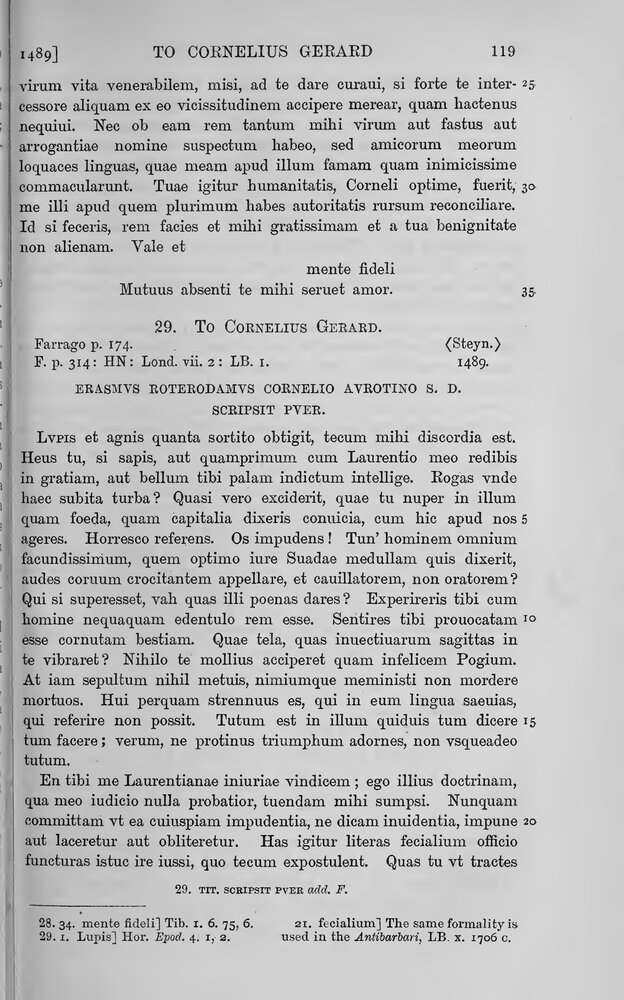
LVPIS et agnis quanta sortito obtigit, tecum mihi discordia est.
Heus tu, si sapis, aut quamprimum cum Laurentio meo redibis
in gratiam, aut bellum tibi palam indictum intellige. Rogas vnde
haec subita turba? Quasi vero exciderit, quae tu nuper in illum
5
quam foeda, quam capitalia dixeris conuicia, cum hic apud nos
ageres. Horresco referens. Os impudens! Tun' hominem omnium
facundissimum, quem optimo iure Suadae medullam quis dixerit,
audes coruum crocitantem appellare, et cauillatorem, non oratorem?
Qui si superesset, vah quas illi poenas dares? Experireris tibi cum
10
homine nequaquam edentulo rem esse. Sentires tibi prouocatam
esse cornutam bestiam. Quae tela, quas inuectiuarum sagittas in
te vibraret? Nihilo te mollius acciperet quam infelicem Pogium.
At iam sepultum nihil metuis, nimiumque meministi non mordere
mortuos. Hui perquam strennuus es, qui in eum lingua saeuias,
15
qui referire non possit. Tutum est in illum quiduis tum dicere
tum facere; verum, ne protinus triumphum adornes, non vsqueadeo
tutum.
En tibi me Laurentianae iniuriae vindicem; ego illius doctrinam,
20
qua meo iudicio nulla probatior, tuendam mihi sumpsi. Nunquam
committam vt ea cuiuspiam impudentia, ne dicam inuidentia, impune
aut laceretur aut obliteretur. Has igitur literas fecialium officio
functuras istuc ire iussi, quo tecum expostulent. Quas tu vt tractes
vide.
25
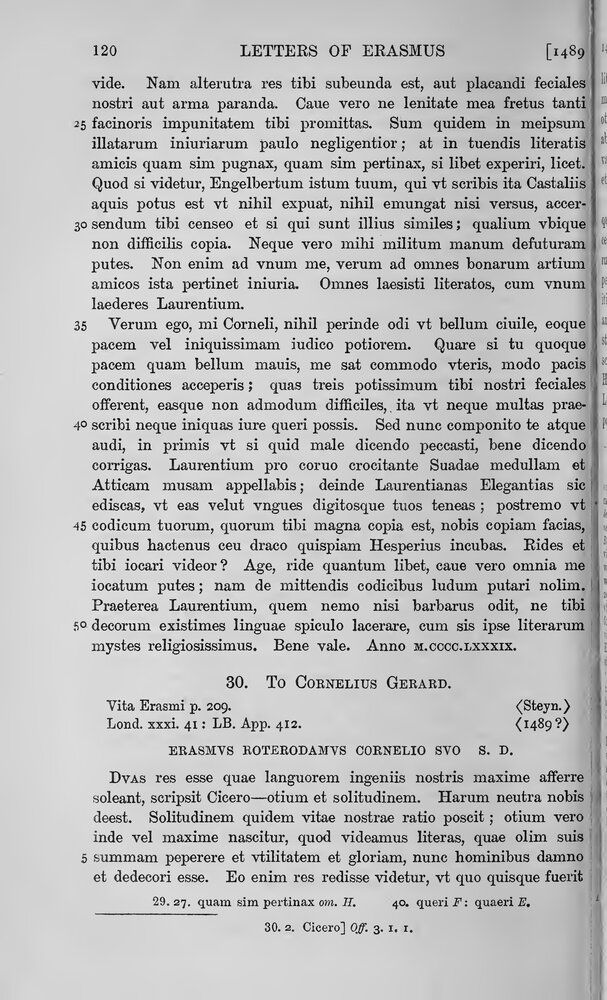
Nam alterutra res tibi subeunda est, aut placandi feciales
nostri aut arma paranda. Caue vero ne lenitate mea fretus tanti
facinoris impunitatem tibi promittas. Sum quidem in meipsum
illatarum iniuriarum paulo negligentior; at in tuendis literatis a
30
amicis quam sim pugnax, quam sim pertinax, si libet experiri, licet.
Quod si videtur, Engelbertum istum tuum, qui vt scribis ita Castaliis
aquis potus est vt nihil expuat, nihil emungat nisi versus, accer-
sendum tibi censeo et si qui sunt illius similes; qualium vbique
non difficilis copia. Neque vero mihi militum manum defuturam
35
putes. Non enim ad vnum me, verum ad omnes bonarum artium
amicos ista pertinet iniuria. Omnes laesisti literatos, cum vnum
laederes Laurentium.
Verum ego, mi Corneli, nihil perinde odi vt bellum ciuile, eoque
40
pacem vel iniquissimam iudico potiorem. Quare si tu quoque
pacem quam bellum mauis, me sat commodo vteris, modo pacis
conditiones acceperis; quas treis potissimum tibi nostri feciales
offerent, easque non admodum difficiles, ita vt neque multas prae-
scribi neque iniquas iure queri possis. Sed nunc componito te atque
45
audi, in primis vt si quid male dicendo peccasti, bene dicendo
corrigas. Laurentium pro coruo crocitante Suadae medullam et
Atticam musam appellabis; deinde Laurentianas Elegantias sic
ediscas, vt eas velut vngues digitosque tuos teneas; postremo vt
codicum tuorum, quorum tibi magna copia est, nobis copiam facias,
50
quibus hactenus ceu draco quispiam Hesperius incubas. Rides et
tibi iocari videor? Age, ride quantum libet, caue vero omnia me
iocatum putes; nam de mittendis codicibus ludum putari nolim.
Praeterea Laurentium, quem nemo nisi barbarus odit, ne tibi
decorum existimes linguae spiculo lacerare, cum sis ipse literarum
55
mystes religiosissimus. Bene vale. Anno M.CCCC.LXXXIX.


Associated Sources

2.
'Opus Epistolarum Des. Erasmi Roterodami', ed. P. S. Allen, 11 vols (Oxford: Clarendon Press, 1906), vol. 1, epistle 29.
3.
'The correspondence of Erasmus: letters 1 to 141, 1484 to 1500', tr. R. A. B. Mynors and D. F. S. Thomson, annot. Wallace K. Ferguson, 'Collected Works of Erasmus', ed. A. Dalzell, et al. (Toronto: University of Toronto Press, 1974), vol. 1, epistle 29.
4.
'La Correspondance d'Erasme. Traduite et annotée d'après l'Opus epistolarum de P. S. Allen, H. M. Allen et H. W. Garrod', ed. Alois Gerlo, et al., 12 vols (Brussels: University Press, 1967), vol. 1: 1484–1514, epistle 29.
5.
'De correspondentie van Desiderius Erasmus: Brieven 1–141', tr. M. J. Steens (Rotterdam: Donker, 2004), vol. 1, epistle 29.
Text has not been meticulously cleaned. You will find splits and errors, especially in Greek text. Refer to the originals or other sources for exact wording. Translation is done by AI, so do not regard it as authoritative! See About for more.

Commentary

M.J. Steens

Link to commentary

AI Summary

Erasmus writes to Cornelius Gerard, angrily defending their mutual friend Laurentius against Gerard's insults. He threatens war unless Gerard reconciles with Laurentius and makes amends by praising him, studying his works, and sharing his books. Despite his aggressive tone, Erasmus expresses a preference for peace over civil war among scholars.

Translations

AI Deepseek

Erasmus of Rotterdam to Cornelius Aurelius, Greetings. A boy wrote this. The discord between you and me is as great as that allotted to wolves and lambs. Listen, if you are wise, you will either return to favor with my Laurentius as soon as possible, or understand that war has been openly declared upon you. You ask whence this sudden uproar? As if it had slipped your mind, what foul, what deadly insults you recently uttered against him when you were staying here with us. I shudder to repeat them. Shameless mouth! Do you dare to call a man the most eloquent of all—whom one might rightly call the very marrow of Persuasion—a croaking crow, and a caviller, not an orator? If he were still alive, ah, what penalties would you pay him? You would find that you were dealing with a man by no means toothless. You would feel that you had provoked a horned beast. What weapons, what arrows of invective would he hurl against you? He would handle you no more gently than the unfortunate Poggio. But now that he is buried, you fear nothing, and you remember all too well that the dead do not bite. Fie, you are exceedingly brave, to rage with your tongue against one who cannot answer back. It is safe to say or do anything against him now; but, lest you immediately prepare a triumph, it is not entirely safe. Behold, I am the avenger of the wrong done to Laurentius; I have undertaken to defend his learning, which in my judgment is unsurpassed in its excellence. I will never allow it to be mangled or obliterated with impunity by anyone's shamelessness, not to say envy. Therefore, I have ordered this letter to go to you in the role of a herald, to remonstrate with you. See how you handle it. For one of two things must befall you: either you must appease our herald, or you must prepare for war. But beware lest, relying on my usual mildness, you promise yourself impunity for such a crime. I am indeed rather negligent regarding injuries inflicted upon myself; but in defending my learned friends, how combative I am, how persistent, you are free to test, if you wish. And if it seems good, I advise you to summon that Engelbert of yours, who, as you write, has drunk so deeply of the Castalian spring that he spits out nothing, blows his nose on nothing, except verses, and any others like him; of whom there is no difficult supply anywhere. Nor should you think that I will lack a band of soldiers. For this injury pertains not to me alone, but to all friends of good learning. You have injured all learned men when you injured Laurentius alone. But I, my dear Cornelius, hate nothing so much as civil war, and for that reason I judge even the most unjust peace to be preferable. Therefore, if you also prefer peace to war, you will find me quite accommodating, provided you accept the terms of peace; these our herald will offer you, three in particular, and not very difficult ones, so that you can neither complain that many are prescribed nor that they are unjust. But now compose yourself and listen: first, that if you have sinned by speaking ill, you correct it by speaking well. You shall call Laurentius, instead of a croaking crow, the very marrow of Persuasion and an Attic Muse; next, that you learn by heart the Laurentian Elegantiae, so that you hold them as your very nails and fingers; finally, that you grant us access to your books, of which you have a great abundance, upon which you have hitherto brooded like some Hesperidean dragon. You laugh and think I am joking? Go on, laugh as much as you like, but beware of thinking that I have been entirely joking; for I would not wish my demand about sending the books to be thought a jest. Furthermore, since you yourself are a most devoted initiate of letters, do not think it fitting to lacerate with the dart of your tongue a Laurentius, whom no one but a barbarian hates. Farewell. In the year 1489.

M.J. Steens