

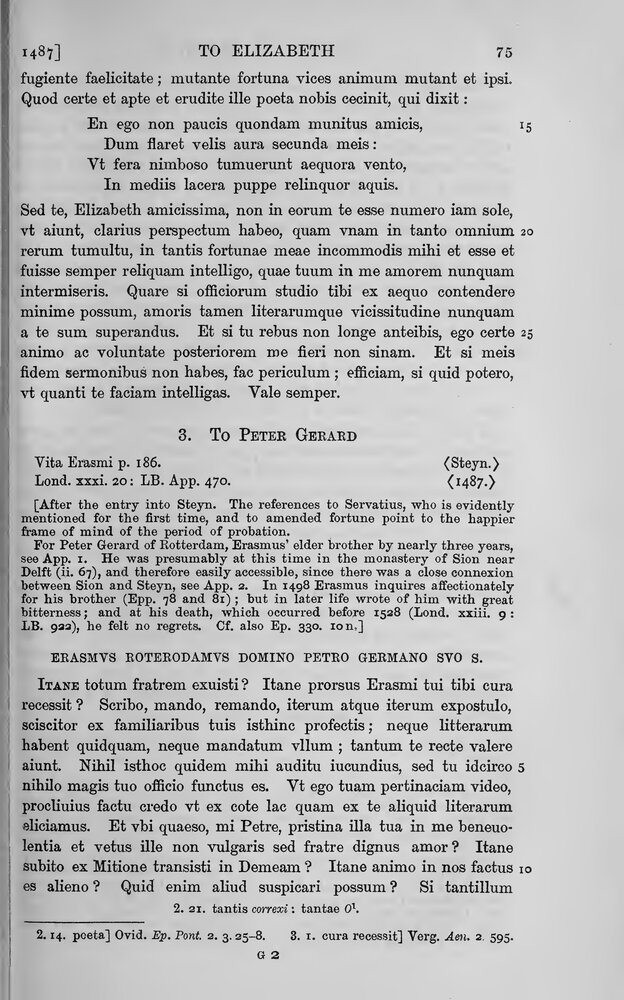
After the entry into Steyn. The references to Servatius, who is evidently mentioned for the first time, and to amended fortune point to the happier frame of mind of the period of probation. For Peter Gerard of Rotterdam, Erasmus' elder brother by nearly three years, see App. 1. He was presumably at this time in the monastery of Sion near Delft (ii. 67), and therefore easily accessible, since there was a close connexion between Sion and Steyn, see App. 2. In 1498 Erasmus inquires affectionately for his brother (Epp. 78 and 81); but in later life wrote of him with great bitterness; and at his death, which occurred before 1528 (Lond. xxiii. 9: LB. 922), he felt no regrets. Cf. also Ep. 330.
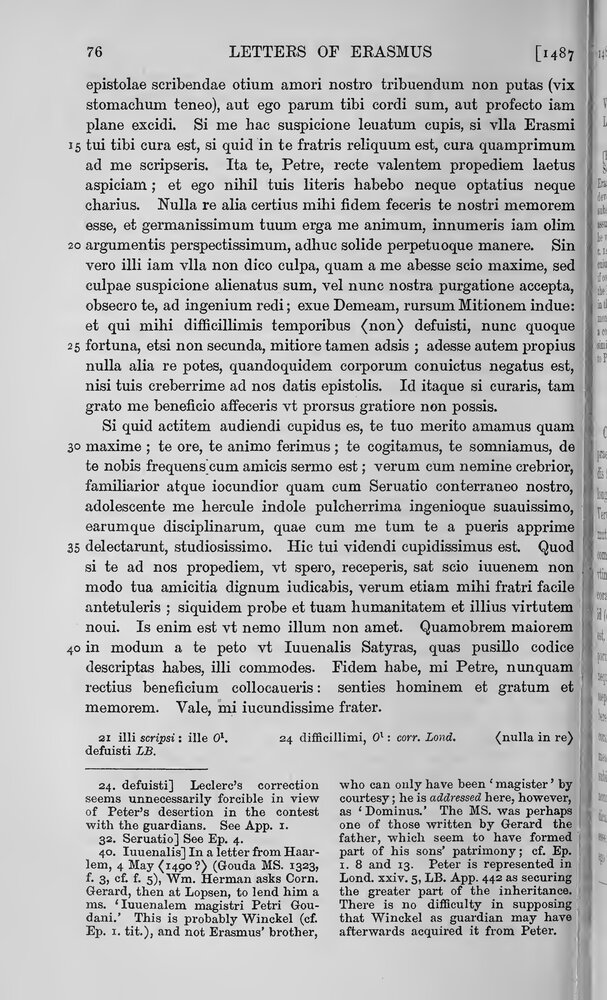
Erasmus writes to his older brother Peter Gerard, expressing frustration at Peter's lack of correspondence and apparent neglect. He appeals to their fraternal bond, asking Peter to resume writing and to lend a copy of Juvenal's Satires to Servatius, a mutual friend. The letter reflects Erasmus's desire for connection and intellectual sharing despite physical separation.
Erasmus of Rotterdam to his brother Peter Germanus, greetings: Have you then cast off your brother entirely? Has all care for your Erasmus truly departed from you? I write, I send messages, I send them again, I protest again and again, I inquire from your friends who have come from there; and they have no letter, nor any message; they only say that you are in good health. Nothing indeed is more pleasant for me to hear than this, but you are nonetheless no more diligent in your duty. As I see your stubbornness, I believe it easier to draw milk from a flint than to elicit any letter from you. And where, I ask you, my Peter, is that former goodwill of yours towards me and that old love, not common but worthy of a brother? Have you so suddenly changed from Mitio into Demea? Have you become so estranged in your feelings towards us? For what else can I suspect? If you think our love deserves not the smallest leisure for writing a letter (I can scarcely contain my irritation), either I am of little importance to you, or I have truly fallen out of your favor completely. If you wish to relieve me of this suspicion, if you have any care for your Erasmus, if any remnant of a brother remains in you, take care to write to me as soon as possible. Thus, Peter, may I soon see you in good health with joy; and I shall hold nothing more desirable or dearer than your letter. By no other means can you more certainly convince me that you remember us, and that your most brotherly spirit towards me, already most clearly proven by countless instances, remains solid and perpetual. But if I am now estranged from you by any fault—I do not say a fault, which I know is very far from me—but by the suspicion of a fault, then now, having received my defense, I beg you, return to your nature; cast off Demea, put on Mitio again: and you who did not fail me in the most difficult times, may you now also be present with a fortune, if not favorable, yet milder; but you can be present more closely by no other means, since living together in person is denied, except by your letters very frequently sent to us. If you take care of this, you will have conferred a favor on me so gratefully received that you could not possibly confer one more gratefully. But if you are eager to hear what I am doing, we love you as much as possible, as you deserve; we bear you in our mouth, in our heart; we think of you, we dream of you, about you we have frequent conversation with friends; but with no one more often, more familiarly, and more pleasantly than with Servatius, our countryman, a young man, by Hercules, of the finest character and most agreeable disposition, and most studious of those disciplines which have delighted both you and me exceedingly since boyhood. He is most eager to see you. And if you return to us soon, as I hope, I know well that you will judge the young man not only worthy of your friendship, but you will easily prefer him even to me, your brother; since I know well both your kindness and his virtue. For he is such that no one fails to love him. Wherefore I ask you in the greatest measure to lend him the Satires of Juvenal, which you have copied in a small codex. Believe me, my Peter, you will never have better placed a kindness: you will find the man both grateful and mindful. Farewell, my most delightful brother.