

Erasmus writes to his friend Cornelius Gerard about how idleness and solitude have dampened his enthusiasm for literary studies, citing the declining appreciation for learning in their time. Despite his own disenchantment and poor health, he has completed an oration for Gerard as a gesture of friendship and gratitude. He reflects on different types of people's attitudes toward literature, criticizing the ignorant and praising the learned, while hoping his work will benefit Gerard and others.
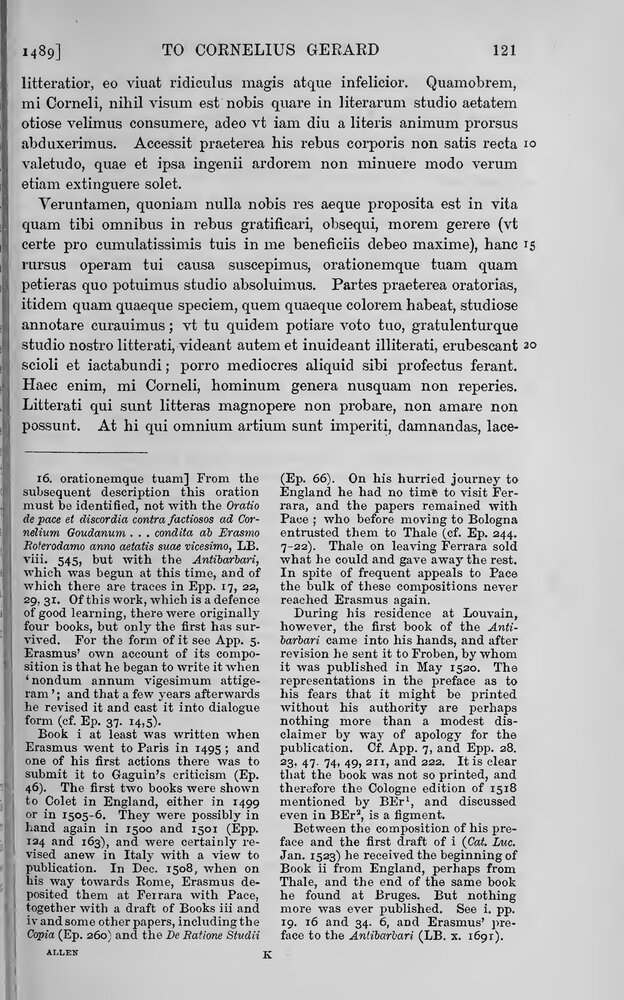
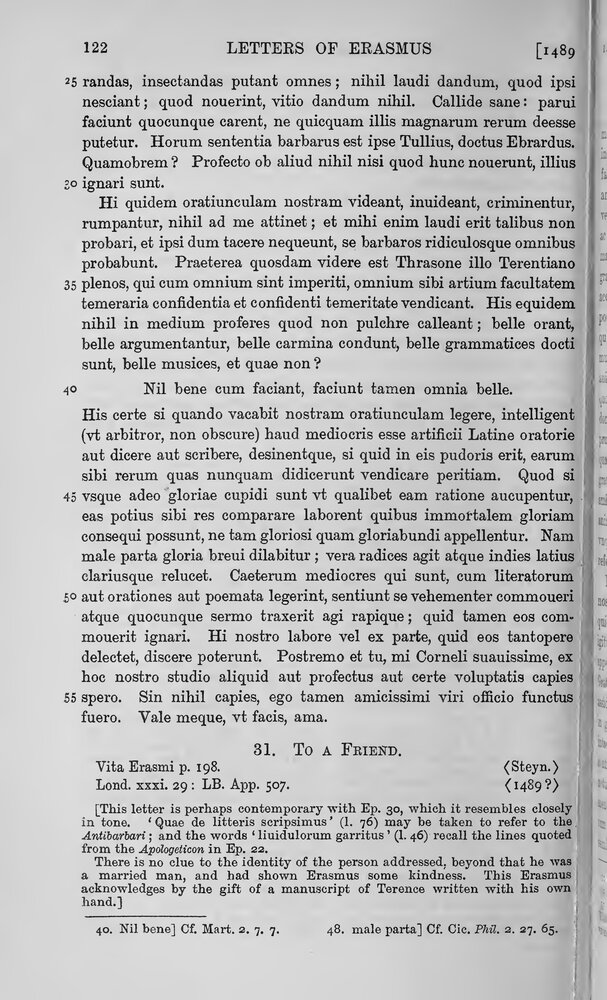
Erasmus of Rotterdam to his friend Cornelius, greetings. Cicero wrote that there are two things which especially tend to bring languor to our minds—leisure and solitude. Of these, neither is lacking for us. Solitude, indeed, the nature of our life demands; but leisure arises from this fact above all: that we see learning, which once brought the greatest benefit and glory to its possessors, now to be a loss and disgrace to men. For matters have come to such a point that, the more learned one is, the more ridiculous and unhappy he lives. For this reason, my Cornelius, it seemed to us there was no point in wishing to spend our life idly in the study of letters, so much so that for a long time now we have completely withdrawn our mind from them. Added to these things has been the not entirely sound health of the body, which itself usually not only diminishes but even extinguishes the ardor of the mind. Nevertheless, since nothing in life has been so much my purpose as to gratify, obey, and humor you in all things (as I certainly ought most of all, in return for your most abundant kindnesses to me), I have undertaken this task again for your sake, and have completed your oration, which you requested, with as much diligence as I could. Furthermore, I have taken care to diligently note the rhetorical divisions, as well as what particular form and what particular color each part has; so that you may indeed obtain your wish, and that learned men may congratulate our effort, while the unlearned may see and envy, and the smatterers and braggarts may blush; and further, that those of moderate ability may carry away some profit for themselves. For these kinds of men, my Cornelius, you will find everywhere. Those who are learned cannot help but greatly approve and love learning. But those who are ignorant of all arts think that all should be condemned, torn to pieces, and attacked; they grant no praise to anything they themselves do not know; and what they do know, they grant that nothing should be considered a fault. A clever tactic, truly: they belittle whatever they lack, lest they be thought to lack anything of great importance. In their opinion, Cicero himself is a barbarian, and Eberhard is learned. Why? Assuredly for no other reason than that they know the latter and are ignorant of the former. Let these men see, envy, accuse, and burst with envy at our little oration—it is of no concern to me; for it will be a credit to me not to be approved by such men, and they, by being unable to keep silent, will prove themselves to all as barbarous and ridiculous. Furthermore, one sees certain men, full of that Thraso from Terence, who, though ignorant of all things, claim for themselves mastery of all arts with rash confidence and confident rashness. To these men, you will bring forth nothing in public which they do not beautifully claim to know expertly; they speak beautifully, they argue beautifully, they compose poems beautifully, they are beautifully learned in grammar, beautifully in music—and what not? Though they do nothing well, yet they do everything *belle*. If ever these men should have the leisure to read our little oration, they will understand (I think, not obscurely) that to speak or write in Latin oratorically is a work of no mean skill, and they will cease, if they have any shame, from claiming for themselves expertise in those things which they never learned. But if they are so desirous of glory that they hunt for it by any means whatsoever, let them strive rather to acquire for themselves those things by which they can obtain immortal glory, lest they be called not so much glorious as vainglorious. For ill-gotten glory quickly slips away; true glory takes root and shines forth more widely and clearly every day. Moreover, those who are of moderate ability, when they read the orations or poems of learned men, feel themselves strongly moved and carried away and swept along wherever the discourse leads; yet they are ignorant of what has moved them. These men will be able to learn from our labor, at least in part, what it is that delights them so greatly. Finally, you too, my dearest Cornelius, will, I hope, gain some profit or at least pleasure from this effort of mine. But if you gain nothing, I will nevertheless have performed the duty of a most devoted friend. Farewell, and love me as you do.