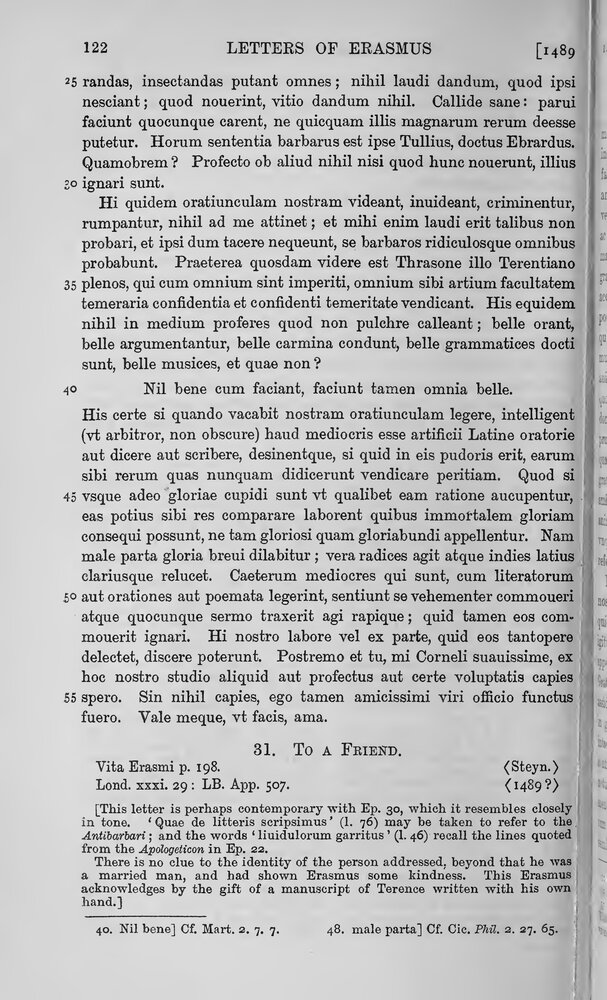
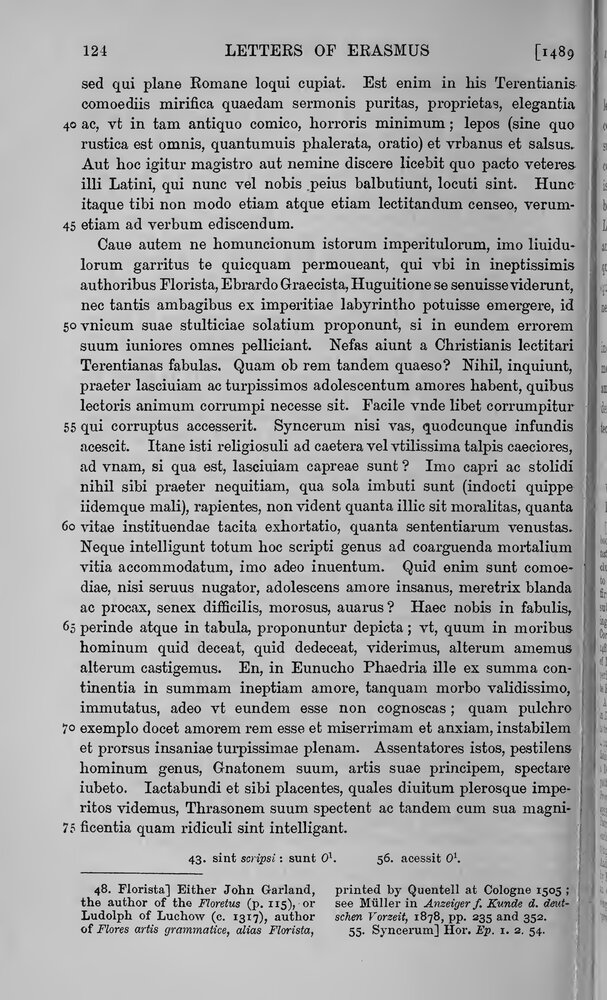
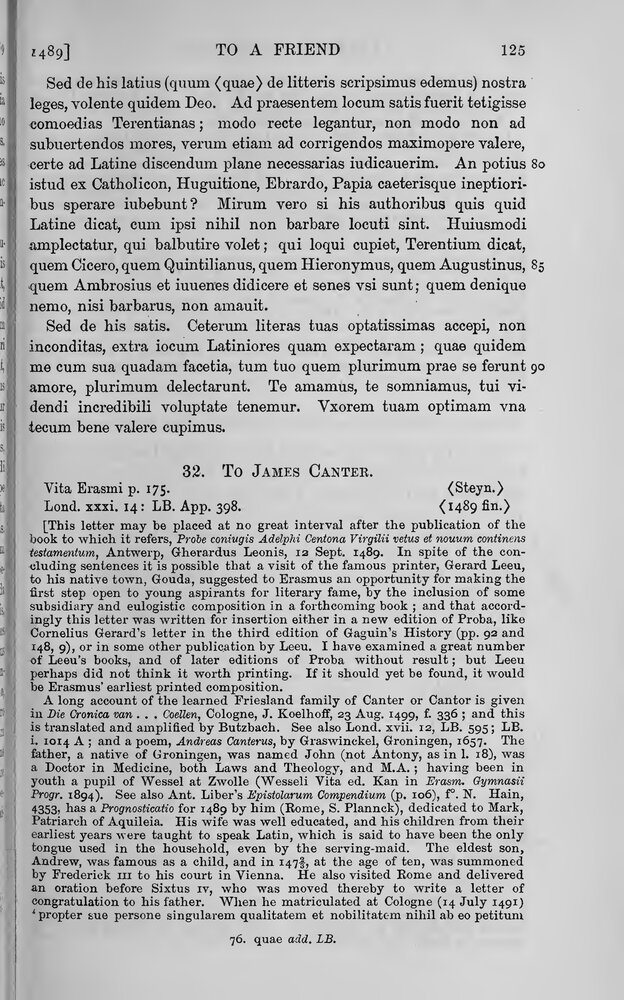
[This letter is perhaps contemporary with Ep. 30, which it resembles closely in tone. 'Quae de litteris scripsimus' (1. 76) may be taken to refer to the Antibarbari; and the words 'liuidulorum garritus' (1. 46) recall the lines quoted from the Apologeticon in Ep. 22. There is no clue to the identity of the person addressed, beyond that he was a married man, and had shown Erasmus some kindness. This Erasmus acknowledges by the gift of a manuscript of Terence written with his own hand.]
Erasmus expresses gratitude to an unnamed friend for past kindnesses and laments his inability to repay these favors due to his poor fortune. He sends a personally handwritten manuscript of Terence as a token of their friendship and mutual affection, urging his friend to study it diligently. Erasmus defends the value of Terence's comedies against critics, arguing they teach morality and proper Latin style rather than corrupting readers.
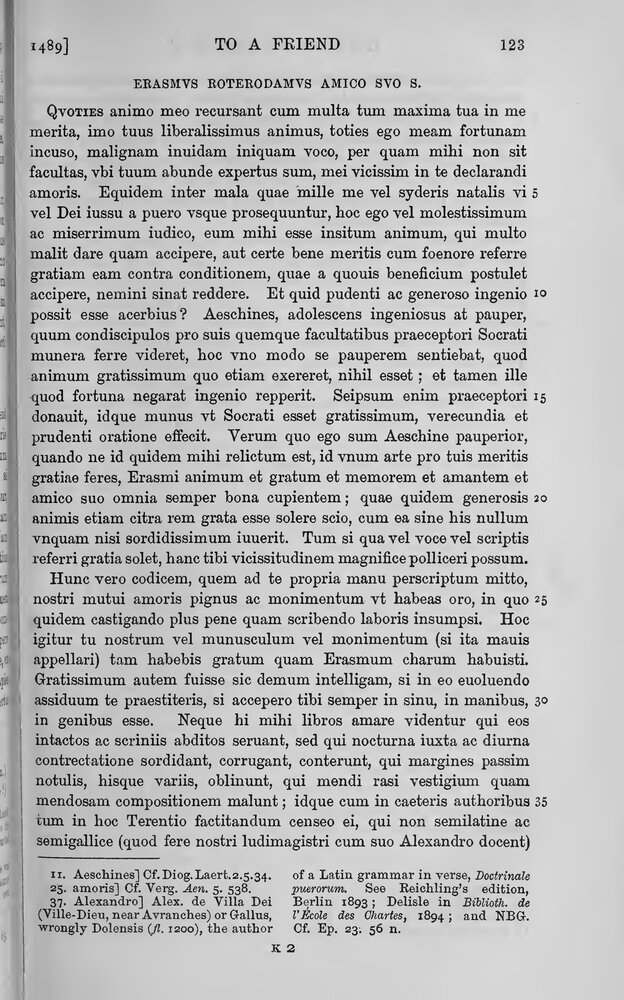
Erasmus of Rotterdam to his friend, greetings. As often as your many and greatest merits toward me—nay, your most generous spirit—recur to my mind, so often do I blame my own fortune, calling it malign, envious, and unjust, because through it I have no opportunity, where I have experienced your goodwill in abundance, to declare in turn my affection for you. Indeed, among the thousand evils which have followed me from childhood either by the influence of my birth star or by God’s command, I judge this one the most vexing and wretched: that there is implanted in me a spirit which much prefers to give than to receive, or at least to repay with interest gratitude to those who have deserved well—a spirit which, contrary to the condition that asks to receive a benefit from anyone, allows me to repay none. And what can be more bitter to a modest and noble nature? Aeschines, a talented but poor youth, when he saw his fellow students each bringing gifts to their teacher Socrates according to their means, felt his poverty in this one respect: that he had nothing with which to exercise his most grateful heart; and yet he found with his talent what fortune had denied. For he presented himself as a gift to his teacher, and by his modesty and prudent speech he made that offering most pleasing to Socrates. But how much poorer am I than Aeschines, since not even that one thing is left to me—to bring you by skill, in return for your merits, the one tribute of gratitude: Erasmus’s heart, grateful and mindful and loving, always wishing every good for his friend. Indeed, I know that such things usually please noble minds even without material substance, since without these no gift ever pleased anyone except the most sordid. Moreover, if any gratitude is usually returned by voice or writing, this repayment I can grandly promise you. But this little book, which I send to you copied out in my own hand, I beg you to keep as a pledge and memorial of our mutual affection; in correcting it I have spent almost more labor than in writing it. Therefore, you will hold this our little gift or memorial (if you prefer it so called) as gratefully as you have held Erasmus dear. And I shall understand that it has been most pleasing only if you show yourself assiduous in unrolling it, if I learn that it is always in your bosom, in your hands, upon your knees. Nor do those seem to me to love books who keep them untouched and hidden away in cases, but those who soil, wrinkle, and wear them out by handling day and night, who fill the margins everywhere with notes, and those of various kinds, who prefer a trace of an erased error to an erroneous reading; and this I think should be done in other authors, but especially in this Terence, by one who wishes to speak not half-Latin and half-Gaulish (as our schoolmasters generally teach with their Alexander), but purely in Roman fashion. For in these comedies of Terence there is a wonderful purity, propriety, and elegance of speech, and, for so ancient a comic writer, very little harshness; the charm (without which every speech, however ornate, is rustic) is both urbane and witty. Therefore, either by this master or by none at all will it be permitted to learn how those ancient Latins, who now stammer worse even than we, spoke. And so I recommend that you not only read and reread him, but even learn him by heart word for word. But take care lest the chatter of those ignorant little men—nay, spiteful ones—disturb you at all, who, when they see that they have grown old over the most foolish authors—Florista, Ebrardus Graecista, Hugutio—and have not been able to emerge from the labyrinth of their ignorance by such long wanderings, set up this one consolation for their stupidity: if they can lure all the younger generation into the same error of theirs. They say it is a sin for Christians to read the plays of Terence. For what reason, pray? They have nothing, they say, except wantonness and the most shameful loves of youths, by which the reader’s mind must be corrupted. Easily from any source is corrupted the mind that has come already corrupted. Unless the vessel is clean, whatever you pour in turns sour. Are these little religious men blinder than moles to all other most useful things, yet as sharp-eyed as goats to any wantonness, if there is any? Nay, like goats and blockheads, snatching for themselves nothing but the wickedness with which alone they are imbued (for they are both unlearned and wicked), they do not see how much morality is there, how much silent exhortation to the conduct of life, how much charm of thought. Nor do they understand that this whole genre of writing is suited—nay, was invented—to reprove the vices of mortals. For what are comedies but a trickster slave, a youth mad with love, a flattering and brazen courtesan, a difficult, morose, avaricious old man? These are set before us in plays, just as in a picture, portrayed; so that, when we have seen in the characters of men what is fitting and what is unseemly, we may embrace the one and censure the other. Behold, in the Eunuch, that Phaedria, from the greatest self-control changed by love, as by a most powerful disease, into the greatest folly, so that you would not recognize him as the same—by how fine an example he teaches that love is a thing both most wretched and anxious, unstable and full of sheer, most shameful madness. Those flatterers, a pestilent race of men, bid them observe his Gnatho, the prince of his art. The boastful and self-satisfied, such as we see many ignorant rich men to be, let them observe his Thraso and at length understand how ridiculous they are with their magnificence. But concerning these things you will read more fully (when God wills, we shall publish what we have written about literature). For the present place, it will have been enough to have touched upon the Terentian comedies; provided they are read rightly, I would judge them not only not to be harmful for undermining morals, but even to be most effective for correcting them, and certainly plainly necessary for learning Latin. Or will they rather bid us hope for that from the Catholicon, Hugutio, Ebrardus, Papias, and other more foolish authors? A wonder indeed if anyone should say anything in Latin from these authors, since they themselves have spoken nothing but barbarously. Let him embrace such authors who wishes to stammer; let him who desires to speak, study Terence, whom Cicero, whom Quintilian, whom Jerome, whom Augustine, whom Ambrose both learned in youth and used in old age; whom, in short, no one but a barbarian has failed to love. But enough of this. For the rest, I have received your most welcome letter, not unpolished—joking aside, more Latin than I had expected; which indeed, both by a certain wit of their own and by the great love for you which they especially display, have delighted me exceedingly. We love you, we dream of you, we are possessed by an incredible pleasure at the prospect of seeing you. Together with you, we wish your excellent wife good health.