

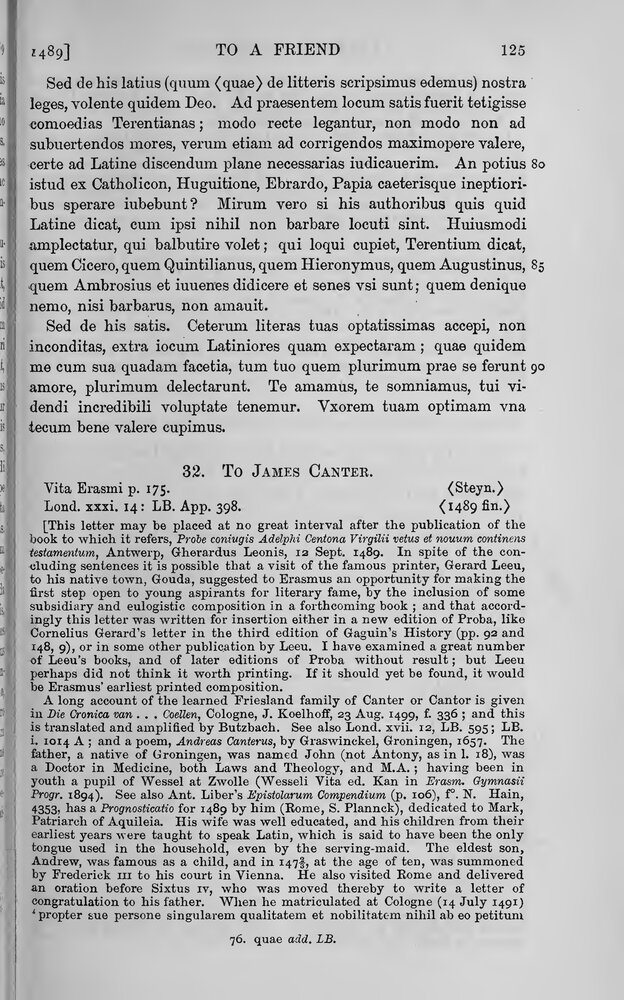
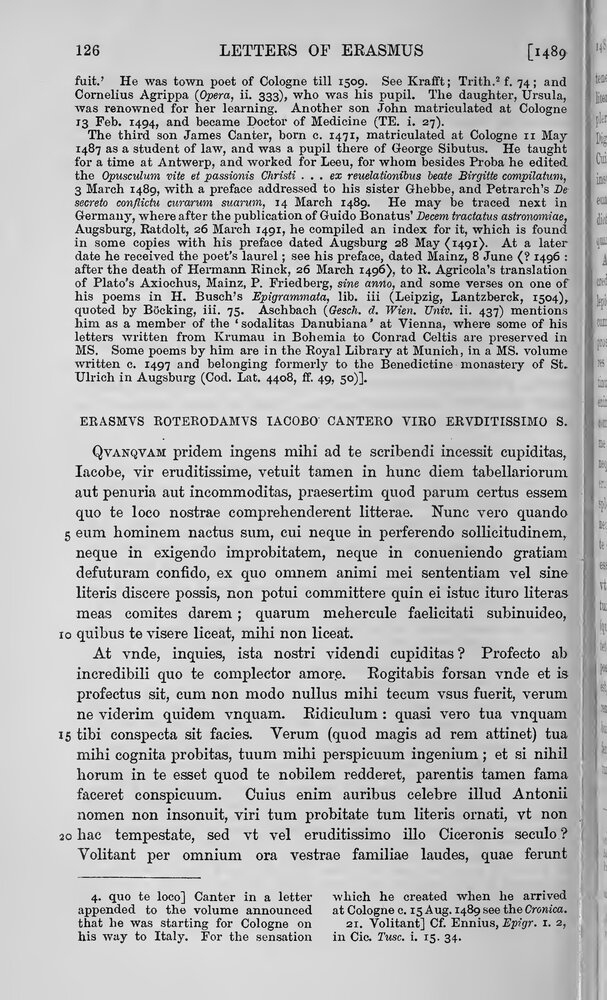
[This letter may be placed at no great interval after the publication of the book to which it refers, Probe coniugis Adelphi Centona Virgilii vetus et nouum continens testamentum, Antwerp, Gherardus Leonis, 12 Sept. 1489. In spite of the concluding sentences it is possible that a visit of the famous printer, Gerard Leeu, to his native town, Gouda, suggested to Erasmus an opportunity for making the first step open to young aspirants for literary fame, by the inclusion of some subsidiary and eulogistic composition in a forthcoming book; and that accordingly this letter was written for insertion either in a new edition of Proba, like Cornelius Gerard's letter in the third edition of Gaguin's History (pp. 92 and 148, 9), or in some other publication by Leeu. I have examined a great number of Leeu's books, and of later editions of Proba without result; but Leeu perhaps did not think it worth printing. If it should yet be found, it would be Erasmus' earliest printed composition. A long account of the learned Friesland family of Canter or Cantor is given in Die Cronica van . . . Coellen, Cologne, J. Koelhoff, 23 Aug. 1499, f. 336; and this is translated and amplified by Butzbach. See also Lond. xvii. 12, LB. 595; LB. i. 1014 A; and a poem, Andreas Canterus, by Graswinckel, Groningen, 1657. The father, a native of Groningen, was named John (not Antony, as in l. 18), was a Doctor in Medicine, both Laws and Theology, and M.A.%; having been in youth a pupil of Wessel at Zwolle (Wesseli Vita ed. Kan in Erasm. Gymnasii Progr. 1894). See also Ant. Liber's Epistolarum Compendium (p. 106), f°. N. Hain, 4353, has a Prognosticatio for 1489 by him (Rome, S. Plannck), dedicated to Mark, Patriarch of Aquileia. His wife was well educated, and his children from their earliest years were taught to speak Latin, which is said to have been the only tongue used in the household, even by the serving-maid. The eldest son, Andrew, was famous as a child, and in 147, at the age of ten, was summoned by Frederick III to his court in Vienna. He also visited Rome and delivered an oration before Sixtus IV, who was moved thereby to write a letter of congratulation to his father. When he matriculated at Cologne (14 July 1491) 'propter sue persone singularem qualitatem et nobilitatem nihil ab eo petitum 76. quae add. LB. He was town poet of Cologne till 1509. See Krafft; Trith.2 f. 74; and Cornelius Agrippa (Opera, ii. 333), who was his pupil. The daughter, Ursula, was renowned for her learning. Another son John matriculated at Cologne 13 Feb. 1494, and became Doctor of Medicine (TE. i. 27). The third son James Canter, born c. 1471, matriculated at Cologne 11 May 1487 as a student of law, and was a pupil there of George Sibutus. He taught for a time at Antwerp, and worked for Leeu, for whom besides Proba he edited the Opusculum vite et passionis Christi . . . ex reuelationibus beate Birgitte compilatum, 3 March 1489, with a preface addressed to his sister Ghebbe, and Petrarch's De secreto conflictu curarum suarum, 14 March 1489. He may be traced next in Germany, where after the publication of Guido Bonatus' Decem tractatus astronomiae, Augsburg, Ratdolt, 26 March 1491, he compiled an index for it, which is found in some copies with his preface dated Augsburg 28 May (1491). At a later date he received the poet's laurel; see his preface, dated Mainz, 8 June (? 1496 : after the death of Hermann Rinck, 26 March 1496), to R. Agricola's translation of Plato's Axiochus, Mainz, P. Friedberg, sine anno, and some verses on one of his poems in H. Busch's Epigrammata, lib. iii (Leipzig, Lantzberck, 1504), quoted by Böcking, iii. 75. Aschbach (Gesch. d. Wien. Univ. ii. 437) mentions him as a member of the 'sodalitas Danubiana' at Vienna, where some of his letters written from Krumau in Bohemia to Conrad Celtis are preserved in MS. Some poems by him are in the Royal Library at Munich, in a MS. volume written c. 1497 and belonging formerly to the Benedictine monastery of St. Ulrich in Augsburg (Cod. Lat. 4408, ff. 49, 50).]
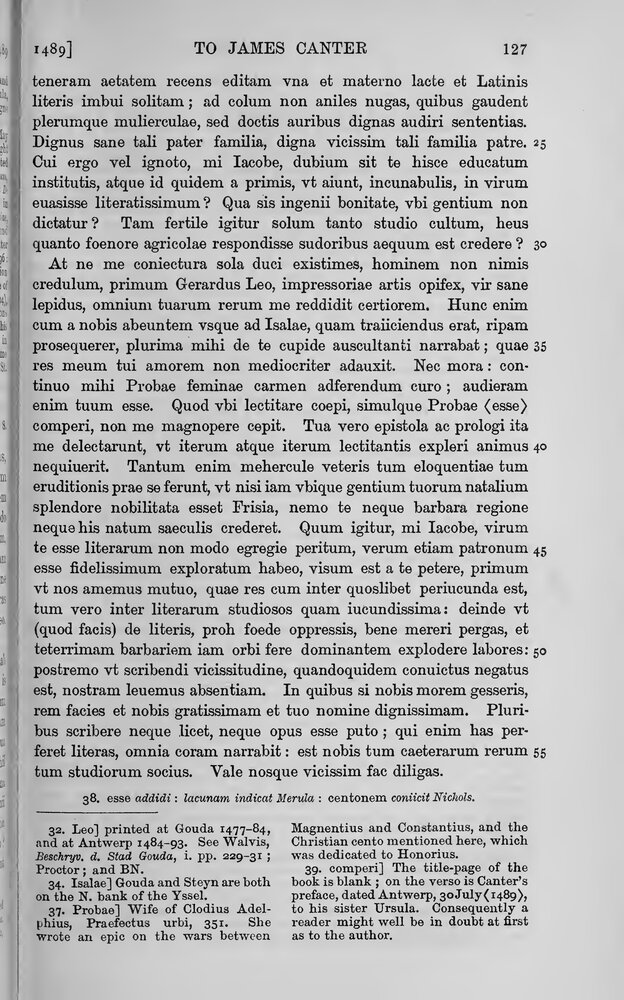
Erasmus writes to James Canter expressing his admiration and desire for friendship, despite never having met him personally. He praises Canter's family reputation, education, and literary work, particularly his preface to Proba's cento. Erasmus requests mutual affection, continued literary collaboration, and correspondence to bridge their physical distance.
Erasmus of Rotterdam to the learned James Canter, Greetings. Although a great desire to write to you arose in me some time ago, most learned James, until this day the scarcity or inconvenience of messengers has prevented it, especially because I was rather uncertain in what place a letter of mine might reach you. But now, since I have found a man in whom I trust there will be no lack of diligence in delivery, nor dishonesty in his dealings, nor goodwill in his approach—a man from whom you could learn the whole sentiment of my mind even without a letter—I could not fail to give him my letter as a companion for his journey there. By Hercules, I envy the good fortune of these pages, which are permitted to see you, while I am not. "But from where," you will say, "comes this desire to see me?" Truly, from the incredible love with which I embrace you. You may perhaps ask from where this, too, has arisen, since not only have I had no interaction with you, but I have never even seen you. Absurd! As if your own face has ever been beheld by yourself. But (what is more to the point) your integrity is known to me, your talent is clear to me; and even if there were none of these qualities in you to make you noble, the fame of your parent would still make you distinguished. For upon whose ears has that celebrated name of Antonius not resounded—a man adorned both with integrity and with learning, so that he would stand out not merely in this age, but even in that most learned age of Cicero? The praises of your family are on everyone's lips, which report that your tender age, newly brought forth, was accustomed to be imbued at once with mother's milk and with Latin literature; at the distaff, not with old wives' tales, in which little women generally delight, but with opinions worthy to be heard by learned ears. Truly a father worthy of such a family, and in turn a family worthy of such a father. To whom then, my James, even if a stranger, could it be doubtful that you, educated in these practices, and that indeed from the first, as they say, cradle, have developed into a most learned man? By what goodness of mind you possess, where in the world is it not spoken of? A soil so fertile, cultivated with such great effort—pray, with how great a yield is it just to believe the farmer's sweat has been repaid? But lest you think I am led by conjecture alone—being a man not overly credulous—first, Gerardus Leo, a craftsman of the printing art, a truly charming man, made me certain of all your affairs. For when I was accompanying him as he departed from us all the way to the bank of the IJssel, which he had to cross, he told me many things as I listened eagerly; this matter increased my love for you not a little. Without delay, I immediately arranged for the poem of Proba to be brought to me; for I had heard it was yours. When I began to read it, and at the same time I learned it was by Proba, it did not greatly capture me. But your epistle and prologue so delighted me that my mind, reading them again and again, could not be satisfied. For by Hercules, they display so much of both the ancient eloquence and erudition that, had not Frisia already been made famous everywhere by the splendor of your birth, no one would believe you were born either in a barbarous region or in this age. Therefore, since I have ascertained, my James, that you are a man not only exceptionally skilled in letters but also a most faithful patron of them, it seemed good to ask of you, first, that we love each other mutually—a thing which is most pleasant among any people, but truly most delightful among those devoted to letters; next, that you continue (as you do) to deserve well of letters, so shamefully oppressed, and labor to drive out the most foul barbarism which now holds sway over almost the whole world; lastly, that by an exchange of writing, since personal interaction is denied us, we may lighten our absence. In these things, if you will oblige us, you will do a thing most pleasing to us and most worthy of your name. It is not permitted for me to write more, nor do I think there is need; for the man who will deliver this letter will relate everything in person: he is a companion to me both in other matters and in studies. Farewell, and in return, see that you hold us dear.