
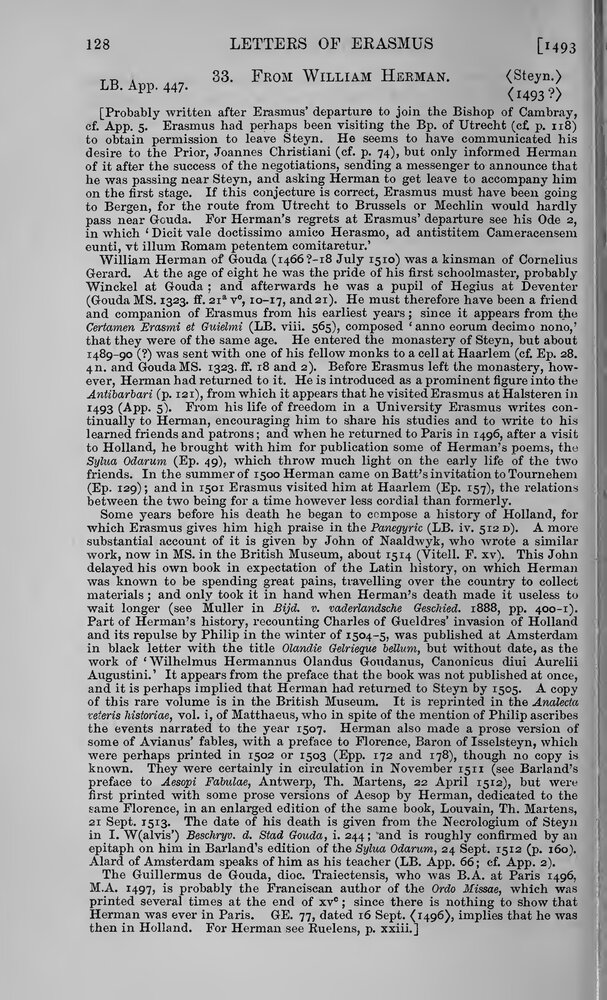
Probably written after Erasmus' departure to join the Bishop of Cambray, cf. App. 5. Erasmus had perhaps been visiting the Bp. of Utrecht (cf. p. 118) to obtain permission to leave Steyn. He seems to have communicated his desire to the Prior, Joannes Christiani (cf. p. 74), but only informed Herman of it after the success of the negotiations, sending a messenger to announce that he was passing near Steyn, and asking Herman to get leave to accompany him on the first stage. If this conjecture is correct, Erasmus must have been going to Bergen, for the route from Utrecht to Brussels or Mechlin would hardly pass near Gouda. For Herman's regrets at Erasmus' departure see his Ode 2, in which 'Dicit vale doctissimo amico Herasmo, ad antistitem Cameracensem eunti, vt illum Romam petentem comitaretur.' William Herman of Gouda (1466?-18 July 1510) was a kinsman of Cornelius Gerard. At the age of eight he was the pride of his first schoolmaster, probably Winckel at Gouda; and afterwards he was a pupil of Hegius at Deventer (Gouda MS. 1323. ff. 21ª v°, 10-17, and 21). He must therefore have been a friend and companion of Erasmus from his earliest years; since it appears from the Certamen Erasmi et Guielmi (LB. viii. 565), composed 'anno eorum decimo nono,' that they were of the same age. He entered the monastery of Steyn, but about 1489-90 (?) was sent with one of his fellow monks to a cell at Haarlem (cf. Ep. 28. 4n. and Gouda MS. 1323. ff. 18 and 2). Before Erasmus left the monastery, however, Herman had returned to it. He is introduced as a prominent figure into the Antibarbari (p. 121), from which it appears that he visited Erasmus at Halsteren in 1493 (App. 5). From his life of freedom in a University Erasmus writes continually to Herman, encouraging him to share his studies and to write to his learned friends and patrons; and when he returned to Paris in 1496, after a visit to Holland, he brought with him for publication some of Herman's poems, the Sylua Odarum (Ep. 49), which throw much light on the early life of the two friends. In the summer of 1500 Herman came on Batt's invitation to Tournehem (Ep. 129); and in 1501 Erasmus visited him at Haarlem (Ep. 157), the relations between the two being for a time however less cordial than formerly. Some years before his death he began to compose a history of Holland, for which Erasmus gives him high praise in the Panegyric (LB. iv. 512 D). A more substantial account of it is given by John of Naaldwyk, who wrote a similar work, now in MS. in the British Museum, about 1514 (Vitell. F. xv). This John delayed his own book in expectation of the Latin history, on which Herman was known to be spending great pains, travelling over the country to collect materials; and only took it in hand when Herman's death made it useless to wait longer (see Muller in Bijd. v. vaderlandsche Geschied. 1888, pp. 400-1). Part of Herman's history, recounting Charles of Gueldres' invasion of Holland and its repulse by Philip in the winter of 1504-5, was published at Amsterdam in black letter with the title Olandie Gelrieque bellum, but without date, as the work of 'Wilhelmus Hermannus Olandus Goudanus, Canonicus diui Aurelii Augustini.' It appears from the preface that the book was not published at once, and it is perhaps implied that Herman had returned to Steyn by 1505. A copy of this rare volume is in the British Museum. It is reprinted in the Analecta veteris historiae, vol. i, of Matthaeus, who in spite of the mention of Philip ascribes the events narrated to the year 1507. Herman also made a prose version of some of Avianus' fables, with a preface to Florence, Baron of Isselsteyn, which were perhaps printed in 1502 or 1503 (Epp. 172 and 178), though no copy is known. They were certainly in circulation in November 1511 (see Barland's preface to Aesopi Fabulae, Antwerp, Th. Martens, 22 April 1512), but were first printed with some prose versions of Aesop by Herman, dedicated to the same Florence, in an enlarged edition of the same book, Louvain, Th. Martens, 21 Sept. 1513. The date of his death is given from the Necrologium of Steyn in I. W(alvis') Beschryv. d. Stad Gouda, i. 244; and is roughly confirmed by an epitaph on him in Barland's edition of the Sylua Odarum, 24 Sept. 1512 (p. 160). Alard of Amsterdam speaks of him as his teacher (LB. App. 66; cf. App. 2). The Guillermus de Gouda, dioc. Traiectensis, who was B.A. at Paris 1496, M.A. 1497, is probably the Franciscan author of the Ordo Missae, which was printed several times at the end of xvc; since there is nothing to show that Herman was ever in Paris. GE. 77, dated 16 Sept. (1496), implies that he was then in Holland. For Herman see Ruelens, p. xxiii.
William Herman expresses regret that he could not accompany Erasmus on his journey and frustration that Erasmus did not consult him about his departure plans. He assures Erasmus that he is managing his affairs and discusses his own difficult circumstances at the monastery, finding solace in philosophy and literature while enduring what he describes as tyrannical conditions.
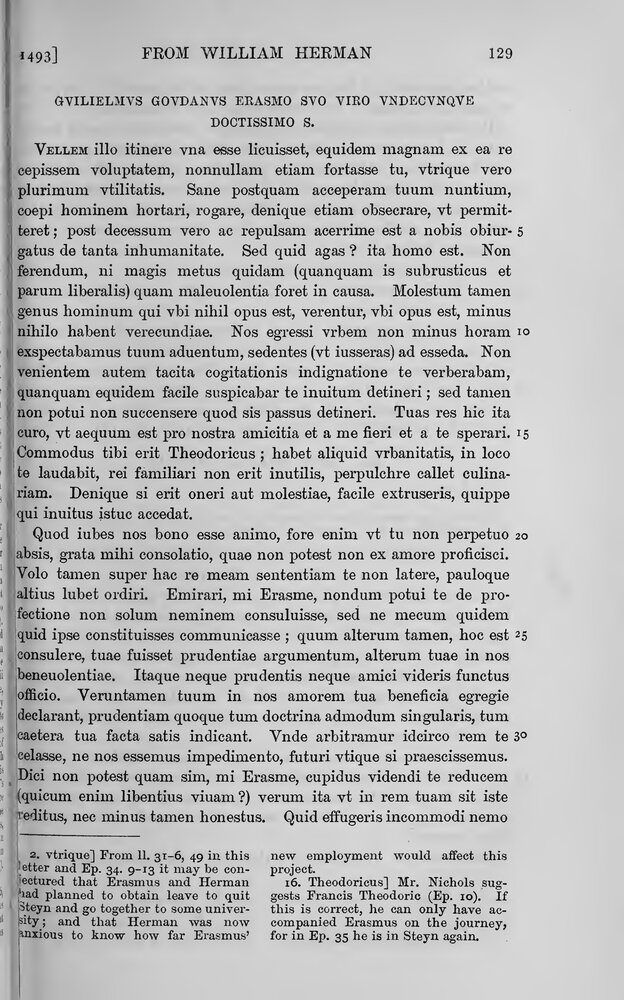
To Erasmus, his most learned friend in all things, William of Gouda sends greetings. I wish it had been possible for me to be with you on that journey—I would certainly have derived great pleasure from it, and perhaps you too some benefit, but certainly the greatest advantage would have been for us both. Indeed, after I received your message, I began to urge, then to ask, and finally even to beg the man to permit it; but after his departure and refusal, he was sharply reproached by us for such discourtesy. But what can you do? That's just how he is. It would be intolerable, were it not that a certain fear (though rather boorish and ungenerous) rather than ill-will was the cause. Yet it is a troublesome sort of person who fears where there is no need, and where there is need, has less than no modesty. We left the city and waited for your arrival for no less than an hour, sitting (as you had instructed) by the carriages. When you did not come, I berated you in silent, indignant thought, though I easily suspected you were being detained against your will; nevertheless, I could not help being angry that you allowed yourself to be detained. I am looking after your affairs here as is fitting for our friendship and as you may expect from me. Theodoricus will be convenient for you; he has some refinement, will praise you appropriately, will not be useless in household matters, and is splendidly skilled in cookery. Finally, if he becomes a burden or a nuisance, you can easily dismiss him, since he goes there reluctantly. That you bid me be of good cheer, for you will not be absent forever, is a welcome consolation to me, which cannot but spring from affection. Yet I wish my opinion on this matter not to be hidden from you, and it pleases me to begin a little more deeply. I have not yet been able to cease wondering, my dear Erasmus, that concerning your departure you not only consulted no one, but did not even share with me what you yourself had decided; although the one—that is, consulting—would have been a mark of your prudence, the other of your goodwill toward us. And so you seem to have fulfilled the duty of neither a prudent man nor a friend. Nevertheless, your love toward us is splendidly declared by your kindnesses, and your prudence likewise is sufficiently indicated both by your exceptionally singular learning and by your other actions. Whence I believe you concealed the matter for this reason: lest we be a hindrance, as we certainly would have been if we had known beforehand. It cannot be said how eager I am, my dear Erasmus, to see you returned (for with whom would I more gladly live?), but only if that return is to your advantage, and no less honorable. What disadvantage you have escaped no one knows better than I, who am even now tossed about in the very storms. Often (so help me) I congratulate you and judge you fortunate to have swum away. About my own affairs I have nothing to write. I am well, which I know for certain will be pleasing to you. I have resolved to do nothing obstinately, but to imitate the cunning and patience of Ulysses. Matters have reached such a point of fortune that this must be done if we wish to have regard for our safety; but listen, take care not to distress yourself on my account. Indeed, I have strengthened my spirit, I have grown so hardened that I can easily despise the powers of fortune; I think a wise man needs nothing. To the Muses' friend, sadness and fear I shall hand over (as Horace wills) to be carried By the wanton winds into the Cretan sea, although I am oppressed under a tyranny and must long be oppressed. I sustain myself with the examples of great men; I keep before my eyes the unworthy prison of that excellent man Socrates, the harsh servitude of that great man Plato. And so I live entirely for literature, and in this way, thanks to philosophy, not only am I free from trouble, but I can even laugh. But you there—how are you faring? Is all well? Is everything to your liking, does it go as you wish? Farewell.