
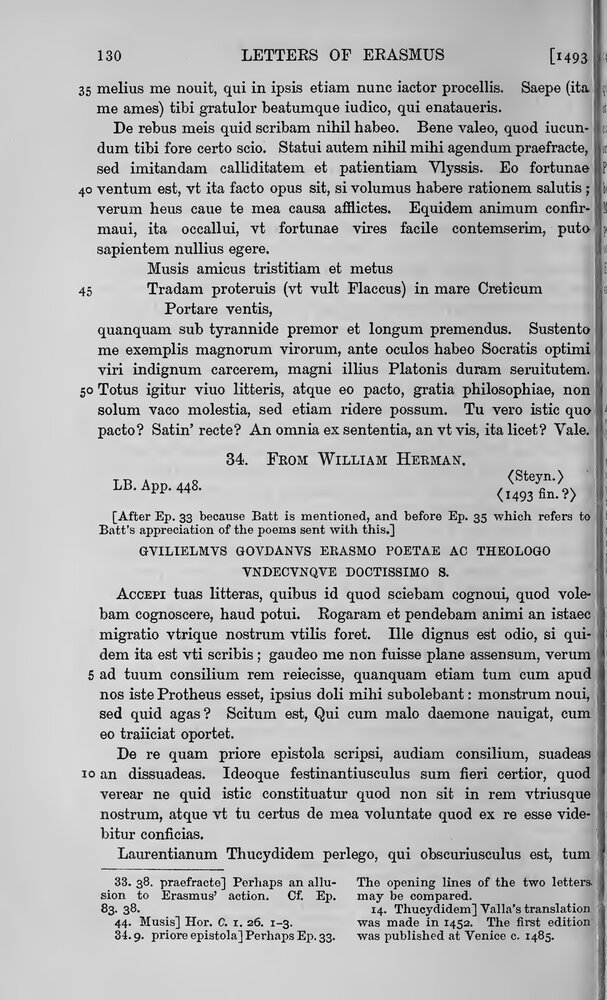
gvilielmvs govdanvs erasmo poetae ac theologo vndecvnqve doctissimo s.


34. from william herman

1493 fin. ?, Steyn


1
ACCEPI tuas litteras, quibus id quod sciebam cognoui, quod vole-
bam cognoscere, haud potui. Rogaram et pendebam animi an istaec
migratio vtrique nostrum vtilis foret. Ille dignus est odio, si qui-
dem ita est vti scribis; gaudeo me non fuisse plane assensum, verum
5
ad tuum consilium rem reiecisse, quanquam etiam tum cum apud
nos iste Protheus esset, ipsius doli mihi subolebant: monstrum noui,
sed quid agas? Scitum est, Qui cum malo daemone nauigat, cum
eo traiiciat oportet.
De re quam priore epistola scripsi, audiam consilium, suadeas
10
an dissuadeas. Ideoque festinantiusculus sum fieri certior, quod
verear ne quid istic constituatur quod non sit in rem vtriusque
nostrum, atque vt tu certus de mea voluntate quod ex re esse vide-
bitur conficias.
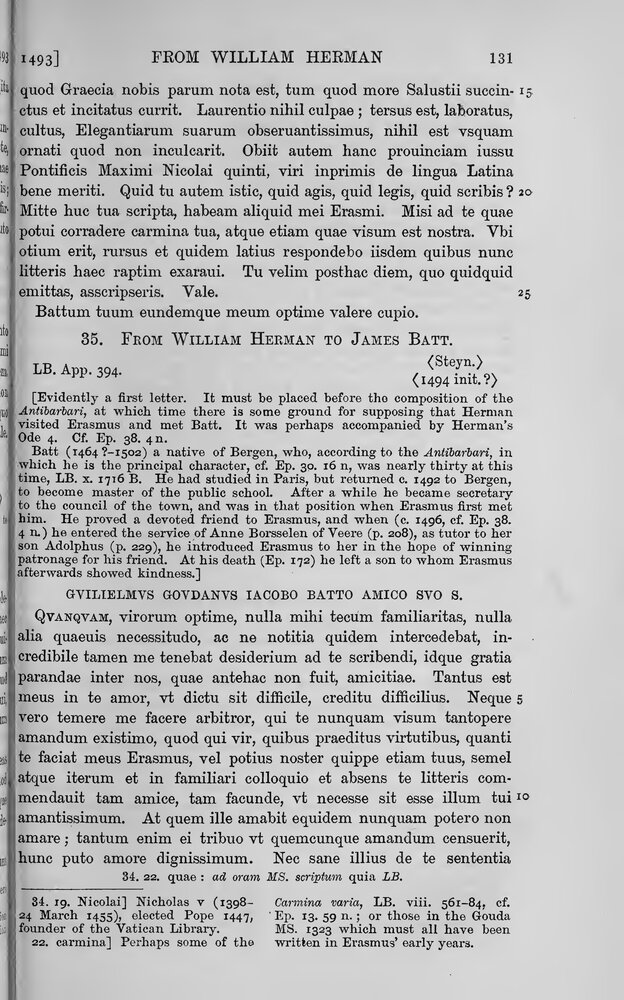
Laurentianum Thucydidem perlego, qui obscuriusculus est, tum
15
ita quod Graecia nobis parum nota est, tum quod more Salustii succin-
ctus et incitatus currit. Laurentio nihil culpae; tersus est, laboratus,
cultus, Elegantiarum suarum obseruantissimus, nihil est vsquam
te, ornati quod non inculcarit. Obiit autem hanc prouinciam iussu
mae Pontificis Maximi Nicolai quinti, viri inprimis de lingua Latina
20
bene meriti. Quid tu autem istic, quid agis, quid legis, quid scribis?
Mitte huc tua scripta, habeam aliquid mei Erasmi. Misi ad te quae
potui corradere carmina tua, atque etiam quae visum est nostra. Vbi
otium erit, rursus et quidem latius respondebo iisdem quibus nunc
litteris haec raptim exaraui. Tu velim posthac diem, quo quidquid
25
emittas, asscripseris. Vale.
Battum tuum eundemque meum optime valere cupio.


Associated Sources

2.
'Opus Epistolarum Des. Erasmi Roterodami', ed. P. S. Allen, 11 vols (Oxford: Clarendon Press, 1906), vol. 1, epistle 34.
3.
'The correspondence of Erasmus: letters 1 to 141, 1484 to 1500', tr. R. A. B. Mynors and D. F. S. Thomson, annot. Wallace K. Ferguson, 'Collected Works of Erasmus', ed. A. Dalzell, et al. (Toronto: University of Toronto Press, 1974), vol. 1, epistle 34.
4.
'La Correspondance d'Erasme. Traduite et annotée d'après l'Opus epistolarum de P. S. Allen, H. M. Allen et H. W. Garrod', ed. Alois Gerlo, et al., 12 vols (Brussels: University Press, 1967), vol. 1: 1484–1514, epistle 34.
5.
'De correspondentie van Desiderius Erasmus: Brieven 1–141', tr. M. J. Steens (Rotterdam: Donker, 2004), vol. 1, epistle 34.
Text has not been meticulously cleaned. You will find splits and errors, especially in Greek text. Refer to the originals or other sources for exact wording. Translation is done by AI, so do not regard it as authoritative! See About for more.

Commentary

Percy Stafford Allen

[After Ep. 33 because Batt is mentioned, and before Ep. 35 which refers to Batt's appreciation of the poems sent with this.]

M.J. Steens

Link to commentary

AI Summary

William Herman responds to Erasmus' letter about a potential migration, expressing concerns about the character of someone involved and seeking Erasmus' advice on a matter mentioned in a previous letter. He discusses his reading of Laurentius Valla's translation of Thucydides and requests Erasmus to send his writings. Herman also mentions sending poems to Erasmus and asks for future correspondence to include dates.

Translations

AI Deepseek

William of Gouda to Erasmus, Poet and Theologian, Most Learned in All Respects, Greetings. I have received your letter, through which I have learned what I already knew, but could not learn what I desired. I had asked and was anxiously wondering whether that migration would be beneficial for both of us. That man deserves hatred, if indeed he is as you describe; I am glad that I did not give full agreement, but referred the matter back to your judgment, although even when that Proteus was with us, his deceptions were beginning to smell suspicious to me: I know the monster, but what can you do? It is a clever saying: "He who sails with an evil demon must cross over with him." Concerning the matter I wrote about in my previous letter, I shall await your advice, whether you recommend it or advise against it. And so I am somewhat hastily seeking to be more certain, because I fear that something may be decided there which would not be to the advantage of either of us, and so that you may be certain of my willingness to carry out whatever seems advantageous. I am reading through the Laurentian Thucydides, who is rather obscure, partly because Greece is little known to us, and partly because he runs along in a concise and hurried manner like Sallust. There is no fault with Laurentius; he is polished, labored-over, refined, most observant of his own elegances—there is no ornament anywhere that he has not studiously inserted. Moreover, he undertook this task by order of the Supreme Pontiff Nicholas V, a man especially well-deserving of the Latin language. But what about you there—what are you doing, what are you reading, what are you writing? Send your writings here, that I may have something of my Erasmus. I sent you what poems of yours I could gather together, and also some of my own that seemed appropriate. When I have leisure, I will reply again, and indeed more fully, to these same matters which I have now hastily scribbled in this letter. I would like you henceforth to add the date on whatever you send out. Farewell. I hope your Battus—who is also mine—is very well.

M.J. Steens