
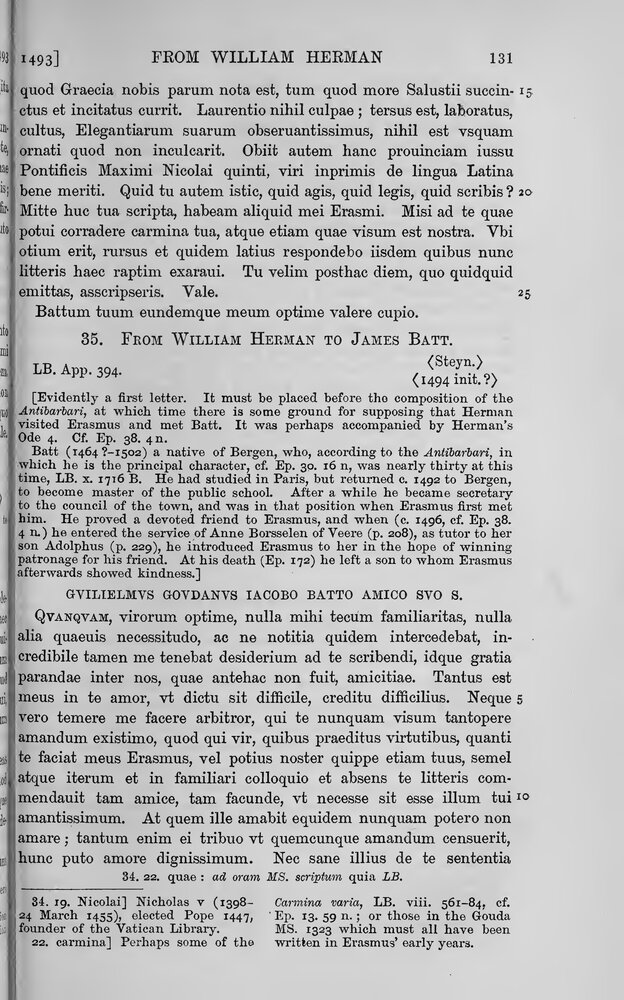
Evidently a first letter. It must be placed before the composition of the Antibarbari, at which time there is some ground for supposing that Herman visited Erasmus and met Batt. It was perhaps accompanied by Herman's Ode 4. Cf. Ep. 38. 4n. Batt (1464?-1502) a native of Bergen, who, according to the Antibarbari, in which he is the principal character, cf. Ep. 30. 16 n, was nearly thirty at this time, LB. x. 1716 B. He had studied in Paris, but returned c. 1492 to Bergen, to become master of the public school. After a while he became secretary to the council of the town, and was in that position when Erasmus first met him. He proved a devoted friend to Erasmus, and when (c. 1496, cf. Ep. 38. 4 n.) he entered the service of Anne Borsselen of Veere (p. 208), as tutor to her son Adolphus (p. 229), he introduced Erasmus to her in the hope of winning patronage for his friend. At his death (Ep. 172) he left a son to whom Erasmus afterwards showed kindness.
William Herman writes to James Batt expressing his deep admiration and desire to establish a friendship, inspired by Erasmus's high praise of Batt. He laments the decline of liberal arts and learning in their time, criticizing those who pursue wealth, power, and pleasure instead of knowledge. Herman praises Batt's eloquence, learning, and character, hoping their correspondence will foster a lasting friendship.
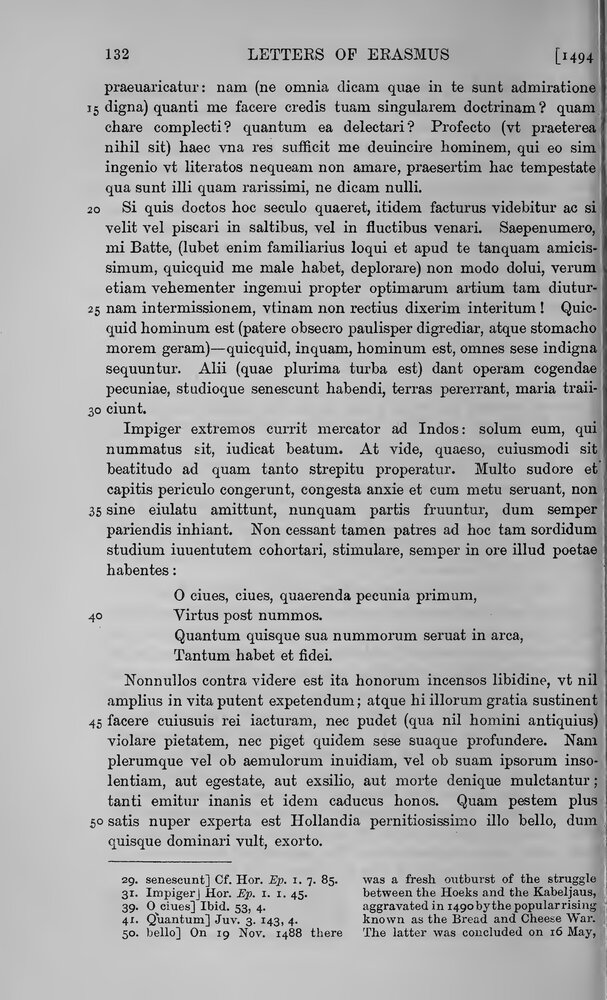
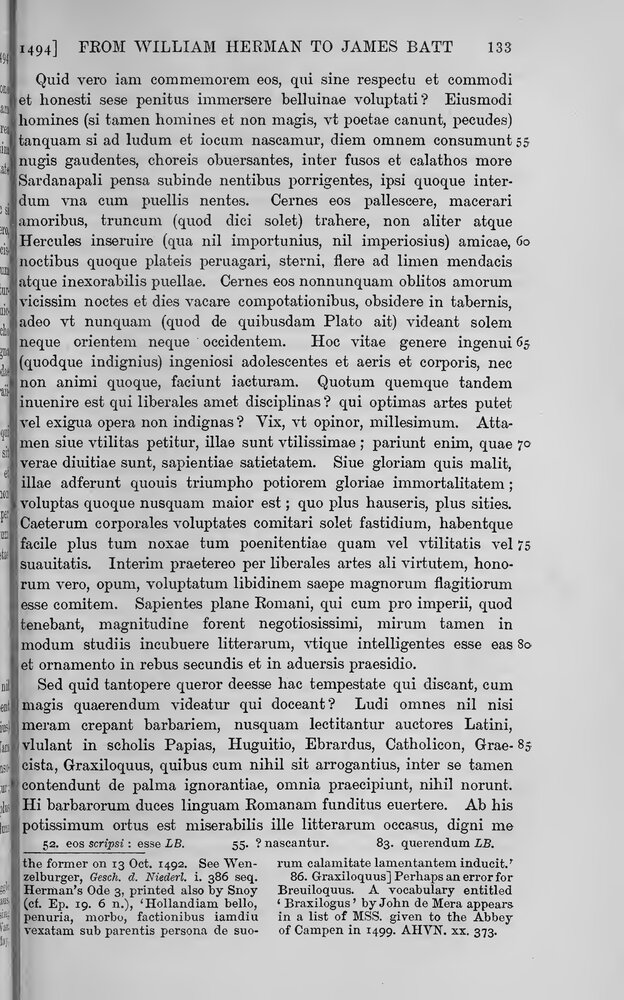
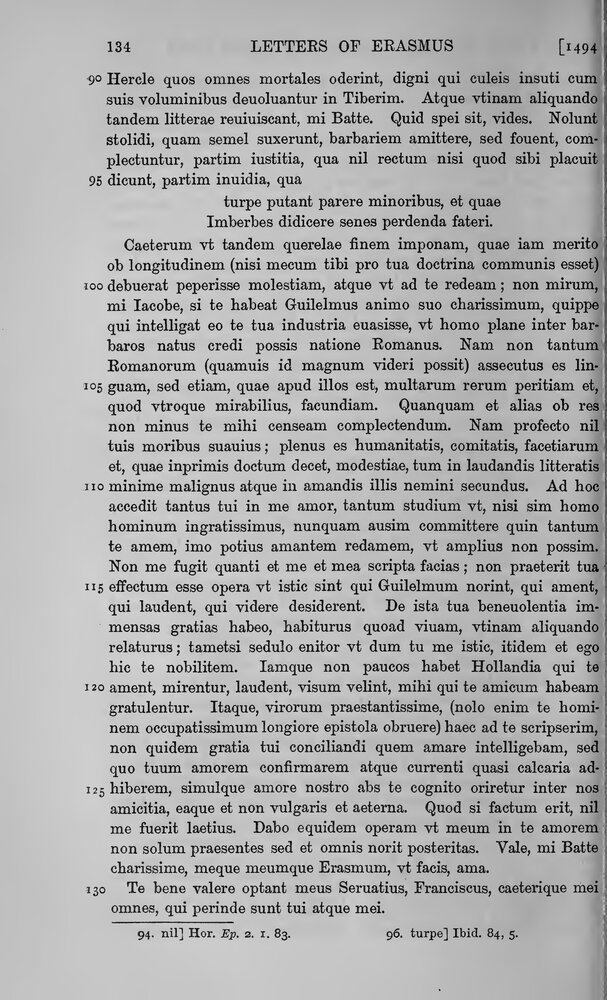
WILLIAM OF GOUDA TO HIS FRIEND JAMES BATT, GREETINGS. Although, most excellent of men, there existed between us no intimacy, no other bond of any kind, nor even acquaintance, yet an incredible longing possessed me to write to you, and that for the sake of securing between us a friendship which has not existed before. So great is my love for you that it is difficult to describe, and more difficult to believe. Nor indeed do I think I act rashly in esteeming you, though never seen, so greatly to be loved, because my Erasmus—or rather ours, for indeed he is yours too—has once and again, both in private conversation and by letter in his absence, recommended you so affectionately, so eloquently, that he must necessarily be most fond of you. But whomever he loves, I certainly shall never be able not to love; for I yield so much to his judgment that I consider whomever he deems worthy of love to be most deserving of affection. Nor indeed does his opinion of you prove false: for (to omit all the qualities in you worthy of admiration) how highly do you think I value your singular learning? How dearly do I embrace it? How greatly do I delight in it? Truly (to say nothing else) this one thing is enough to bind me completely, a man of such a nature that I cannot help but love the learned, especially in this age when they are as rare as can be, not to say non-existent. If anyone should seek learned men in this century, he would seem likely to do just as if he wished to fish in the woods or to hunt in the waves. Very often, my Batt (for it pleases me to speak more familiarly and to lament before you, as a most trusted friend, whatever troubles me) I have not only grieved, but even groaned vehemently on account of the so long interruption—would that I might not more rightly call it the destruction!—of the best arts. Whatever the character of men is (allow me, I beg you, to digress a little and indulge my indignation)—whatever, I say, the character of men is, they all pursue unworthy things. Some (which is the largest crowd) devote their energy to amassing money and grow old in the zeal for possessing; they wander over lands, they cross seas. "The busy merchant runs to the farthest Indies": he judges only him who has money to be blessed. But see, I ask you, of what sort is the blessedness toward which there is such noisy haste? With much sweat and danger to their lives they heap it up, they anxiously and fearfully guard what is heaped, they lose it not without wailing, they never enjoy what they have gained, while they always gape after gaining more. Yet fathers do not cease to urge on, to spur, the youth to this so sordid pursuit, always having on their lips that saying of the poet: "O citizens, citizens, money must be sought first, virtue after cash." "How much money each man keeps in his chest, so much credit does he have." On the other hand, some are to be seen so inflamed with a lust for honors that they think nothing more should be sought in life; and for the sake of these they endure making a loss of anything, nor are they ashamed (than which nothing is more important for a man) to violate piety, nor indeed do they hesitate to squander themselves and their possessions. For very often, either because of the envy of rivals or because of their own insolence, they are punished by poverty, or exile, or finally by death; so dearly is empty and likewise fleeting honor bought. Of this plague Holland has experienced more than enough recently through that most pernicious war, while everyone wanted to rule, which broke out. But why should I now recount those who, without regard for both advantage and honor, have plunged themselves utterly into brutish pleasure? Men of this sort (if indeed they are men and not rather, as the poets sing, cattle) as if we were born for play and jest, spend the whole day rejoicing in trifles, frequenting dances, handing over the tasks of Sardanapalus from time to time to women spinning, sometimes even spinning themselves along with the girls. You will see them grow pale, waste away with loves, dragging a "trunk" (as the saying goes), no differently than Hercules slaving for his mistress (than whom nothing is more troublesome, nothing more imperious), wandering also through the streets at night, prostrating themselves, weeping at the threshold of a false and inexorable girl. You will see them, sometimes forgetting their loves, in turn spending nights and days in drinking parties, sitting in taverns, so that they never (as Plato says of certain men) see the sun either rising or setting. By this manner of life, well-born (and what is more unworthy) and talented young men make a loss of both money and body, and also of mind. How few, pray, is it possible to find who love the liberal disciplines? Who think the best arts worthy of even a little effort? Scarcely, I think, one in a thousand. And yet if utility is sought, they are the most useful; for they produce a fullness of wisdom, which is true riches. If one prefers glory, they bring an immortality of glory preferable to any triumph; pleasure also is nowhere greater; the more you have drunk, the more you will thirst. But bodily pleasures are usually accompanied by disgust, and they easily have more both of harm and of regret than either of utility or sweetness. Meanwhile I pass over the fact that through the liberal arts virtue is nourished, while the lust for honors, riches, and pleasures is often the companion of great crimes. Clearly the Romans were wise, who, although they were most busy because of the greatness of the empire they held, nevertheless applied themselves to literary studies in a wonderful way, certainly understanding that they are both an ornament in prosperous circumstances and a protection in adverse ones. But why do I complain so greatly that in this age there are none who learn, when it seems one should rather ask if there are any who teach? All the schools resound with nothing but sheer barbarism, Latin authors are read nowhere, in the schools they howl with Papias, Huguito, Eberhard, Catholicon, Graecista, Graxiloquus; than whom nothing is more arrogant, yet they contend among themselves for the prize of ignorance, they teach everything, they know nothing. These leaders of the barbarians utterly overthrow the Roman language. From these especially arose that miserable decline of letters, worthy, by Hercules, to be hated by all mortals, worthy to be sewn up in sacks with their volumes and hurled into the Tiber. And would that at last someday letters might revive, my Batt. You see what hope there is. The stupid refuse to let go of the barbarism they once sucked in, but they cherish it, embrace it, partly from a sense of justice—they say nothing is right except what pleased them—partly from envy—they think it shameful to obey their juniors, and "to confess that what beardless boys learned, old men must unlearn." But to put an end at last to my complaint, which by now, due to its length (unless it were shared with you on my account, thanks to your learning), ought to have produced annoyance, and to return to you; it is no wonder, my James, if William holds you most dear in his heart, since he understands that you have by your industry so far advanced that you, a man clearly born among barbarians, could be believed to be Roman by nation. For you have attained not only the language of the Romans (although that might seem a great thing), but also the expertise in many things which exists among them, and, more wonderful than both, eloquence. Although also for other reasons I would judge you no less to be embraced by me. For truly nothing is more agreeable than your character; you are full of humanity, courtesy, wit and, which especially becomes a learned man, modesty, then in praising the learned you are by no means spiteful and in loving them you are second to none. To this is added so great a love of you for me, so much zeal, that, unless I am the most ungrateful of men, I would never dare to fail to love you so much, or rather to love you back as you love, so that I could not love more. It does not escape me how highly you value both me and my writings; it has not passed by unnoticed that it has been effected by your effort that there are those in your parts who know William, who love him, who praise him, who desire to see him. For that goodwill of yours I have immense thanks, and will have as long as I live, would that I might someday repay them; although I diligently strive that while you make me famous there, I likewise make you famous here. And now Holland has not a few who love you, admire you, praise you, wish to see you, congratulate me that I have you as a friend. And so, most outstanding of men (for I do not wish to overwhelm you, a most busy man, with a longer letter), I would have written this to you, not indeed for the sake of winning you over, whom I understood to be loved, but that I might confirm your love and apply, as it were, spurs to one running, and at the same time, our love having been recognized by you, a friendship might arise between us, and that both not ordinary and eternal. If this shall have been done, nothing will have made me happier. I shall indeed take care that not only those present but all posterity may know my love for you. Farewell, my dearest Batt, and love me and my Erasmus, as you do. My Servatius, Francis, and all my other friends, who are as much yours as mine, wish you well.