

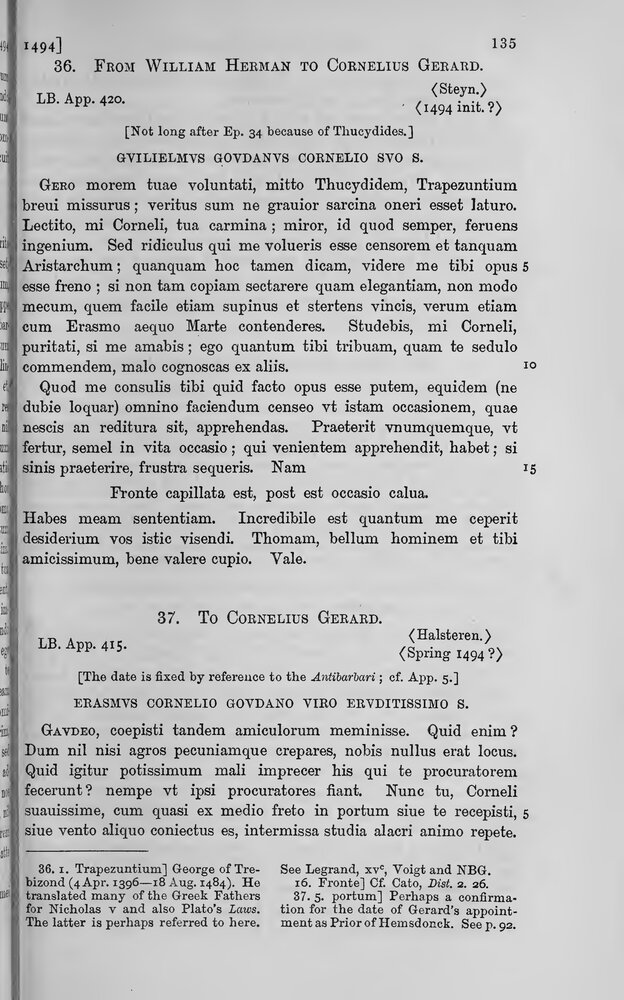
William Herman sends Cornelius Gerard a copy of Thucydides and promises to send Trapezuntium soon, while praising Gerard's poetic talent and urging him to focus on elegance over copiousness. He advises Gerard to seize a current opportunity that may not return, and expresses strong desire to visit Gerard and sends regards to their mutual friend Thomas.
WILLIAM OF GHENT TO HIS FRIEND CORNELIUS, GREETINGS. I humor your wish and send you Thucydides, being about to send Trapezuntius shortly; I feared a heavier bundle would be too burdensome for the carrier. Read over your poems, my Cornelius; I marvel, as I always do, at your fervent genius. But you are ridiculous for wanting me to be a critic and, as it were, an Aristarchus; although this much I will say: I see that you need to apply a bridle; if you pursued elegance no less than abundance, you would contend not only with me—whom you easily surpass even when I am lying on my back and snoring—but even with Erasmus on equal terms. You will strive for purity, my Cornelius, if you love me; how much I esteem you, how diligently I recommend you, I prefer you learn from others. As for what you ask me—what I think you ought to do—indeed (to speak without ambiguity) I judge that you should by all means seize this opportunity, which you do not know if it will return. As the saying goes, opportunity passes each person once in life; he who seizes it when it comes, has it; if you let it pass by, you pursue it in vain. For *Chance has a head of hair in front, behind she's bald.* You have my opinion. It is incredible how much a desire to see you there has seized me. I hope Thomas, a fine fellow and most friendly to you, is well. Farewell.