

[The date is fixed by reference to the Antibarbari; cf. App. 5.]
Erasmus expresses joy that Cornelius Gerard has remembered his friends and encourages him to resume his interrupted studies with renewed vigor. He mentions his own work in progress, a two-part book defending literature against barbarians and praising learned friends, and requests Gerard's assistance in gathering material that either criticizes or praises literary studies.
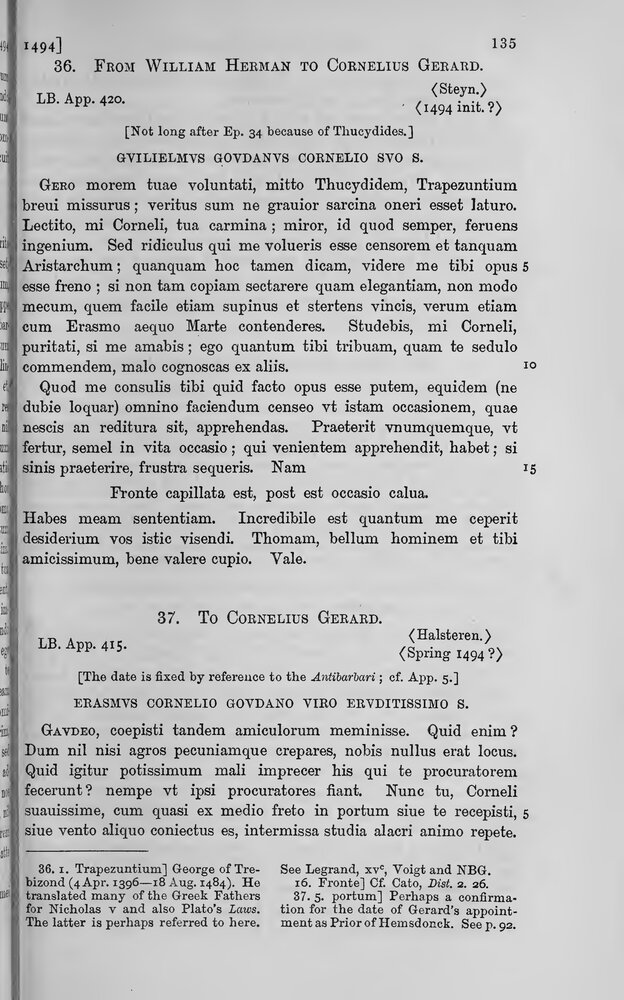
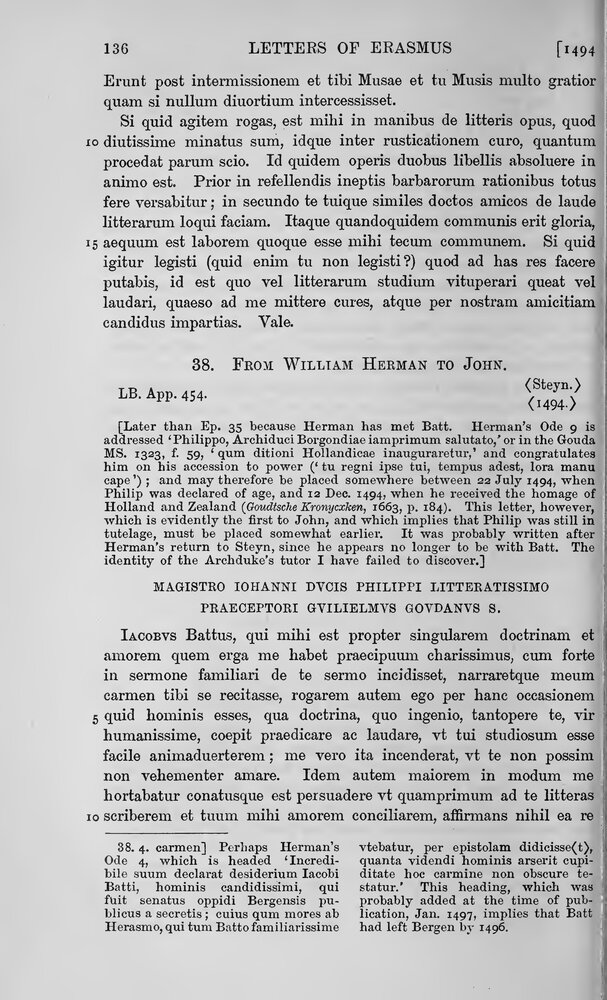
Erasmus to the Most Learned Man Cornelius Goudanus, Greetings. I rejoice that you have at last begun to remember your friends. For what else? But while you did nothing but chatter about fields and money, there was no place for us. What evil, then, shall I chiefly call down upon those who have made you a manager? Namely, that they themselves may become managers. Now, my dearest Cornelius, since you have either withdrawn yourself, as if from the open sea into a harbor, or have been driven by some wind, take up again your interrupted studies with an eager spirit. After this interruption, the Muses will be much more pleasing to you, and you to the Muses, than if no divorce had come between you. You ask what I am doing. I have in hand a work on literature, which I have threatened for a very long time, and I am attending to it during my rural retreat; how far it progresses, I know little. It is my intention to complete this work in two little books. The first will be almost entirely occupied with refuting the foolish arguments of the barbarians; in the second, I shall make you and learned friends like you speak in praise of literature. And so, since the glory will be common, it is right that the labor should also be common to you and me. If, therefore, you have read anything (for what have you not read?) which you think pertains to these matters—that is, by which the pursuit of literature can either be censured or praised—I ask that you take care to send it to me, and by our friendship, share it with me freely. Farewell.