
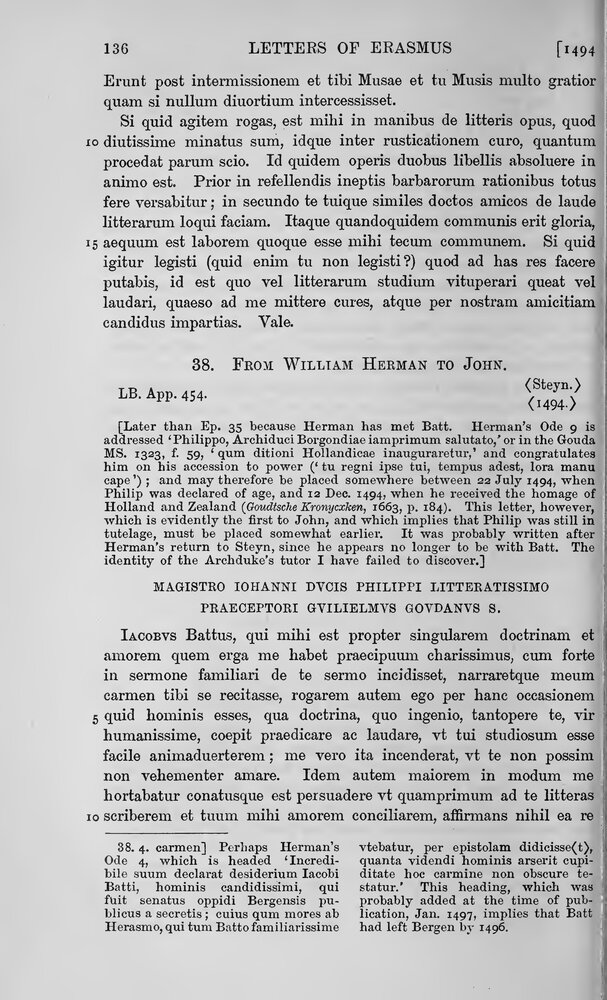
[Later than Ep. 35 because Herman has met Batt. Herman's Ode 9 is addressed 'Philippo, Archiduci Borgondiae iamprimum salutato,' or in the Gouda MS. 1323, f. 59, 'qum ditioni Hollandicae inauguraretur,' and congratulates him on his accession to power ('tu regni ipse tui, tempus adest, lora manu cape'); and may therefore be placed somewhere between 22 July 1494, when Philip was declared of age, and 12 Dec. 1494, when he received the homage of Holland and Zealand (Goudtsche Kronycxken, 1663, p. 184). This letter, however, which is evidently the first to John, and which implies that Philip was still in tutelage, must be placed somewhat earlier. It was probably written after Herman's return to Steyn, since he appears no longer to be with Batt. The identity of the Archduke's tutor I have failed to discover.]
William Herman writes to John, tutor to Archduke Philip, expressing his admiration and desire for friendship after hearing about John from their mutual friend Jacob Batt. He congratulates John on his role as tutor and offers advice on classical education for the young prince, recommending authors like Terence, Livy, and Cicero. Herman also mentions his friendship with Erasmus and requests that John maintain correspondence with him.
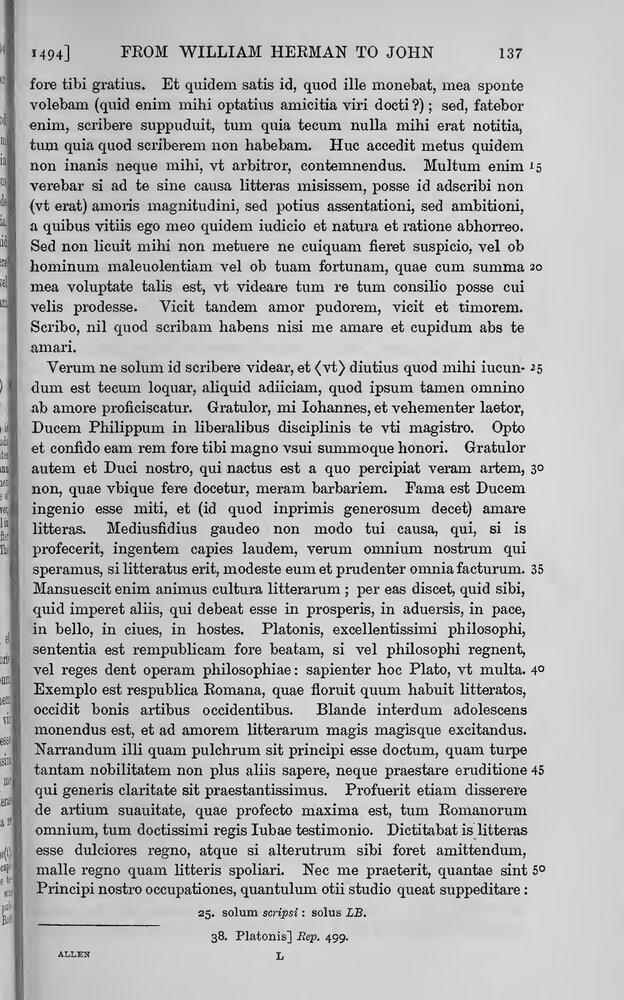
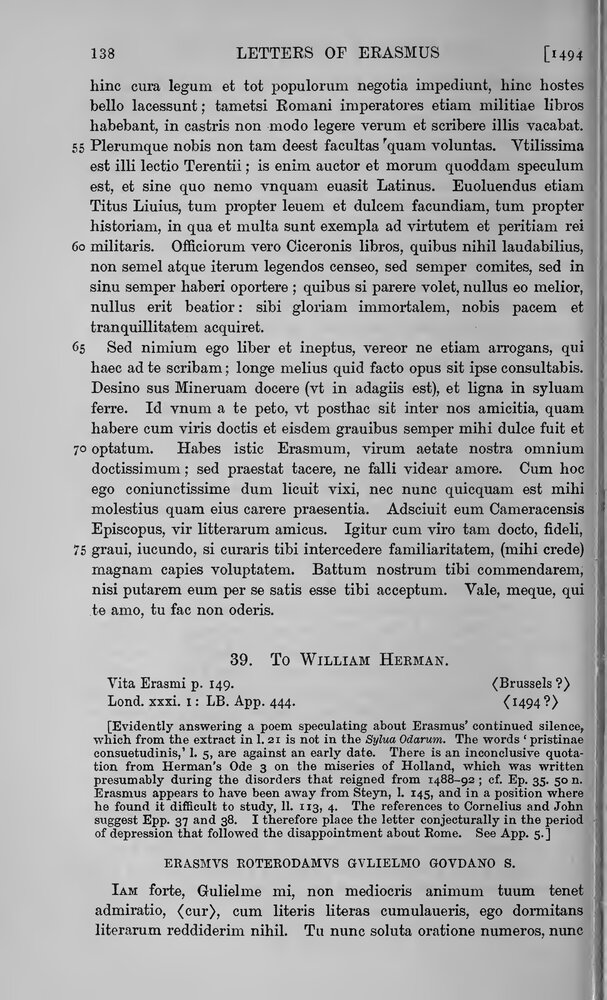
TO MASTER JOHANNES, MOST LEARNED TUTOR OF DUKE PHILIP WILLEM OF GOUDA SENDS GREETINGS When by chance in familiar conversation our talk fell upon you, and Jacobus Battus—who is especially dear to me because of his singular learning and the exceptional affection he bears toward me—related that he had recited my poem to you, and I took the opportunity to ask what sort of man you were, of what learning, what character, he began to praise and commend you so greatly, most humane sir, that I easily perceived he was devoted to you; indeed he so inflamed me that I cannot but love you vehemently. Furthermore, he strongly urged me and tried to persuade me to write to you as soon as possible and secure your affection for me, declaring nothing would be more pleasing to you. And indeed I was quite willing of my own accord to do what he advised (for what is more desirable to me than the friendship of a learned man?); but, I confess, I felt too ashamed to write, both because I had no acquaintance with you, and because I had nothing to write about. To this was added a fear—not groundless, I think, nor to be disregarded by me. For I greatly feared that if I had sent a letter to you without cause, it could be attributed not (as was the case) to the greatness of my affection, but rather to flattery or ambition, vices from which I believe I recoil by both nature and reason. But I could not help fearing lest suspicion arise in anyone, either from the ill-will of men or on account of your fortune, which to my great delight is such that you seem able to benefit whomever you wish both by your resources and your counsel. Love finally conquered shame; it also conquered fear. I write, having nothing to write except that I love you and am eager to be loved by you in return. But lest I seem to write only that, and to speak with you longer—which is pleasant to me—I shall add something, though this too springs entirely from affection. I congratulate you, my dear Johannes, and rejoice greatly, that Duke Philip employs you as his teacher in the liberal disciplines. I hope and trust this will be of great use and the highest honor to you. I also congratulate our Duke, who has found in you a source from which he may acquire true art, not the mere barbarism that is taught almost everywhere. Report says the Duke is of a gentle disposition and (a quality especially fitting for nobility) loves literature. By Hercules, I rejoice not only for your sake—for if he makes progress, you will gain immense praise—but for the sake of all of us who hope that, if he becomes learned, he will act in all things with moderation and prudence. For the spirit is softened by the cultivation of letters; through them he will learn what is due to himself, what he may command of others, how he ought to behave in prosperity, in adversity, in peace, in war, toward citizens, toward enemies. It is the opinion of Plato, that most excellent philosopher, that the state will be blessed if either philosophers rule or rulers devote themselves to philosophy: wisely said Plato, as in many things. The Roman republic is an example, which flourished when it had learned men, and declined as the good arts perished. The young man must sometimes be gently admonished and increasingly stimulated to the love of literature. He should be told how beautiful it is for a prince to be learned, how disgraceful for such nobility not to be wiser than others, nor to excel in erudition when he is most outstanding in the distinction of his lineage. It will also be useful to discourse on the charm of the arts, which is certainly very great, as testified by all the Romans and by that most learned King Juba. He used to say that letters were sweeter than kingship, and if he had to lose one of the two, he would prefer to be deprived of his kingdom rather than his letters. Nor do I overlook how great are the occupations of our Prince, how little leisure he can supply for study: on one side the care of laws and the business of so many peoples hinder him, on the other enemies provoke him with war; although even the Roman commanders had books on campaign, in camp they had time not only to read but even to write. Very often it is not so much ability we lack as will. The reading of Terence is most useful for him; for that author is a kind of mirror of morals, and without him no one has ever become proficient in Latin. Titus Livy should also be unrolled, both for his smooth and pleasing eloquence and for his history, in which there are many examples for virtue and skill in military affairs. Indeed, I judge that Cicero's books *On Duties*, than which nothing is more praiseworthy, should be read not once and again, but should always be companions, should always be kept in the bosom; if he wishes to obey them, none will be better, none will be more blessed than he: he will acquire immortal glory for himself, peace and tranquility for us. But I am too free and foolish, I fear even arrogant, to write these things to you; you yourself will consider far better what needs to be done. I cease teaching Minerva (as the adage goes), and carrying wood to the forest. This one thing I ask of you, that henceforth there may be friendship between us, which to have with learned and likewise serious men has always been sweet and desired by me. You have there Erasmus, the most learned man of all in our age; but it is better to be silent, lest I seem misled by affection. With him I lived in the closest intimacy while it was possible, nor is there anything more troublesome to me now than to lack his presence. The Bishop of Cambrai has taken him into his household, a man friendly to letters. Therefore, if you take care to secure familiarity with such a learned, faithful, serious, and pleasant man, (believe me) you will take great pleasure in it. I would commend our Battus to you, did I not think he is sufficiently acceptable to you on his own merit. Farewell, and do not you, whom I love, dislike me.