

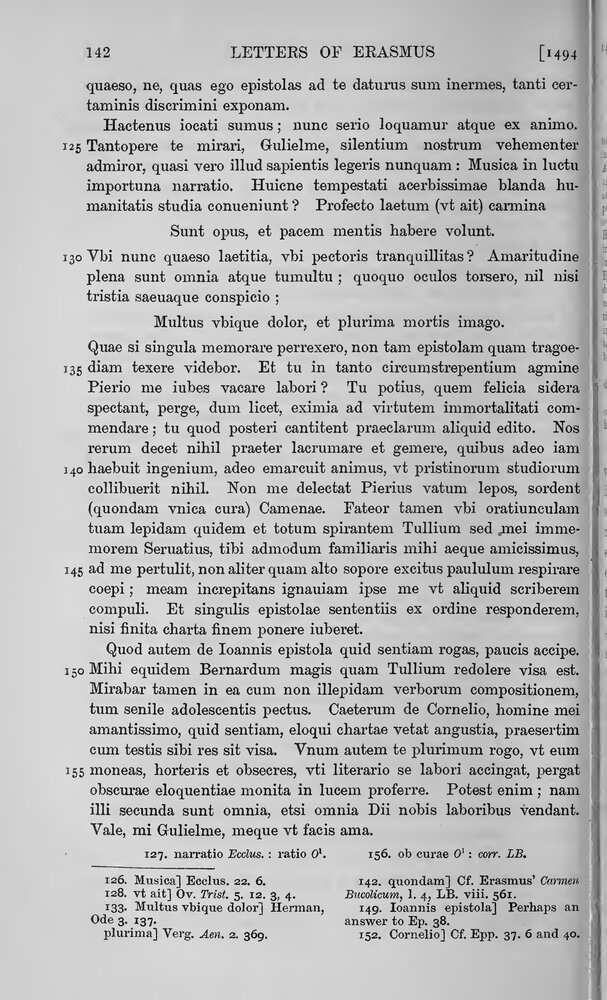
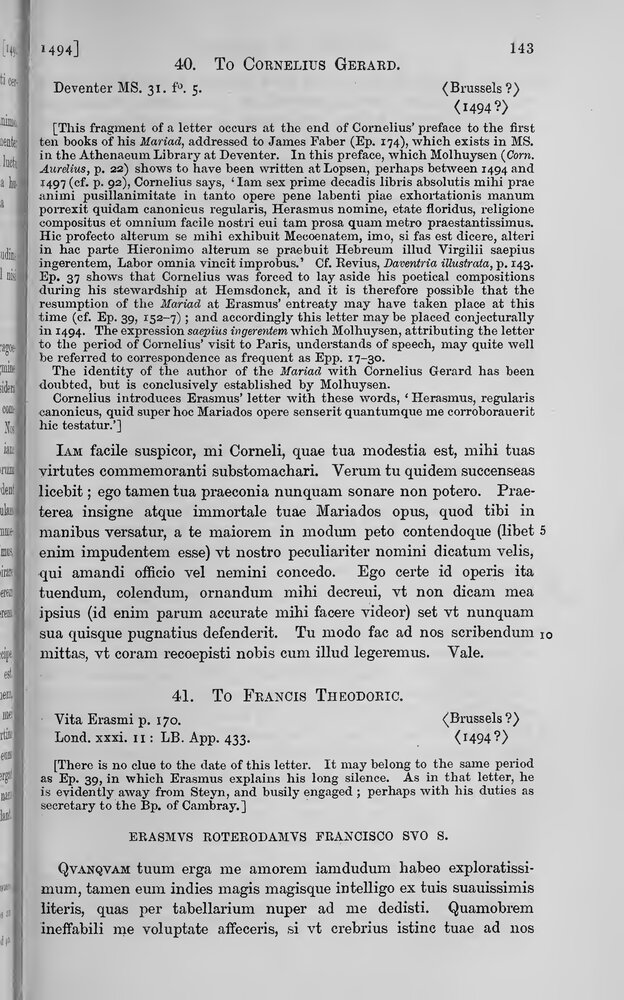
[Evidently answering a poem speculating about Erasmus' continued silence, which from the extract in l. 21 is not in the Sylua Odarum. The words 'pristinae consuetudinis,' l. 5, are against an early date. There is an inconclusive quotation from Herman's Ode 3 on the miseries of Holland, which was written presumably during the disorders that reigned from 1488-92; cf. Ep. 35. 50 n. Erasmus appears to have been away from Steyn, l. 145, and in a position where he found it difficult to study, ll. 113, 4. The references to Cornelius and John suggest Epp. 37 and 38. I therefore place the letter conjecturally in the period of depression that followed the disappointment about Rome. See App. 5.]
Erasmus responds to William Herman's concerns about his silence, defending himself by explaining his current state of depression and inability to study. He playfully critiques Herman's poetic interpretations while reaffirming their enduring friendship. The letter reveals Erasmus' emotional struggles and his encouragement for Herman's literary pursuits.
ERASMUS OF ROTTERDAM TO WILLIAM OF GOUDA, GREETINGS. Perhaps now, my dear William, no small astonishment possesses your mind—(why?)—since you have heaped letter upon letter, I, as if sleeping, have rendered no letters in return. You now alternate prose with verse, now verse with prose, so that by your very persistence you might extort something from me and break my silence. And I, truly forgetful of our former custom (since I was accustomed to provoke you with immoderate frequency of letters), should have prepared no response in return? And has some ill-omened bird of sinister suspicion already whispered something in your ear, which you recall has settled on your rooftops, the messenger, surely, of dreadful evil, of which our Virgil makes mention: "And alone on the rooftops the owl with its funeral song Often laments and draws out its mournful cries." But, I ask you, William (for I wish to jest), do you practice augury or philosophy? I indeed thought the latter, but I seem to perceive the former. By which of the gods, I ask, or by what secret power of nature was your bird endowed with such foresight, that, uttering from its divine breast, it prophesies things hidden from you? And perhaps (to speak according to the Pythagoreans) the soul of Cato inhabits its breast, or certainly some messenger has set out to you from the abodes of the gods, lest the counsels of the gods be hidden from you; for thus you sound in your poem: "Often a messenger of evil." I marvel more vehemently why Juno's Iris did not glide down to you as the messenger of such serious news, she who is always wont to announce mournful and weighty matters; but perhaps at that very moment the queen of the gods had sent her elsewhere to carry commands. What need then was there for the owl's service? It is summoned, it hastens its approach, and having received its command and traversed the spacious journey of the ether, it settled on your rooftops; and with its fatal voice it made you aware of a most harsh misfortune, of which you were ignorant. I ask you for the mystery of this augury; you, not without shame, interpret it as my love for you being extinguished. O sound prophet, O interpreter full of wit! Believe me, William, as far as I can see, this is how it happened. While your prophetess was gazing rather intently with equal eye upon the face of the sun, moon, stars, and the other celestial monsters, she forgot what Juno had entrusted. What was she to do? Using the cleverness in which she was most skilled, she devised something new within herself and brought it to you, and you, too credulous, were deceived. For that old goodwill of my love for you, which you prophesied was extinguished, not only has not perished, but has not even cooled, nor indeed has it grown faint; daily it grows stronger, daily some increase comes to it, and it gathers strength from time, never to yield to any chances of fortune, to any efforts of rivals. Let them separate our bodies, intercept our union, forbid our conversations; they will certainly never bring it about that my spirit wanders abroad from you. And (to use the words of Virgil): "As long as the boar shall love the mountain ridges, the fish the rivers, And while the bees shall feed on thyme, the cicadas on dew, As long as the bright stars of the ancient world shall run their course, And Ocean vast shall encircle the globe with its waves: I shall never regret remembering so sweet a friend." But hold, take care lest you seem to have cast a stain upon our mutual friendship, you who, led by so facile an opinion, suspected it was extinguished; take care lest you be noted for having imposed the mark of fiction upon it. For friendship (says Seneca) which could cease, was never true. Unless you had thought my love for you was feigned, you ought also not to have doubted its immortality, and you from conjecture, and that indeed so slight, argue its death, on the grounds that because my letters do not come to you more frequently, you believe you have fallen from our heart; do you value our silence so highly? I indeed will clear myself of this charge with which you strive to strike me; I will turn back the dart upon you and slay you with your own sword. Did I not some time ago, while you were utterly sleeping, assail you with such assiduity of letters that you were already taking it amiss? You begged me not to provoke you more than usual, as you had turned your mind to some little oration. To these letters you not only rendered no reply in turn; but you scarcely afforded a brief leisure for reading them, so sated were you with our brief acquaintance, not to say disgusted. But perhaps you will accuse me of falsehood, since you have very often written to me. I do not deny it; at last, importunate, I wrung from you certain little notes unworthy of the name of letter, as very rare as they are very brief, full of Filelphian flatteries, muddy and heavier with dust, easily presenting by their very appearance an inestimable goodwill of your mind towards me. And (which I bore most annoyingly of all) indulging in certain rather light jests and witticisms in them, you were in no way humoring my wishes. But if I perhaps in those letters which I have sent to you had written anything rather jocular, you ought not to have believed I was playing a game everywhere, but jests were to be matched with jests and serious matters with serious. You were playing in both cases. Furthermore, while you prepare in turn to jest back with me, you have forgotten the precept of our Seneca: "Let your witticisms be without a sting"; and likewise, "One ought not to injure a friend even in jest." Do you understand what I mean? And so if you accuse me because I have suspended my pen for a little while, with how much more fairness shall I condemn you in turn with the same charge, you who after long silences have written slanderously. Now I consider myself cleared; now the dart with which you were aiming at me I believe has been turned back upon you, now I think you are slain by your own sword. But perhaps you will not yet confess; I shall proceed therefore, and bring forth another, surer weapon. You pretend to be so impatient of my silence that you wrote you had no inclination of mind. But when you had learned that a letter, which I was hastening to send to you, was in my hands, you were already making fun of it before it arrived and criticizing it unseen; which I would call a prophecy rather than a judgment, unless perhaps you will estimate this from the judgment of other poems which I once published, which you accuse of obscurity. I confess indeed, it is especially worthwhile for the orator and poet alike, that his speech be not only learned, but also brilliant and cheerful, as Horace testifies: "It is not enough for poems to be beautiful; let them be sweet, And lead the listener's soul where they will." This, however, I vehemently marvel at, that, although when I was always reciting my poems to you, you praised to a wonderful degree the charming and cheerful brilliance in them, now, with changed heart or tongue, you mark them for obscurity and sleepiness; I am uncertain whether you jest or are serious. If you jest, please indicate it; but if you speak from the heart, I would like you to inform me by whom they are seen as obscure in understanding. If by rustics and barbarians, blame me along with Cicero and Virgil and the whole flock of poets, for those understand nothing of them; but if by learned men and those like you, that indeed I do not deny must be considered a fault. But for this very reason I beg that your letters go to me frequently; so that I may imitate Ciceronian brilliance in them and unlearn how to be obscure. Furthermore, to correct a friend who errs is faithfulness, to mock him is a sin. You present yourself as a critic of the letter, not a corrector. What? Have you not by this very thing deserved never to see our letters? You have deserved it, surely. Nevertheless, I will throw these very ones to you for criticism, if indeed in them you perceive anything worthy of the file or the erasure, I ask you again and again to correct your friend in a friendly manner. I will not only not take it amiss, but indeed, considering that I have obtained the greatest benefit, I shall give you immortal thanks. But if your intention is to injure a friend, it is indeed an unfair contest, William. For now you are engaged in the midst of Ciceronian artistic pursuits; for me, all faculty for studies is utterly removed. You read every new work, and handle polished volumes: To me, scarcely any grimy paper is given to read. You compose sublime poems in your small cell: To me, a most harsh misfortune has taken away all the liveliness of my former talent. Patience under many hardships has crushed my genius, And no part of its ancient vigor remains. Nevertheless, if there is no way of escape, I ask you to forewarn me, lest I expose the letters I am about to send to you, unarmed, to the hazard of so great a contest. Thus far we have jested; now let us speak seriously and from the heart. I vehemently marvel, William, that you marvel so greatly at our silence, as if you had never read that saying of the wise man: "Music in mourning is an unseasonable recital." Do the pursuits of bland humanity suit this most bitter tempest? Certainly a cheerful song (as he says) "Requires work, and demands peace of mind." Where now, I ask, is cheerfulness, where is tranquility of heart? All things are full of bitterness and tumult; wherever I turn my eyes, I see nothing but sad and cruel things; "Everywhere much grief, and the image of death most frequent." If I proceed to recount these things one by one, I will seem to weave not so much a letter as a tragedy. And do you, in such a great throng of circumstances clamoring around, bid me devote myself to Pierian labor? You rather, upon whom favorable stars look, proceed, while it is permitted, to commend yourself to immortality by exceptional virtue; you, publish something excellent for posterity to sing repeatedly. It befits us to do nothing but weep and lament, for whom talent has now so grown dull, spirit so withered, that nothing of our former studies is pleasing. The Pierian charm of the poets does not delight me, the Muses (once my sole care) are distasteful. I confess, however, when Servatius, quite familiar to you and equally most friendly to me, brought to me your little oration—indeed elegant and breathing Cicero throughout, but forgetful of me—I, as if awakened from a deep sleep, began to breathe a little; rebuking my own sloth, I compelled myself to write something. And I would reply to each sentiment of your letter in order, did not the finished paper bid me put an end. But as to what I think about John's letter, you ask, hear in few words. To me indeed it seemed to smell more of Bernard than of Cicero. I marveled, however, in it at both the not ungraceful composition of words and the youthful breast of an old man. But concerning Cornelius, a man most loving of me, what I think, the narrowness of the paper forbids me to express, especially since the matter seems to be its own witness. One thing, however, I ask you most earnestly, that you advise, urge, and beseech him to gird himself for literary labor, to proceed to bring forth into the light the precepts of an obscure eloquence. For he can; for all things are favorable to him, even though the gods sell us all things with toil. Farewell, my dear William, and love me as you do.