

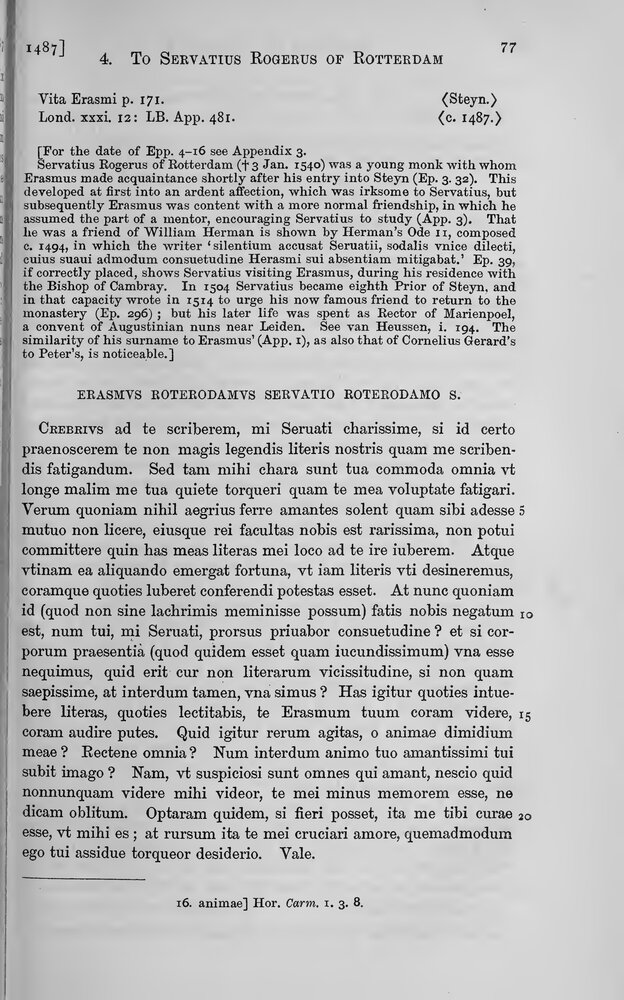
[For the date of Epp. 4-16 see Appendix 3. Servatius Rogerus of Rotterdam († 3 Jan. 1540) was a young monk with whom Erasmus made acquaintance shortly after his entry into Steyn (Ep. 3. 32). This developed at first into an ardent affection, which was irksome to Servatius, but subsequently Erasmus was content with a more normal friendship, in which he assumed the part of a mentor, encouraging Servatius to study (App. 3). That he was a friend of William Herman is shown by Herman's Ode 11, composed c. 1494, in which the writer 'silentium accusat Seruatii, sodalis vnice dilecti, cuius suaui admodum consuetudine Herasmi sui absentiam mitigabat.' Ep. 39, if correctly placed, shows Servatius visiting Erasmus, during his residence with the Bishop of Cambray. In 1504 Servatius became eighth Prior of Steyn, and in that capacity wrote in 1514 to urge his now famous friend to return to the monastery (Ep. 296); but his later life was spent as Rector of Marienpoel, a convent of Augustinian nuns near Leiden. See van Heussen, i. 194. The similarity of his surname to Erasmus' (App. 1), as also that of Cornelius Gerard's to Peter's, is noticeable.]
Erasmus writes to his friend Servatius Rogerus expressing his deep affection and longing for their friendship. He explains that he writes frequently despite knowing it may burden Servatius, preferring to suffer himself rather than inconvenience his friend. Erasmus expresses hope that they may one day meet in person rather than relying on letters, and reveals his anxiety that Servatius may not remember him as fondly.
ERASMUS OF ROTTERDAM TO SERVATIUS OF ROTTERDAM, GREETINGS. I would write to you more frequently, my dearest Servatius, if I knew for certain that you would not be wearied by reading my letters as much as I am by writing them. But all your comforts are so dear to me that I would far rather be tormented by your peace than have you fatigued by my pleasure. However, since lovers usually find nothing harder to bear than being unable to be present with one another, and since the opportunity for that is exceedingly rare for us, I could not refrain from sending this letter of mine to you in my stead. And would that fortune might someday so favor us that we could cease using letters and have the ability to meet face to face as often as we wished. But now, since that—which I cannot recall without tears—has been denied us by fate, shall I be utterly deprived of your companionship, my Servatius? And if we cannot be together in bodily presence (which would indeed be most delightful), what reason is there why we should not be united by the exchange of letters, if not very often, at least sometimes? Therefore, whenever you look upon this letter, whenever you read it, imagine that you see your Erasmus before you, that you hear him speaking in person. So what are you doing, O half of my soul? Is all well? Does the image of your most loving friend sometimes come to your mind? For, as all who love are suspicious, I sometimes seem to perceive something that makes me think you remember me less—not to say have forgotten me. I would wish, if it were possible, that I were as much in your thoughts as you are in mine; but then again, I would wish you to be tormented by love for me just as I am constantly tortured by longing for you. Farewell.