

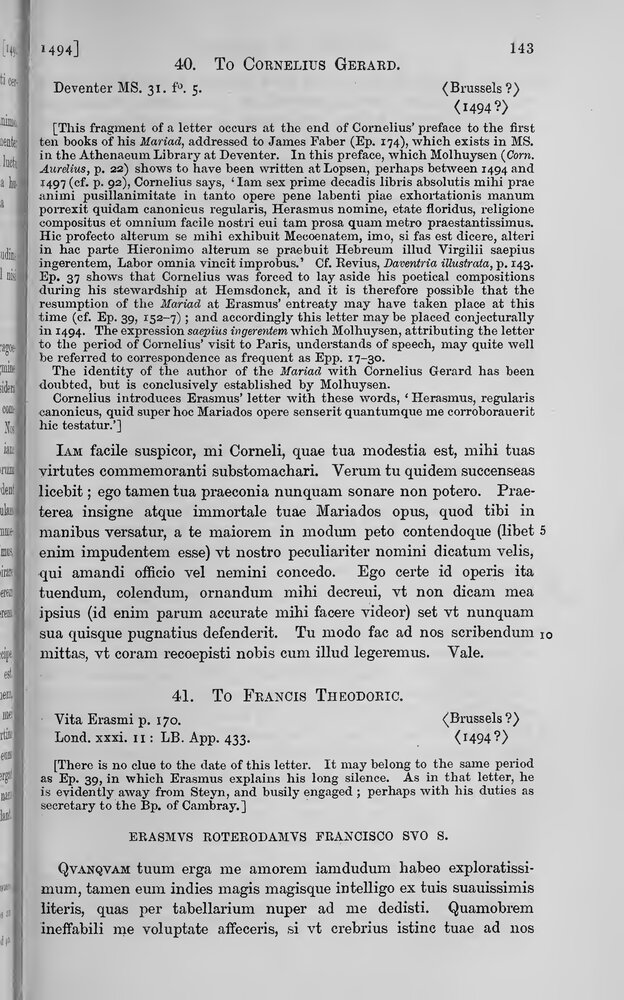
erasmvs roterodamvs francisco svo s.


41. to francis theodoric

(1494?), (Brussels?)


1
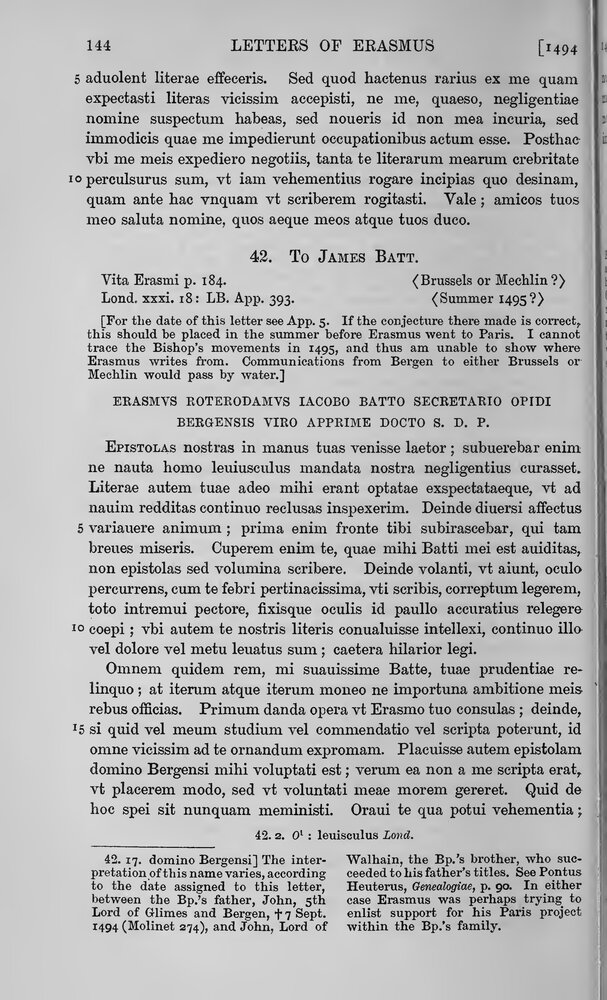
QVANQVAM tuum erga me amorem iamdudum habeo exploratissi-
mum, tamen eum indies magis magisque intelligo ex tuis suauissimis
literis, quas per tabellarium nuper ad me dedisti. Quamobrem
ineffabili me voluptate affeceris, si vt crebrius istine tuae ad nos
5
aduolent literae effeceris. Sed quod hactenus rarius ex me quam
expectasti literas vicissim accepisti, ne me, quaeso, negligentiae
nomine suspectum habeas, sed noueris id non mea incuria, sed
immodicis quae me impedierunt occupationibus actum esse. Posthac
vbi me meis expediero negotiis, tanta te literarum mearum crebritate
10
perculsurus sum, vt iam vehementius rogare incipias quo desinam,
quam ante hac vnquam vt scriberem rogitasti. Vale; amicos tuos
meo saluta nomine, quos aeque meos atque tuos duco.


Associated Sources

2.
'Opus Epistolarum Des. Erasmi Roterodami', ed. P. S. Allen, 11 vols (Oxford: Clarendon Press, 1906), vol. 1, epistle 41.
3.
'The correspondence of Erasmus: letters 1 to 141, 1484 to 1500', tr. R. A. B. Mynors and D. F. S. Thomson, annot. Wallace K. Ferguson, 'Collected Works of Erasmus', ed. A. Dalzell, et al. (Toronto: University of Toronto Press, 1974), vol. 1, epistle 41.
4.
'La Correspondance d'Erasme. Traduite et annotée d'après l'Opus epistolarum de P. S. Allen, H. M. Allen et H. W. Garrod', ed. Alois Gerlo, et al., 12 vols (Brussels: University Press, 1967), vol. 1: 1484–1514, epistle 41.
5.
'De correspondentie van Desiderius Erasmus: Brieven 1–141', tr. M. J. Steens (Rotterdam: Donker, 2004), vol. 1, epistle 41.
Text has not been meticulously cleaned. You will find splits and errors, especially in Greek text. Refer to the originals or other sources for exact wording. Translation is done by AI, so do not regard it as authoritative! See About for more.

Commentary

Percy Stafford Allen

[There is no clue to the date of this letter. It may belong to the same period as Ep. 39, in which Erasmus explains his long silence. As in that letter, he is evidently away from Steyn, and busily engaged; perhaps with his duties as secretary to the Bp. of Cambray.]

M.J. Steens

Link to commentary

AI Summary

Erasmus acknowledges Francis Theodoric's friendship and expresses gratitude for his recent letter. He apologizes for his own infrequent correspondence, explaining that it was due to overwhelming professional duties rather than neglect. Erasmus promises to write more frequently once his current obligations are resolved.

Translations

M.J. Steens
AI Deepseek

Erasmus of Rotterdam to his friend Francis, greetings. Although I have long held your affection toward me as most thoroughly proven, nevertheless I daily understand it more and more from your most delightful letters, which you recently gave to the messenger for me. Therefore, you would fill me with inexpressible pleasure if you would arrange that your letters fly to us more frequently from your place. But that you have thus far received letters from me more rarely than you expected, I beg you, do not hold me suspect under the name of negligence, but know that this happened not through my carelessness, but through the excessive occupations which have hindered me. Hereafter, when I have freed myself from my affairs, I shall strike you with such frequency of my letters that you will begin to beg more vehemently that I cease than you ever before entreated me to write. Farewell; greet your friends in my name, whom I consider equally mine and yours.