robertvs gagvinvs herasmo s.


44. from robert gaguin

24 September 1495, Paris


1
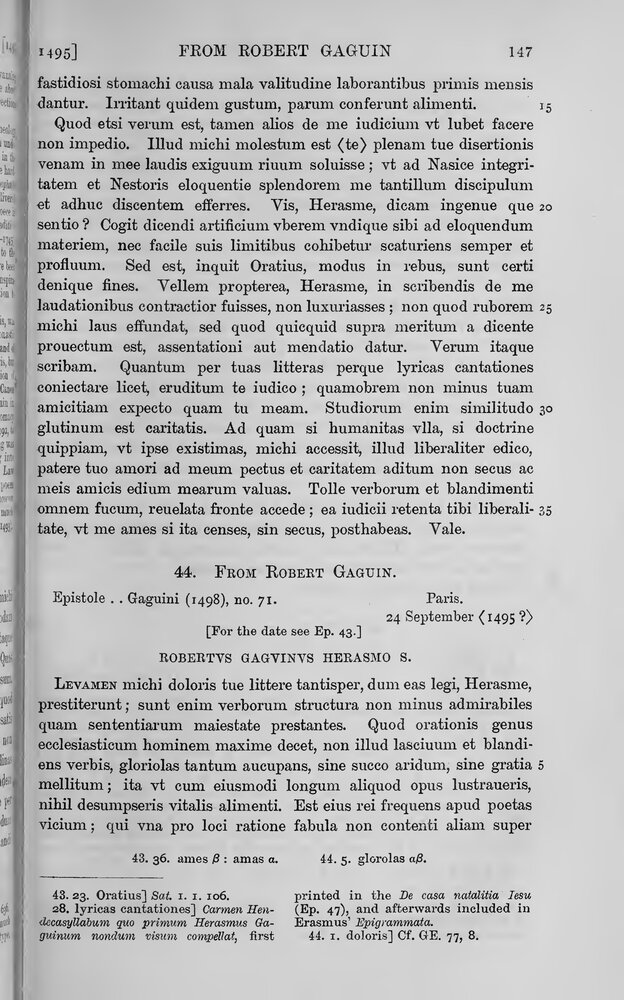
LEVAMEN michi doloris tue littere tantisper, dum eas legi, Herasme,
prestiterunt; sunt enim verborum structura non minus admirabiles
quam sententiarum maiestate prestantes. Quod orationis genus
ecclesiasticum hominem maxime decet, non illud lasciuum et blandi-
5
ens verbis, gloriolas tantum aucupans, sine succo aridum, sine gratia
mellitum; ita vt cum eiusmodi longum aliquod opus lustraueris,
nihil desumpseris vitalis alimenti. Est eius rei frequens apud poetas
vicium; qui vna pro loci ratione fabula non contenti aliam super
aliam ad fastidium vsque congerunt. Qui etiam error iureconsultorum
10
hactenus fuit, quibus non satis lex vna aut altera est, nisi longissima
pagella legibus scateat. At scite admodum, Herasme, te facere
existimo, qui stilum religioso dignum apprehendis; sequere igitur
atque moratos et grauiores autores imitari stude, quorum prudentia
ingenium erudias et mores formes.
15
Neque hoc docendi tui causa scribo qui aliorum potes esse preceptor,
sed iter sponte currenti spem vere laudis ostendo. Ita enim michi
de te persuasi, vt purgatos cum religione mores te coniunxisse putem,
nullius assentationis nulliusque mendacii fallacias pretexentem. De
20
quibus tametsi priore ad te epistola scripsi, blandos tantum et petu-
lantes taxare mens erat, quorum ego Gnatonicas artes magis quam
Tersitis vile genus despicio. Illi enim amicitie specie vultum vt
volunt componentes fallunt. Hic pro suo instituto et sordibus viuens
pre se fert qualis sit. Nichil mediusfidius in toto hominum genere
25
plus odi quam blanditores. Cetera enim peccata fere omnia in aperto
sunt, sola assentatio diu in abstruso dolos condit, quos dum nichil
caues in te exerceat. Illud propterea suspectum michi semper habui,
ne plus iusto me blanditor veneretur. Enimuero in prouerbio Italico
est: Qui supra solitum te honorat, eum vel fefellisse te vel fallere
30
conari.
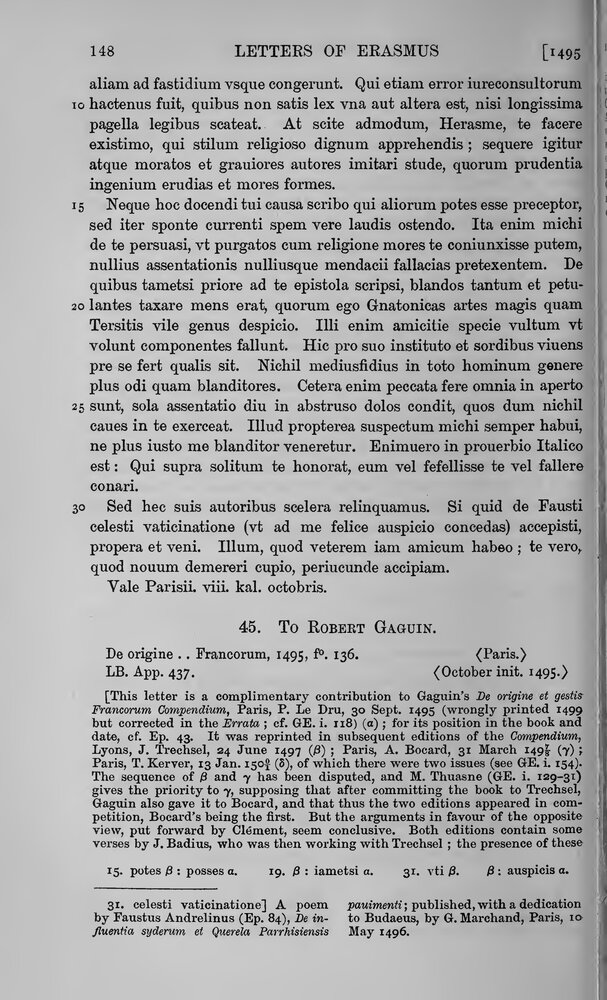
Sed hec suis autoribus scelera relinquamus. Si quid de Fausti
celesti vaticinatione (vt ad me felice auspicio concedas) accepisti,
propera et veni. Illum, quod veterem iam amicum habeo; te vero,
35
quod nouum demereri cupio, periucunde accipiam.
Vale Parisii. viii. kal. octobris.


Associated Sources

2.
'Opus Epistolarum Des. Erasmi Roterodami', ed. P. S. Allen, 11 vols (Oxford: Clarendon Press, 1906), vol. 1, epistle 44.
3.
'The correspondence of Erasmus: letters 1 to 141, 1484 to 1500', tr. R. A. B. Mynors and D. F. S. Thomson, annot. Wallace K. Ferguson, 'Collected Works of Erasmus', ed. A. Dalzell, et al. (Toronto: University of Toronto Press, 1974), vol. 1, epistle 44.
4.
'La Correspondance d'Erasme. Traduite et annotée d'après l'Opus epistolarum de P. S. Allen, H. M. Allen et H. W. Garrod', ed. Alois Gerlo, et al., 12 vols (Brussels: University Press, 1967), vol. 1: 1484–1514, epistle 44.
5.
'De correspondentie van Desiderius Erasmus: Brieven 1–141', tr. M. J. Steens (Rotterdam: Donker, 2004), vol. 1, epistle 44.
Text has not been meticulously cleaned. You will find splits and errors, especially in Greek text. Refer to the originals or other sources for exact wording. Translation is done by AI, so do not regard it as authoritative! See About for more.

Commentary

Percy Stafford Allen

[For the date see Ep. 43.]

M.J. Steens

Link to commentary

AI Summary

Robert Gaguin praises Erasmus's writing style as admirable and suitable for an ecclesiastical man, contrasting it with frivolous, flattering speech. He warns against flatterers and their deceptive arts, expressing his particular disdain for such individuals. Gaguin invites Erasmus to visit him in Paris, mentioning Faustus and expressing his desire to welcome Erasmus warmly.

Translations

AI Deepseek

Your letter, Erasmus, brought me relief from sorrow for a time while I was reading it, for its structure of words is no less admirable than it is outstanding in the majesty of its thoughts. This kind of language especially befits a churchman—not that wanton, flattering style that merely hunts for petty glories, dry without substance, cloying without grace; so that when you have perused some lengthy work of that sort, you take away no vital nourishment. This fault is common among poets, who, not content with one tale suited to the occasion, pile one upon another to the point of weariness. This error has also been common among lawyers until now, for whom one or two laws are not enough unless the longest page teems with statutes. But I think you act very wisely, Erasmus, in adopting a style worthy of a religious man; follow it, then, and strive to imitate serious and dignified authors, by whose prudence you may cultivate your intellect and shape your character. Nor do I write this to teach you, who can be an instructor to others, but I show the path of true praise to one already running freely. For I am so convinced about you that I believe you have joined pure morals with religion, weaving no deceptions of flattery or falsehood. Though I wrote to you about these matters in a previous letter, my intention was only to censure the fawning and impudent—whose Gnathonic arts I despise more than the vile sort of Thersites. For the former, under the guise of friendship, compose their expression as they wish and deceive. The latter, living according to his own habits and in squalor, shows openly what he is. By heaven, I hate nothing in the whole human race more than flatterers. For almost all other sins are out in the open; flattery alone long hides its treachery in secret, and while you are off guard, it works upon you. For this reason, I have always held it suspect that a flatterer may honor me more than is right. Indeed, there is an Italian proverb: "Whoever honors you beyond the usual, has either deceived you or is trying to deceive you." But let us leave these crimes to their own authors. If you have heard anything about Faustus’ heavenly prophecy (so that you may come to me under a happy omen), make haste and come. I shall welcome him with great pleasure because I already have him as an old friend, and you because I desire to win you as a new one. Farewell. Paris, September 24.

M.J. Steens