

[This letter is a complimentary contribution to Gaguin's De origine et gestis Francorum Compendium, Paris, P. Le Dru, 30 Sept. 1495 (wrongly printed 1499 but corrected in the Errata; cf. GE. i. 118) (a); for its position in the book and date, cf. Ep. 43. It was reprinted in subsequent editions of the Compendium, Lyons, J. Trechsel, 24 June 1497 (B); Paris, A. Bocard, 31 March 149 (Y); Paris, T. Kerver, 13 Jan. 150º (6), of which there were two issues (see GE. i. 154). The sequence of ẞ and y has been disputed, and M. Thuasne (GE. i. 129-31) gives the priority to y, supposing that after committing the book to Trechsel, Gaguin also gave it to Bocard, and that thus the two editions appeared in competition, Bocard's being the first. But the arguments in favour of the opposite view, put forward by Clément, seem conclusive. Both editions contain some verses by J. Badius, who was then working with Trechsel; the presence of these in Bocard's edition is easily explained, if his followed Trechsel's, but not if the two editions were competing. Bocard's again has a letter and a poem, by Cornelius Gerard of Gouda, who was in Paris from the autumn of 1497 till August 1498 (p. 205); like this letter they are the last items in the book, and were almost certainly composed and added in the same way when the printing was nearly complete. Gaguin's preface to the reader speaks in Trechsel's edition of the book being given secunde impressioni, in Bocard's denuo impressioni; the prefaces being otherwise identical except for the printers' names. Finally, Gaguin speaks of Trechsel's as the second edition (GE. 85); and there is no reference to a third edition, except in a letter (GE. 79) of 27 June, the year date of which can only be supplied from this mention of the Compendium.]
This letter is Erasmus's complimentary contribution to Robert Gaguin's historical work 'De origine et gestis Francorum Compendium'. Erasmus praises Gaguin for undertaking the important task of documenting French history, which had been neglected, and commends his eloquence, erudition, and patriotism. He argues that Gaguin's work will immortalize French achievements and spread French glory throughout the world.
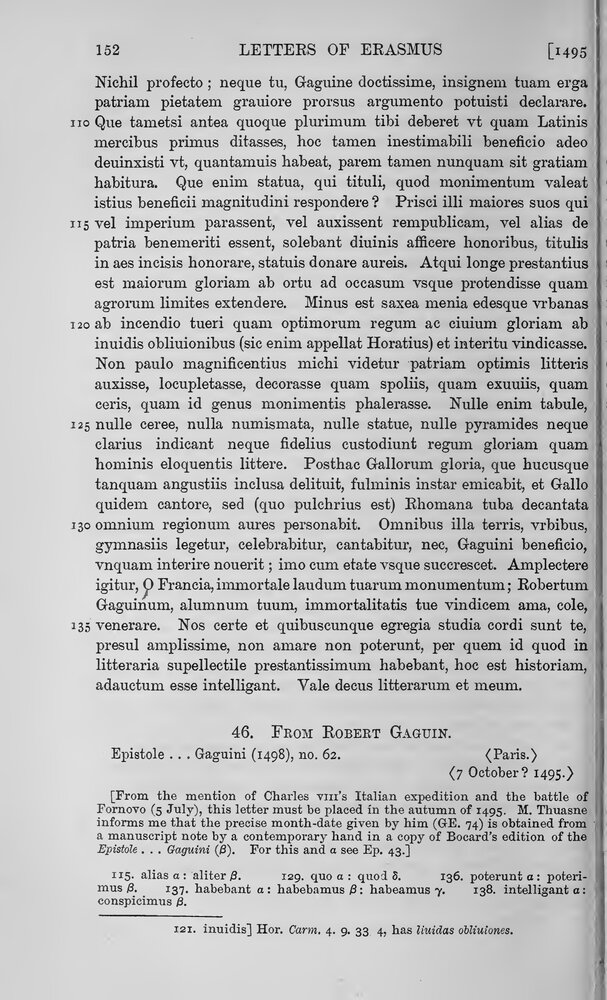
Erasmus of Rotterdam to Robert Gaguin, a man most learned in every respect, sends greetings. That you have undertaken to bring forth from darkness and consecrate to immortality the deeds of the French kings and princes—which have hitherto lain almost buried for want of a suitable writer—in a prose history, Robert Gaguin, chief ornament of the French academy, I truly cannot but greatly approve of this labor of yours. For you have taken up, or rather, undertaken, a task which in my opinion is most beautiful, and which will bring incredible pleasure to all students of Latin literature, but especially to your France as a splendid, magnificent, and (so to speak) triumphant work, and finally, one most worthy of your learning, your eloquence, and your devotion. For I can easily believe that no other reason (since you have never held account of profit or even slight glory) provoked you to take on this business than your singular devotion to your country; a quality which you and every good man have always held in the highest regard. It undoubtedly grieved you (as I too sometimes privately marvel) that the glory accorded to the virtue of the Gauls is so meager, and that those who once often rivaled the Italians in deeds, and now even surpass them, nevertheless follow them by such a long interval in reputation and fame due to a scarcity of historians. The Italians will pardon me if what seems true to us is what Francesco Filelfo, though Italian-born, was not ashamed to admit. For his letter to King Charles, this one's grandfather I believe, stands as testimony; in which, besides the many praises with which he honors the kingdom of France, he also candidly admits that the Romans indeed once procured for themselves by far the most extensive empire of all through the arts of peace and war; furthermore, that they contended with the Greeks no less zealously with their intellects than they had previously with their arms; but that their ancient imperial glory declined for the worse through factions and misguided zeal. On the contrary, he states that the kingdom of France, through the prudence of its kings, the loyalty of its princes, and the harmony of its citizens, has grown to such an extent that it can now easily contend with any other empire in the Christian world, whether in resources, the extent of its dominion, the greatness of its achievements, or the nobility of its kings; of whom it is well-known France has had very many, not only most valiant but also most pious. Wherefore, it seems not without reason that the Christian senate has established in this kingdom the chief and unique bulwark for itself against the violence of the Turks. And yet, one thing seemed still lacking to the majesty of so great an empire. In other respects, Italy was either equal or inferior, but it still surpassed us in Livy and Sallust. For (as Horace wisely sang) the well-fought deeds of kings and leaders, however brilliant they may otherwise be, must necessarily either die out or grow dim with age, unless they are entrusted by the work of an eloquent historian to letters, the unique guardians of events, to have as much weight of glory among posterity as the writer had power of talent. This supreme province, most eloquent Gaguin, as if reserved for you by fate, you have undertaken like a second Scipio with the utmost applause of all—a task clearly most difficult and of immense labor, yet one utterly most fitting for Robert. You ask why I believe so? For many reasons, it seems thus to me, but chiefly for two. For there are two principal qualities usually sought in an approved historian, namely trustworthiness and erudition. For just as a writer's frivolity sometimes strips credibility even from true events, so too the seriousness of a historian usually lends a certain credibility to the events themselves by his personal authority. Likewise, just as the inexperience of a narrator (to gain credence for what it itself cannot achieve) usually obscures, diminishes, and disfigures events which are in themselves quite illustrious; so the talent of a learned writer illuminates the obscure, elevates the humble, and adds a certain light and splendor to the splendid. Since, however, both trustworthiness and erudition exist in you to such a degree as in no other person, assuredly no one was more suited to this duty; or this duty was suited to no one more than to you alone, who can both command belief because of your singular seriousness and adorn the subject matter because of your uncommon eloquence. Now I easily suspect, most humane Gaguin, that you are growing somewhat angry with your Erasmus, for daring to touch even the smallest part of your praises. For it is not unknown to me how modest, how restrained (not to say fastidious) a nature you are endowed with, since you usually bear even a friendly little compliment much more uncomfortably than anyone else bears an insult. But I beg you, grant this pardon to my love for you, that what all men everywhere proclaim, it should be permitted also for a friend to mention. For to whom of your acquaintances is the incredible integrity, innocence, and seriousness of your life and character not most highly regarded? In what region of the world is it not proclaimed? So much so that not only concerning your writings, but not even concerning your words, can any suspicion of vanity possibly arise. Add to this that since all know that you have always held the French kings in the highest esteem by your own merit, that they have very often used your services in serious affairs, that you have been frequently summoned to the king's secret councils, that you have often performed a legation in the king's name both among diverse nations and among the Italians, they easily conjecture that you alone of the Gauls have both reread the ancient deeds with greater care and investigated the more recent ones more thoroughly. Furthermore, why should I recount your erudition? It (as they say) proclaims itself abundantly. The most celebrated university of the city of Paris is a sufficient witness; whose otherwise flourishing studies you were the first to adorn with the resources of Latin literature, and you increased them with the most beautiful advancement of eloquence, which they seemed hitherto to lack. Italy itself is a witness, which has often heard you discoursing most weightily on the greatest matters, not without astonishment, indeed perhaps not without chagrin; because (as Apollonius said of Cicero) it saw the praise of eloquence, which it had hitherto considered its own unique possession, becoming common to France through you. The witnesses are all the most learned writers of our time; who all with one voice, in competition, proclaim and extol your genius. There is scarcely a page of theirs which does not bear the name of Gaguin. Finally, the most abundant witnesses, most distinguished prelate, are your books which, now scattered throughout the world, are everywhere read with the greatest pleasure by scholars. In all these works, although you satisfy abundantly not only learned but also curious ears, whether in prose or verse, in this kind of writing, however, that is in history (if you permit the cobbler to judge beyond the sandal), you seem to display a certain singular and marvelous skill, and to have surpassed yourself in history, while in other genres you have surpassed very many. Such is the purity of your language, the Sallustian elegance, the Livian felicity, the utmost clarity, the most pleasing variety, a singular skill in the observation of plans, reasons, occasions, advantage, dignity, and other things of that kind which mark the learned historian. So great is the liveliness of the narrative that the event seems to be happening, not being narrated. Nor is there lacking a certain pleasing brevity, which in histories is as rare as it is most welcome to readers. For, good God, what a vast forest of events do you embrace in how brief a volume, and how completely—being copiously brief and briefly copious! Who, therefore, would not think that the affairs of France have been splendidly served, to whom such a herald has fallen? When Alexander the Great had arrived at the tomb of Achilles, he said, "O fortunate Achilles, who obtained a poet like Homer as the herald of your praises!" And who would not judge France also most fortunate, which has obtained Robert as the best herald of its praises? What more beautiful, magnificent, or divine thing could the kindness of the gods have bestowed upon you? Nothing, assuredly; nor could you, most learned Gaguin, have declared your remarkable devotion towards your country by a weightier argument. Although it already owed you a very great debt because you were the first to enrich it with Latin wares, yet by this inestimable benefit you have so bound it that, however much gratitude it may have, it will never be able to have an equal amount. For what statue, what inscription, what monument can match the magnitude of this benefit? Those ancient ancestors used to honor with divine honors, honor with inscriptions carved in bronze, reward with golden statues those who had either acquired an empire, or increased the state, or were otherwise well-deserving of their country. But it is far more outstanding to have extended the glory of one's ancestors from sunrise to sunset than to have extended the boundaries of fields. It is a lesser thing to protect stone walls and city buildings from fire than to have vindicated the glory of the best kings and citizens from envious oblivions (for thus Horace calls them) and from destruction. It seems to me not a little more magnificent to have increased, enriched, and adorned one's country with the best literature than to have decked it out with spoils, trophies, wax images, or monuments of that kind. For no tablets, no waxes, no coins, no statues, no pyramids indicate the glory of kings more clearly or preserve it more faithfully than the writings of an eloquent man. Henceforth the glory of the Gauls, which up until now has lain hidden as if confined in narrow straits, will flash forth like lightning, and, sung by a Gallic bard indeed, but (which is more beautiful) with a Roman trumpet, it will resound in the ears of all regions. It will be read, celebrated, and sung in all lands, cities, and universities, and, by Gaguin's benefit, it will never know how to perish; indeed, it will grow ever greater with age. Embrace therefore, O France, the immortal monument of your praises; love, cherish, revere Robert Gaguin, your foster-son, the vindicator of your immortality. We certainly, and all to whom distinguished studies are dear, cannot but love you, most distinguished prelate, through whom they understand that which they held as the most outstanding part of their literary furnishings—that is, history—has been increased. Farewell, ornament of letters and my own.