
[From the mention of Charles VIII's Italian expedition and the battle of Fornovo (5 July), this letter must be placed in the autumn of 1495. M. Thuasne informs me that the precise month-date given by him (GE. 74) is obtained from a manuscript note by a contemporary hand in a copy of Bocard's edition of the Epistole... Gaguini (B). For this and a see Ep. 43.]
Gaguin praises Erasmus for his work against those who oppose humanistic studies, particularly commenting on Erasmus' Antibarbari. He offers some literary criticism about the dialogue structure being too lengthy without interlocutors, and then provides a detailed account of Charles VIII's Italian expedition, including the battle of Fornovo and recent military developments.
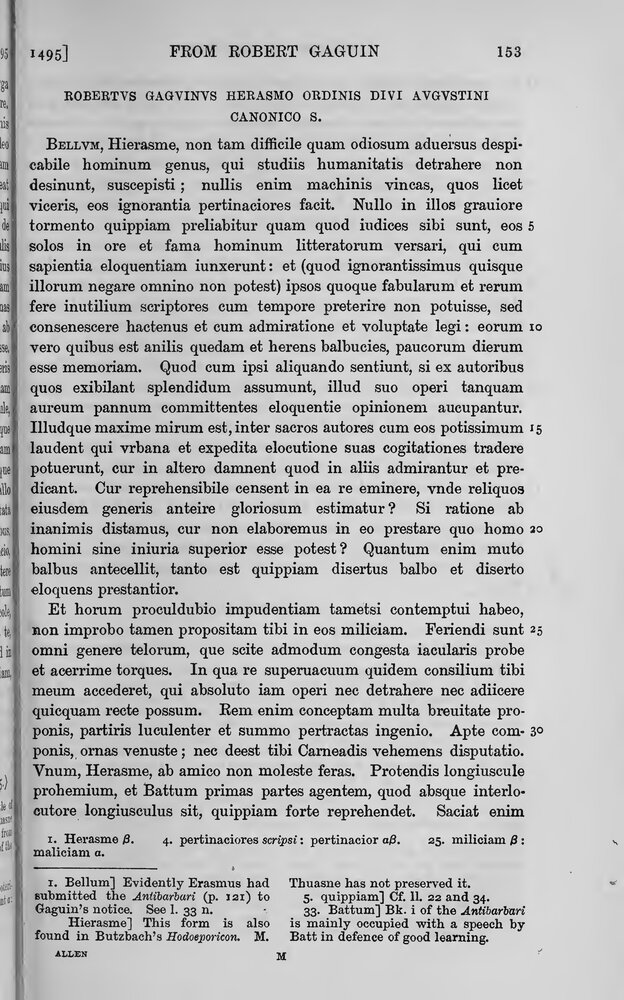
ROBERT GAGUIN OF THE ORDER OF SAINT AUGUSTINE TO ERASMUS, CANON REGULAR GREETINGS. You have undertaken a war, Erasmus, not so much difficult as odious, against a contemptible class of men who do not cease to disparage humane studies; for you will conquer them with no engines, since even if you should conquer them, their ignorance makes them more obstinate. No heavier torment will be wielded against them than the fact that they are their own judges, that only those are on the lips and in the reputation of learned men who have joined eloquence with wisdom: and (what the most ignorant of them cannot possibly deny) that even the writers of fables and generally useless matters could not be passed over with time, but grow old and are still read with admiration and pleasure: whereas the memory of those who have a certain old-womanish and stammering speech will last but a few days. And when they themselves perceive this at some point, if they borrow something splendid from the authors they execrate, attaching that golden patch, as it were, to their own work, they hunt for a reputation for eloquence. And this is especially remarkable, that among sacred authors, while they particularly praise those who were able to convey their thoughts with urbane and ready elocution, why do they condemn in one what they admire and extol in others? Why do they judge it reprehensible to excel in that very thing for which it is considered glorious to surpass others of the same kind? If we differ from inanimate things by reason, why should we not strive to excel in that in which one man can be superior to another without injury? For as much as a stammerer is surpassed by a mute, by so much is an eloquent man superior to one who is merely fluent and a fluent man to a stammerer. And although I hold the impudence of these men in contempt, I do not, however, disapprove of the campaign you have undertaken against them. They must be struck with every kind of weapon, which you skillfully gather and hurl aptly and most sharply. In this matter, my advice would indeed be superfluous to you, since I can rightly neither take away from nor add anything to a work already finished. For you set forth the conceived matter with great brevity, divide it lucidly, and treat it with the highest genius. You compose aptly, you adorn gracefully; nor are you lacking the forceful argumentation of Carneades. One thing, Erasmus, may you not take amiss from a friend. You extend the preface rather lengthily, and some might perhaps criticize Battus, playing the leading role, for being somewhat long-winded without an interlocutor. For continuous speech, when prolonged, satiates, whereas when varied by the alternation of disputants, it also refreshes and delights the listener. Nor would I wish you to use me as a censor for this matter. Consult those who write dialogues. They frequently dispute by means of certain points and sections, but rarely by continuous speeches through a single character. That Plato among the Greeks, Cicero among the Latins, and several other more recent authors will be your guides. But I shall be a ridiculous trainer to you if I concern myself with the sinews in the beautiful skin of Venus. It is enough for you to blot out what is redundant and to add anything that is lacking. As for the deeds gloriously performed by the French in recent days, a long letter would have to be composed, indeed a huge treatise set in motion. For it is well known that for over a year now, King Charles, having crossed the Alps, then passed through Liguria, the Insubres, Etruria, and Latium, led an expedition into Campania and Naples, and having driven out Alfonso, recovered the entire region; and after he had triumphed over his enemies, and was then making his journey back to France with affairs settled according to his will, the Venetians with Ludovico of Milan and many Italian rulers threw an army against the victorious Charles, thinking they could intercept him, though they had been provoked by no injury from him. But it turned out otherwise than they hoped. At Fornovo, the enemy, bursting upon the French with thirty thousand men, was repulsed and routed, having lost four thousand, while far fewer are reported missing from Charles's forces. In this manner, with his army safe, he withdraws to the city of Asti, not without the enemy's disgrace. Now, however, with his forces increased, he remains at Turin, spirited against the enemy. If you wish these things written more fully, I am sending you a letter about this victory written by one who was present at the battle. Farewell.