
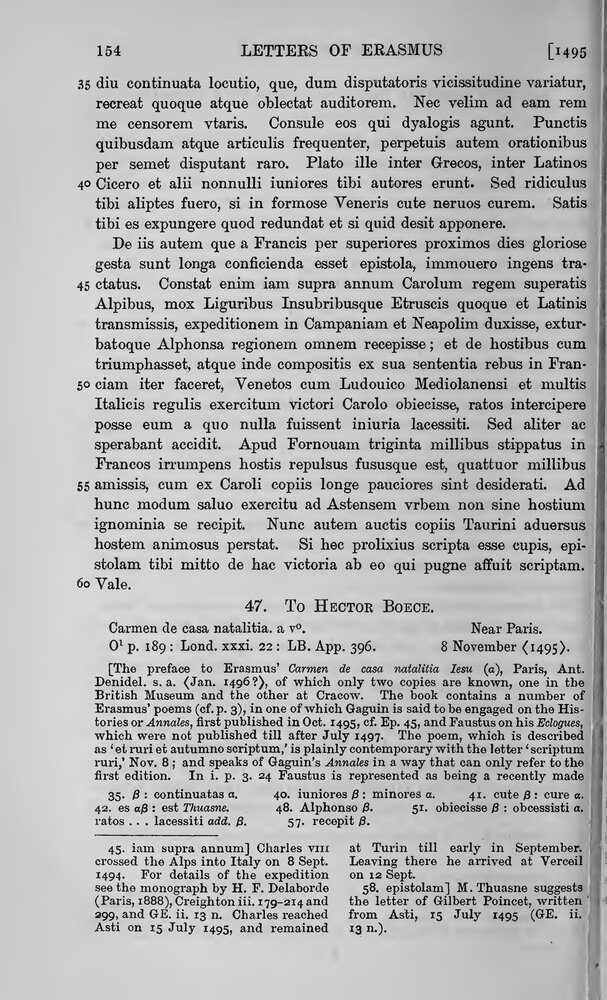
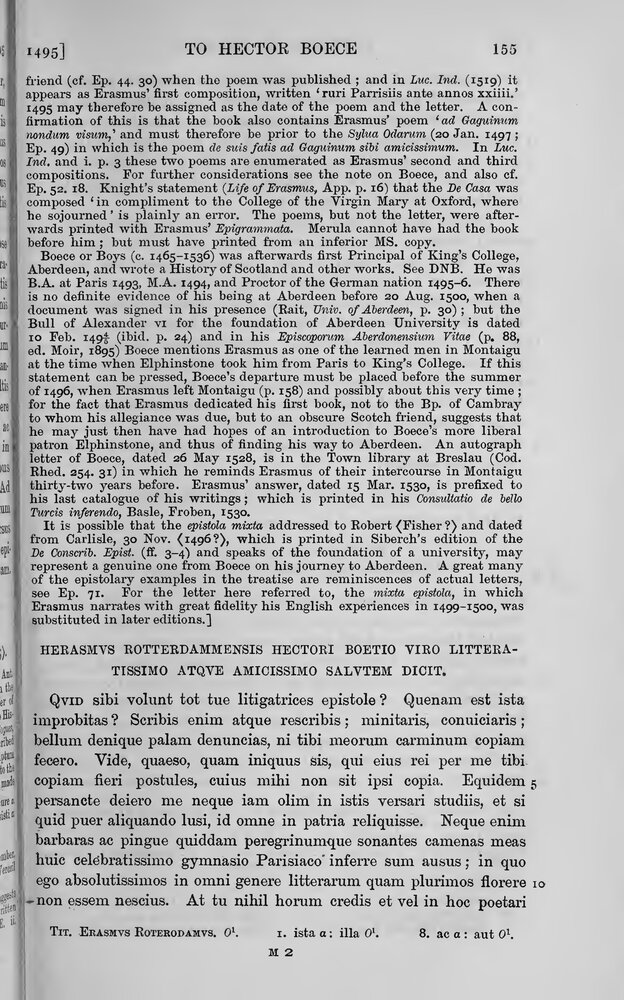
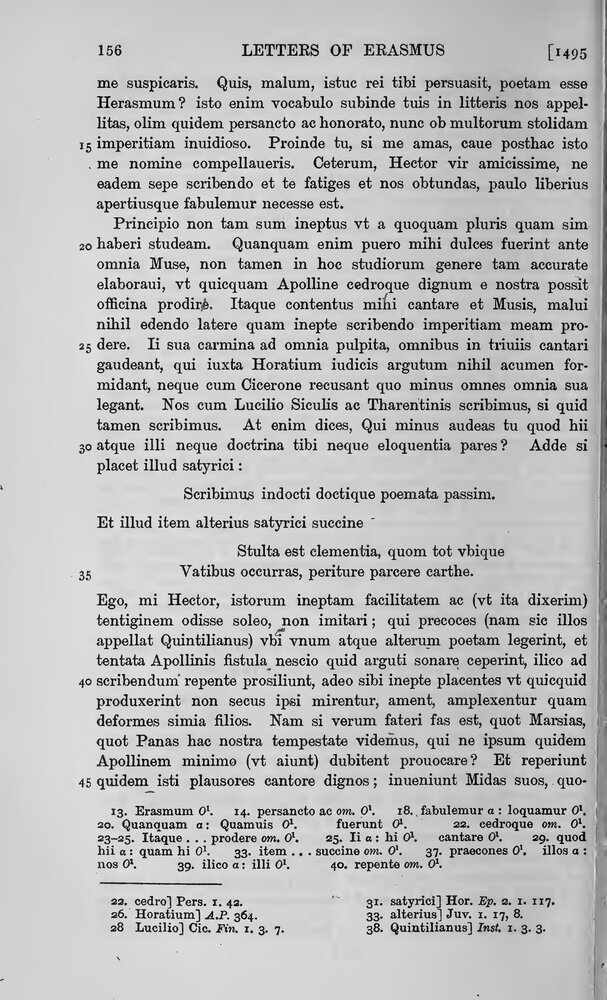
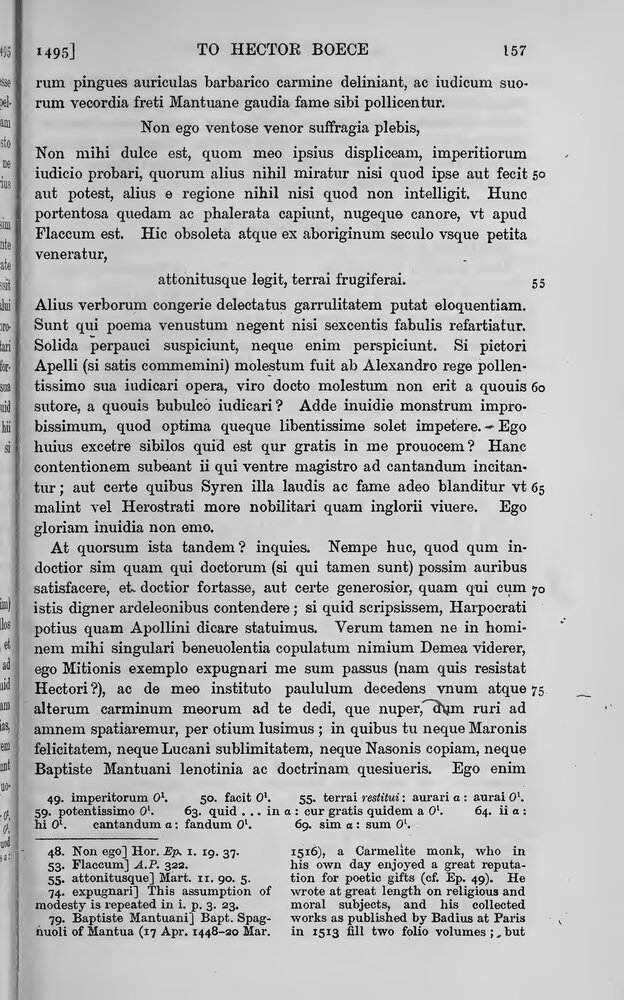
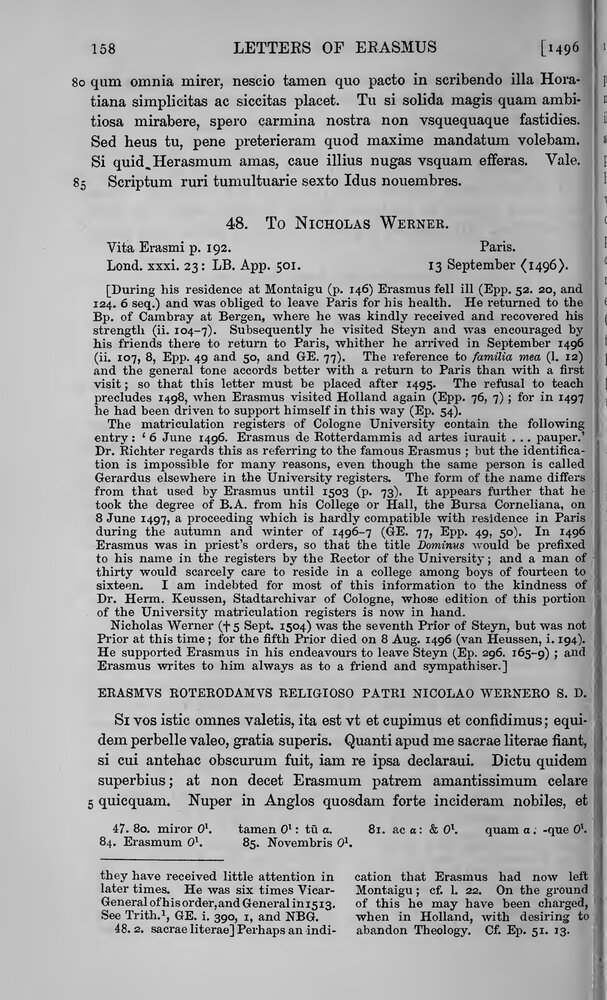
[The preface to Erasmus' Carmen de casa natalitia Iesu (a), Paris, Ant. Denidel. s. a. (Jan. 1496?), of which only two copies are known, one in the British Museum and the other at Cracow. The book contains a number of Erasmus' poems (cf. p. 3), in one of which Gaguin is said to be engaged on the Histories or Annales, first published in Oct. 1495, cf. Ep. 45, and Faustus on his Eclogues, which were not published till after July 1497. The poem, which is described as 'et ruri et autumno scriptum,' is plainly contemporary with the letter 'scriptum ruri,' Nov. 8; and speaks of Gaguin's Annales in a way that can only refer to the first edition. In i. p. 3. 24 Faustus is represented as being a recently made friend (cf. Ep. 44. 30) when the poem was published; and in Luc. Ind. (1519) it appears as Erasmus' first composition, written 'ruri Parrisiis ante annos xxiiii.' 1495 may therefore be assigned as the date of the poem and the letter. A confirmation of this is that the book also contains Erasmus' poem 'ad Gaguinum nondum visum,' and must therefore be prior to the Sylua Odarum (20 Jan. 1497; Ep. 49) in which is the poem de suis fatis ad Gaguinum sibi amicissimum. In Luc. Ind. and i. p. 3 these two poems are enumerated as Erasmus' second and third compositions. For further considerations see the note on Boece, and also cf. Ep. 52. 18. Knight's statement (Life of Erasmus, App. p. 16) that the De Casa was composed 'in compliment to the College of the Virgin Mary at Oxford, where he sojourned' is plainly an error. The poems, but not the letter, were afterwards printed with Erasmus' Epigrammata. Merula cannot have had the book before him; but must have printed from an inferior MS. copy. Boece or Boys (c. 1465-1536) was afterwards first Principal of King's College, Aberdeen, and wrote a History of Scotland and other works. See DNB. He was B.A. at Paris 1493, M.A. 1494, and Proctor of the German nation 1495-6. There is no definite evidence of his being at Aberdeen before 20 Aug. 1500, when a document was signed in his presence (Rait, Univ. of Aberdeen, p. 30); but the Bull of Alexander vi for the foundation of Aberdeen University is dated 10 Feb. 149 % (ibid. p. 24) and in his Episcoporum Aberdonensium Vitae (p. 88, ed. Moir, 1895) Boece mentions Erasmus as one of the learned men in Montaigu at the time when Elphinstone took him from Paris to King's College. If this statement can be pressed, Boece's departure must be placed before the summer of 1496, when Erasmus left Montaigu (p. 158) and possibly about this very time; for the fact that Erasmus dedicated his first book, not to the Bp. of Cambray to whom his allegiance was due, but to an obscure Scotch friend, suggests that he may just then have had hopes of an introduction to Boece's more liberal patron Elphinstone, and thus of finding his way to Aberdeen. An autograph letter of Boece, dated 26 May 1528, is in the Town library at Breslau (Cod. Rhed. 254. 31) in which he reminds Erasmus of their intercourse in Montaigu thirty-two years before. Erasmus' answer, dated 15 Mar. 1530, is prefixed to his last catalogue of his writings; which is printed in his Consultatio de bello Turcis inferendo, Basle, Froben, 1530. It is possible that the epistola mixta addressed to Robert (Fisher?) and dated from Carlisle, 30 Nov. (1496?), which is printed in Siberch's edition of the De Conscrib. Epist. (ff. 3-4) and speaks of the foundation of a university, may represent a genuine one from Boece on his journey to Aberdeen. A great many of the epistolary examples in the treatise are reminiscences of actual letters, see Ep. 71. For the letter here referred to, the mixta epistola, in which Erasmus narrates with great fidelity his English experiences in 1499-1500, was substituted in later editions.]
Erasmus responds to Hector Boece's repeated requests for his poems by explaining his reluctance to publish his work. He expresses modesty about his poetic abilities and criticizes contemporary poets who publish inferior work. Despite his reservations, Erasmus ultimately sends Boece a few poems written during leisure time in the countryside, asking him not to share them widely.
Erasmus of Rotterdam sends greetings to Hector Boethius, a most learned and dearest friend. What is the meaning of so many quarrelsome letters from you? What manner of impropriety is this? For you write and rewrite; you threaten, you rail; in short, you openly declare war unless I supply you with copies of my poems. See, I pray, how unjust you are, demanding that I provide you with something of which I myself have no supply. Indeed, I most solemnly swear that I have not engaged in those pursuits for a long time now, and if I ever trifled with anything in my youth, I left it all behind in my homeland. For I have not dared to introduce my barbarous and somewhat crude, foreign-sounding Muses into this most celebrated University of Paris; in which I am not unaware that there flourish very many men most accomplished in every branch of letters. But you believe none of this and even suspect that I am writing poetry in this very matter. Who the devil persuaded you of this, that Erasmus is a poet? For you repeatedly call me by that name in your letters, a name indeed once most sacred and honored, but now invidious due to the foolish ignorance of many. Therefore, if you love me, take care not to address me by that name hereafter. Furthermore, dearest friend Hector, lest by writing often you both weary yourself and pester us, we must speak a little more freely and openly. In the first place, I am not so foolish as to wish to be esteemed by anyone more highly than I am. For although the Muses were sweet to me above all things as a boy, yet I have not labored so meticulously in this kind of study that anything worthy of Apollo and the cedar could issue from my workshop. And so, content to sing for myself and the Muses, I preferred to lie hidden by publishing nothing rather than to betray my lack of skill by writing ineptly. Let those rejoice that their poems are sung at every platform, at every crossroads, who, according to Horace, fear nothing the critic's sharp acumen, nor do they refuse, with Cicero, that all men read all their works. I, with Lucilius, write for the Sicilians and Tarentines, if indeed I write anything at all. But you will say, "Why should you not dare what these and those, your inferiors in both learning and eloquence, dare?" Add, if you please, that line of the satirist: "Learned and unlearned, we all write poems everywhere." And likewise that of another satirist chimes in: "It is foolish mercy, when you meet so many poets everywhere, to spare paper destined to perish." I, my dear Hector, am accustomed to hate, not imitate, that foolish facility and (so to speak) itch of those men; who, precocious (for so Quintilian calls them), when they have read one or two poets, and having tried the pipe of Apollo, begin to sound forth something tinkling, immediately leap forth suddenly to write, so pleased with their own ineptitude that they marvel at, love, and embrace whatever they have produced, just as an ugly ape does her offspring. For if it is right to confess the truth, how many Marsyas, how many Pans do we see in this our age, who would not hesitate to challenge Apollo himself for the smallest stake (as they say)? And indeed these men find clappers worthy of their singer; they find their own Midas, whose fat ears they soothe with barbaric song, and relying on the folly of their judges, they promise themselves the joys of Mantuan fame. I do not hunt the fickle votes of the common crowd, it is not sweet to me, when I displease myself, to be approved by the judgment of the less learned, of whom one admires nothing except what he himself has made or can make, another, on the contrary, nothing except what he does not understand. One is captivated by certain monstrous and flashy things, and tinkling trifles, as in Flaccus. Another venerates things obsolete and fetched from the age of the aborigines, "and reads astonished, of the fruit-bearing earth." Another, delighted by a heap of words, thinks garrulity is eloquence. There are those who deny a poem is elegant unless it is stuffed with six hundred tales. Very few admire solid substance, for they do not perceive it. If it was troublesome for the painter Apelles (if I remember rightly) to have his works judged by King Alexander, a most powerful man, will it not be troublesome for a learned man to be judged by any cobbler, by any ploughman? Add the most wicked monster of envy, which is wont most gladly to attack all the best things. Why should I gratuitously provoke the hisses of this creature? Let those undertake this struggle who are driven to sing by a master belly; or certainly those to whom that Siren of praise and fame flatters so much that they would prefer to become famous even in the manner of Herostratus than to live without glory. I do not buy glory with envy. "But to what end, pray, is all this?" you will say. Precisely to this: since I am less learned than to satisfy the ears of the learned (if any there are), and perhaps more learned, or certainly more noble, than to deign to contend with those wretched scribblers; if I had written anything, I have decided to dedicate it to Harpocrates rather than to Apollo. But nevertheless, lest I should seem too much of a Demea towards a man joined to me by singular goodwill, I have allowed myself to be overcome by the example of Mitio (for who could resist Hector?), and departing a little from my principle, I have sent to you one or two of my poems, which recently, while we were strolling in the countryside by the river, I trifled with at leisure; in which you must seek neither the felicity of Maro, nor the sublimity of Lucan, nor the copiousness of Naso, nor the polish and learning of Baptista Mantuanus. For although I admire all these, yet I know not how, in writing, that Horatian simplicity and dryness pleases me. If you will admire things solid more than ambitious, I hope you will not utterly disdain our poems. But hark you, I had almost forgotten what I chiefly wished to enjoin. If you love Erasmus at all, take care not to publish his trifles anywhere. Farewell. Written in the country, in haste, on the sixth day before the Ides of November.