

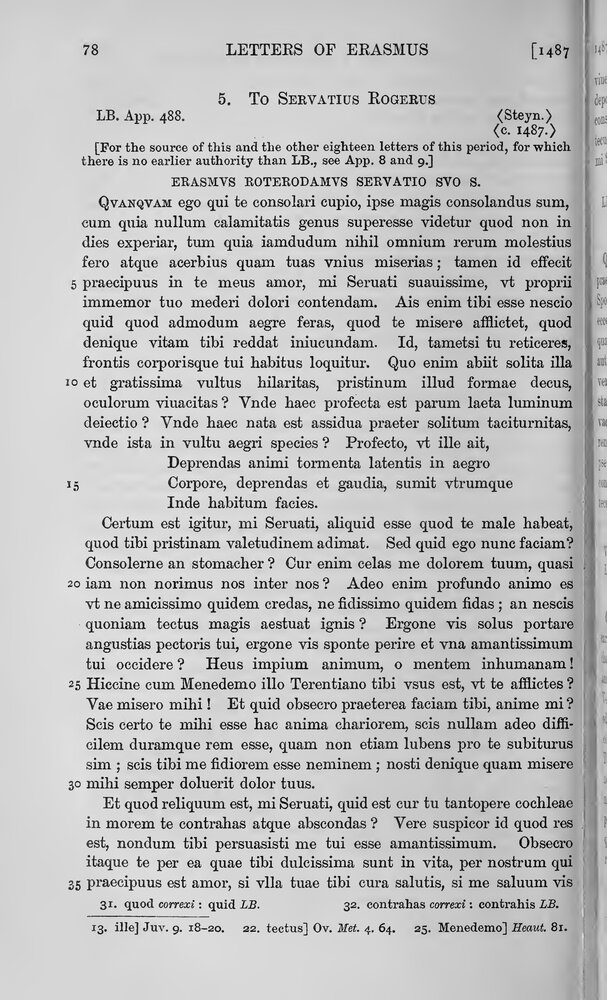
erasmvs roterodamvs servatio svo s.


5. to servatius rogerus

c. 1487, Steyn


1
QVANQVAM ego qui te consolari cupio, ipse magis consolandus sum,
cum quia nullum calamitatis genus superesse videtur quod non in
dies experiar, tum quia iamdudum nihil omnium rerum molestius
fero atque acerbius quam tuas vnius miserias; tamen id effecit
5
praecipuus in te meus amor, mi Seruati suauissime, vt proprii
immemor tuo mederi dolori contendam. Ais enim tibi esse nescio
quid quod admodum aegre feras, quod te misere afflictet, quod
denique vitam tibi reddat iniucundam. Id, tametsi tu reticeres,
frontis corporisque tui habitus loquitur. Quo enim abiit solita illa
10
et gratissima vultus hilaritas, pristinum illud formae decus,
oculorum viuacitas ? Vnde haec profecta est parum laeta luminum
deiectio? Vnde haec nata est assidua praeter solitum taciturnitas,
vnde ista in vultu aegri species? Profecto, vt ille ait,
15
Deprendas animi tormenta latentis in aegro
Corpore, deprendas et gaudia, sumit vtrumque
Inde habitum facies.
Certum est igitur, mi Seruati, aliquid esse quod te male habeat,
20
quod tibi pristinam valetudinem adimat. Sed quid ego nunc faciam?
Consolerne an stomacher? Cur enim celas me dolorem tuum, quasi
iam non norimus nos inter nos? Adeo enim profundo animo es
vt ne amicissimo quidem credas, ne fidissimo quidem fidas; an nescis
quoniam tectus magis aestuat ignis? Ergone vis solus portare
25
angustias pectoris tui, ergone vis sponte perire et vna amantissimum
tui occidere? Heus impium animum, o mentem inhumanam!
Hiccine cum Menedemo illo Terentiano tibi vsus est, vt te afflictes?
Vae misero mihi! Et quid obsecro praeterea faciam tibi, anime mi?
Scis certo te mihi esse hac anima chariorem, scis nullam adeo diffi-
30
cilem duramque rem esse, quam non etiam lubens pro te subiturus
sim; scis tibi me fidiorem esse neminem ; nosti denique quam misere
mihi semper doluerit dolor tuus.
Et quod reliquum est, mi Seruati, quid est cur tu tantopere cochleae
35
in morem te contrahas atque abscondas? Vere suspicor id quod res
est, nondum tibi persuasisti me tui esse amantissimum. Obsecro
itaque te per ea quae tibi dulcissima sunt in vita, per nostrum qui
praecipuus est amor, si vlla tuae tibi cura salutis, si me saluum vis
viuere, ne tanto studio celes animum tuum, sed quidquid habes
40
depone tutis auribus. Ego te quidem quoquo modo aut auxilio aut
consilio iuuero. Sin neutrum praestare potero, dulce tamen erit
tecum gaudere, tecum lachrimari, tecum viuere, tibi commori. Vale,
mi Seruati, tuaeque curam salutis habe.


Associated Sources

2.
'Opus Epistolarum Des. Erasmi Roterodami', ed. P. S. Allen, 11 vols (Oxford: Clarendon Press, 1906), vol. 1, epistle 5.
3.
'The correspondence of Erasmus: letters 1 to 141, 1484 to 1500', tr. R. A. B. Mynors and D. F. S. Thomson, annot. Wallace K. Ferguson, 'Collected Works of Erasmus', ed. A. Dalzell, et al. (Toronto: University of Toronto Press, 1974), vol. 1, epistle 5.
4.
'La Correspondance d'Erasme. Traduite et annotée d'après l'Opus epistolarum de P. S. Allen, H. M. Allen et H. W. Garrod', ed. Alois Gerlo, et al., 12 vols (Brussels: University Press, 1967), vol. 1: 1484–1514, epistle 5.
5.
'De correspondentie van Desiderius Erasmus: Brieven 1–141', tr. M. J. Steens (Rotterdam: Donker, 2004), vol. 1, epistle 5.
Text has not been meticulously cleaned. You will find splits and errors, especially in Greek text. Refer to the originals or other sources for exact wording. Translation is done by AI, so do not regard it as authoritative! See About for more.

Commentary

Percy Stafford Allen

[For the source of this and the other eighteen letters of this period, for which there is no earlier authority than LB., see App. 8 and 9.]

M.J. Steens

Link to commentary

AI Summary

Erasmus expresses deep concern for his friend Servatius, who appears troubled and withdrawn. He pleads with Servatius to confide in him, emphasizing their close friendship and his willingness to share both joy and sorrow. Erasmus offers his support and urges Servatius not to suffer alone.

Translations

AI Deepseek

Erasmus of Rotterdam to his Servatius, Greetings. Although I, who desire to console you, am myself more in need of consolation—both because there seems no kind of calamity left that I do not experience daily, and because for a long time now I have found nothing in all the world more vexing and bitter than your miseries alone—yet my extraordinary love for you, my sweetest Servatius, has brought it about that, forgetful of my own, I strive to heal your sorrow. For you say there is something—I know not what—that you bear with great difficulty, that miserably afflicts you, that finally renders life unpleasant for you. This, even if you were silent, the appearance of your brow and body proclaims. For where has that usual and most pleasing cheerfulness of countenance gone, that former grace of form, the liveliness of your eyes? From where has this rather joyless downcast gaze arisen? From where has this constant, uncharacteristic silence been born, from where this sickly look upon your face? Truly, as the poet says, > You may detect the torments of a mind hiding in a sick body, you may detect its joys too; the face takes on its appearance from either state. It is certain, then, my Servatius, that there is something which troubles you, which robs you of your former well-being. But what am I to do now? Console you or be angry? For why do you hide your pain from me, as if we do not know each other intimately? For you are so deep of spirit that you do not entrust it even to your most devoted friend, that you have no faith even in the most faithful; do you not know that a fire covered over burns more fiercely? Do you then wish to bear the straits of your breast alone? Do you then wish to perish by your own will and, in doing so, kill one who loves you most dearly? Ah, what an impious spirit, O what an inhuman mind! Is this the use you make of that Menedemus from Terence, to torment yourself? Woe is me, unhappy! And what else, I beseech you, am I to do for you, my soul? You know for certain that you are dearer to me than this life of mine; you know there is no task so difficult and hard that I would not willingly undertake it for you; you know that no one is more faithful to you than I; you know, finally, how miserably your pain has always pained me. And what remains, my Servatius, what reason is there for you to withdraw and hide yourself in the manner of a snail? I truly suspect what is the case: you have not yet convinced yourself that I am most loving of you. Therefore, I beseech you by those things which are sweetest to you in life, by our love which is supreme, if you have any care for your own welfare, if you wish me to live safe and sound, do not with such zeal conceal your mind, but lay down whatever you have in trusting ears. I will indeed help you in whatever way, either by aid or by counsel. But if I can provide neither, it will yet be sweet to rejoice with you, to weep with you, to live with you, to die with you. Farewell, my Servatius, and take care for your well-being.

M.J. Steens