

erasmvs servatio svo s.


6. to servatius rogerus

c. 1487, Steyn


1
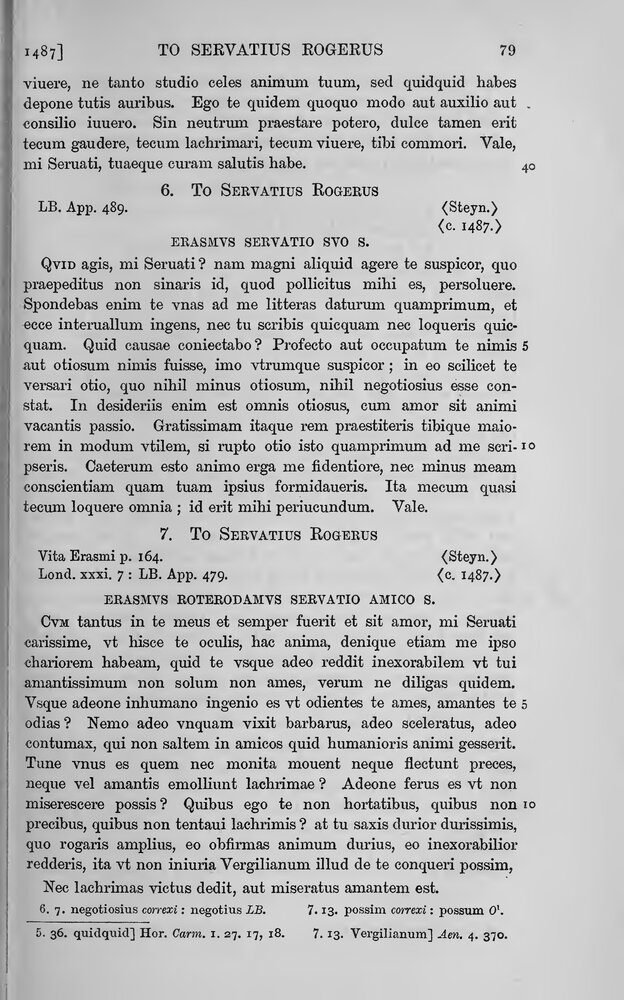
QVID agis, mi Seruati? nam magni aliquid agere te suspicor, quo
praepeditus non sinaris id, quod pollicitus mihi es, persoluere.
Spondebas enim te vnas ad me litteras daturum quamprimum, et
ecce interuallum ingens, nec tu scribis quicquam nec loqueris quic-
5
quam. Quid causae coniectabo? Profecto aut occupatum te nimis
aut otiosum nimis fuisse, imo vtrumque suspicor; in eo scilicet te
versari otio, quo nihil minus otiosum, nihil negotiosius esse con-
stat. In desideriis enim est omnis otiosus, cum amor sit animi
vacantis passio. Gratissimam itaque rem praestiteris tibique maio-
10
rem in modum vtilem, si rupto otio isto quamprimum ad me scri-
pseris. Caeterum esto animo erga me fidentiore, nec minus meam
conscientiam quam tuam ipsius formidaueris. Ita mecum quasi
tecum loquere omnia; id erit mihi periucundum. Vale.


Associated Sources

2.
'Opus Epistolarum Des. Erasmi Roterodami', ed. P. S. Allen, 11 vols (Oxford: Clarendon Press, 1906), vol. 1, epistle 6.
3.
'The correspondence of Erasmus: letters 1 to 141, 1484 to 1500', tr. R. A. B. Mynors and D. F. S. Thomson, annot. Wallace K. Ferguson, 'Collected Works of Erasmus', ed. A. Dalzell, et al. (Toronto: University of Toronto Press, 1974), vol. 1, epistle 6.
4.
'La Correspondance d'Erasme. Traduite et annotée d'après l'Opus epistolarum de P. S. Allen, H. M. Allen et H. W. Garrod', ed. Alois Gerlo, et al., 12 vols (Brussels: University Press, 1967), vol. 1: 1484–1514, epistle 6.
5.
'De correspondentie van Desiderius Erasmus: Brieven 1–141', tr. M. J. Steens (Rotterdam: Donker, 2004), vol. 1, epistle 6.
Text has not been meticulously cleaned. You will find splits and errors, especially in Greek text. Refer to the originals or other sources for exact wording. Translation is done by AI, so do not regard it as authoritative! See About for more.

Commentary

M.J. Steens

Link to commentary

AI Summary

Erasmus expresses concern that Servatius has not written to him as promised, speculating that he is either too busy or too idle. He urges Servatius to break from his idleness and write soon, reassuring him that he can speak as freely with Erasmus as he would with himself.

Translations

AI Deepseek

ERASMUS TO HIS SERVATIUS, GREETINGS. WHAT are you doing, my Servatius? For I suspect you are engaged in some great affair, which so occupies you that you are not permitted to fulfill what you promised me. For you pledged that you would send me a single letter as soon as possible, and behold, a great interval has passed, and you write nothing nor say anything. What reason shall I guess? Truly, you have either been too busy or too idle—indeed, I suspect both; namely, that you are in that kind of leisure than which nothing is less leisurely, nothing more full of business. For every idle person is in a state of longing, since love is a passion of an unoccupied mind. Therefore, you will do a thing most pleasing and exceedingly useful to yourself if, breaking that leisure, you write to me as soon as possible. Moreover, be of a more confident spirit towards me, and fear my conscience no less than your own. Speak all things with me as if with yourself; that will be most delightful to me. Farewell.

M.J. Steens