
Erasmus writes an emotional letter to his friend Servatius Rogerus, expressing deep hurt and confusion over Servatius's apparent rejection and coldness toward him. He pleads for Servatius to either reciprocate his friendship or clearly reject him, rather than leaving him in emotional torment. Despite the pain, Erasmus declares he will never stop loving Servatius, though he may need to moderate his affection to avoid further suffering.
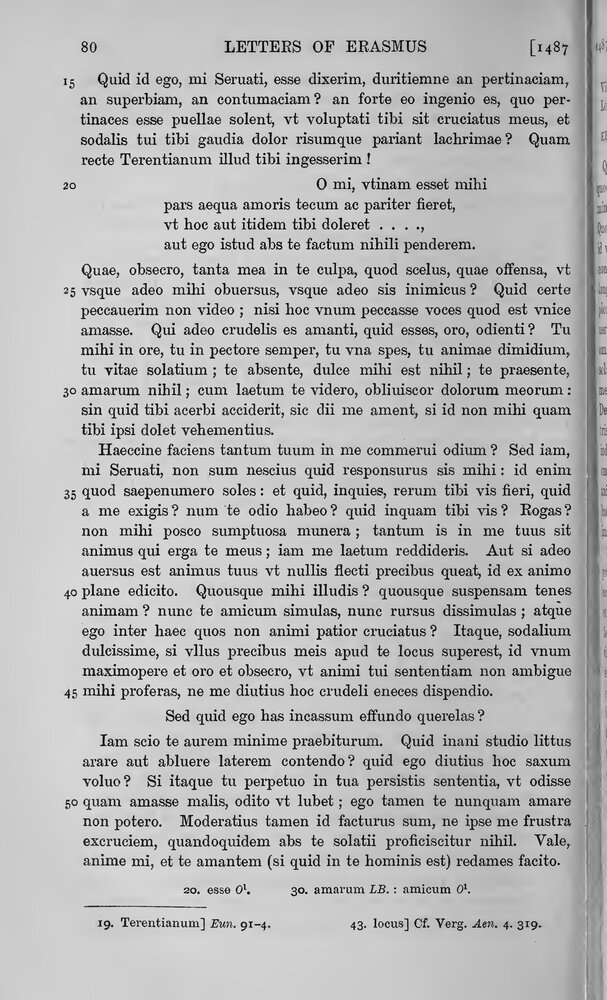
ERASMUS OF ROTTERDAM TO HIS FRIEND SERVATIUS, GREETINGS. Since my love for you, my dearest Servatius, has always been and remains so great that I hold you dearer than these eyes, dearer than this spirit, and finally dearer than my very self—what renders you so unyielding that you not only do not love one who loves you most, but do not even hold him in affection? Are you of so inhuman a nature that you love those who hate you and hate those who love you? No one has ever lived so barbarous, so wicked, so obstinate, who did not show at least some human feeling toward his friends. Are you alone unmoved by admonitions, unbent by entreaties, not even softened by a lover’s tears? Are you so savage that you cannot take pity? With what encouragements, with what entreaties, with what tears have I not tried to move you? But you, harder than the hardest stone—the more you are begged, the more firmly you harden your heart, the more unyielding you become, so that I might rightly complain of you in Virgil’s words: "Nor, overcome, did he yield tears or pity his lover." What shall I call this, my Servatius—hardness or stubbornness, or pride, or defiance? Or perhaps you are of that nature typical of obstinate girls, so that my torment gives you pleasure, and your friend’s joys bring you sorrow, his tears laughter? How aptly I might apply to you that line of Terence: "Oh, if only I had an equal share of love with you, so that either you likewise felt this pain, or I cared nothing for what you have done." What, I beg you, is my great fault toward you, what crime, what offense, that you are so turned against me, so hostile? I truly do not see what I have done wrong—unless you call it a sin to have loved uniquely. You who are so cruel to one who loves you, what would you be, I ask, to one who hates you? You are always on my lips, always in my heart; you are my one hope, the half of my soul, the comfort of my life; in your absence, nothing is sweet to me; in your presence, nothing is bitter; when I see you happy, I forget my sorrows; but if any trouble befalls you, so help me God, it pains me more sharply than it does you. Have I deserved such hatred from you by acting thus? But now, my Servatius, I am not unaware what you will reply to me—for you often say: "And what," you will ask, "do you want to happen? What do you demand of me? Do I hate you? What do you want?" You ask? I do not demand costly gifts; only let your heart be toward me as mine is toward you; that alone will make me happy. Or if your heart is so averse that it cannot be swayed by any prayers, declare it plainly from your soul. How long will you mock me? How long will you keep my soul in suspense? Now you pretend friendship, now again you dissemble; and I, meanwhile—what torments of spirit do I not suffer? Therefore, sweetest friend, if any place remains for my prayers with you, this one thing I earnestly beg and beseech: that you reveal your mind’s decision to me without ambiguity, lest you kill me longer with this cruel wasting away. But why do I pour forth these complaints in vain? I know well you will not lend an ear. Why do I strive to plow the shore or wash a brick in futile effort? Why longer roll this stone? If, therefore, you persist in your resolve—to prefer hating over loving—then hate as you please; yet I shall never be able not to love you. But I shall do so more moderately, lest I torment myself to no purpose, since from you no comfort comes. Farewell, my soul, and see that you love in return one who loves you—if there is any humanity in you.