

Erasmus expresses deep emotional distress over Servatius Rogerus's apparent neglect and indifference, lamenting that their friendship has deteriorated. He passionately argues for the restoration of their bond, citing classical examples of loyalty even among wild animals, and pleads for mutual affection and openness. The letter concludes with a desperate appeal for reconciliation, stating that without Servatius's friendship, life holds no meaning for him.
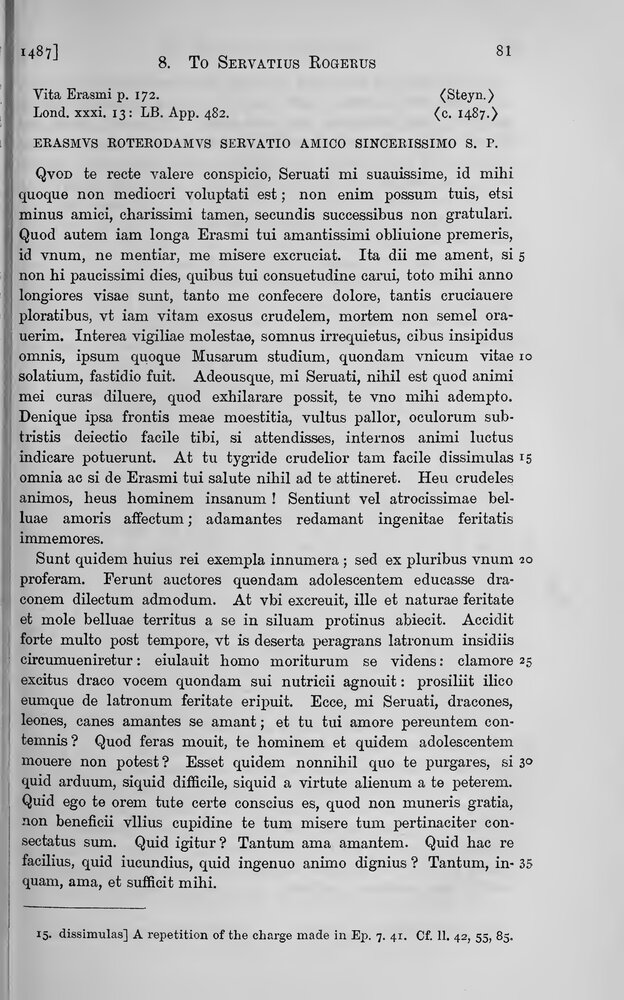
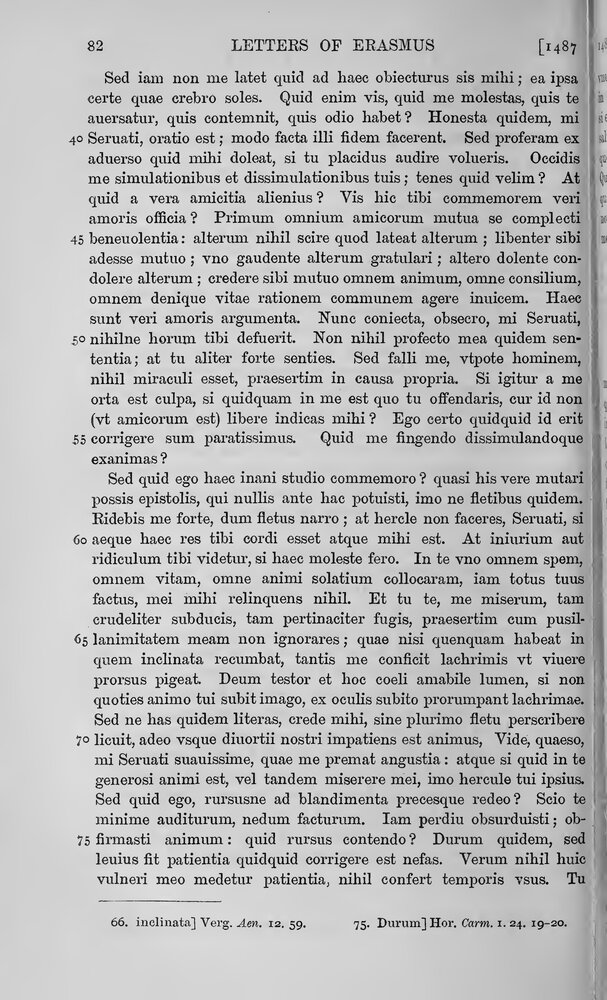
Erasmus of Rotterdam to Servatius, his most sincere friend, sends greetings. That I see you are in good health, my sweetest Servatius, is a source of no small pleasure to me; for I cannot but rejoice in the successes of one who, if not a friend, is still most dear to me. But that you are now oppressed by a long forgetfulness of your most loving Erasmus—this one thing, to tell the truth, tortures me wretchedly. So help me God, these very few days, during which I have lacked your company, have seemed longer to me than a whole year; they have so consumed me with grief, so tormented me with lamentations, that already loathing this cruel life, I have more than once prayed for death. Meanwhile, troubled wakefulness, restless sleep, tasteless food—everything, even the study of the Muses, once the sole comfort of my life, has become an object of disgust. So far, my Servatius, there is nothing that can soothe the cares of my mind, nothing that can cheer me, now that you alone are taken from me. In short, the very sadness of my brow, the pallor of my face, the somewhat sorrowful downcast look of my eyes could easily have indicated to you, had you paid attention, the inner grief of my soul. But you, more cruel than a tigress, so easily pretend that nothing is wrong, as if the well-being of your Erasmus were of no concern to you. Alas for such cruel feelings, alas for such a madman! Even the fiercest beasts feel the emotion of love; they love in return, forgetful of their innate savagery. Indeed, there are countless examples of this; but from many I shall bring forth one. Authors relate that a certain young man reared a dragon, very much beloved. But when it grew up, he, terrified both by its natural ferocity and its size, immediately cast it away from him into a forest. It happened by chance a long time afterwards, that this same man, wandering in the wilderness, was surrounded by an ambush of robbers: the man cried out, seeing himself about to die: aroused by the shout, the dragon recognized the voice of its former foster-parent: it sprang out at once and rescued him from the ferocity of the robbers. Behold, my Servatius, dragons, lions, dogs love those who love them; and do you scorn one who is perishing from love of you? What moves wild beasts, cannot move you, a man and a youth at that? There would indeed be something with which you could clear yourself, if I were asking something arduous, something difficult, something alien to virtue. What I ask of you, you yourself are certainly aware—it was not for the sake of a gift, not from desire for any benefit that I so wretchedly and so persistently pursued you then. What then? Only love one who loves you. What is easier than this, what more pleasant, what more worthy of a noble spirit? Only, I say, love, and it is enough for me. But now I am not unaware of what you are going to object to me about these things; certainly those very things you often do. For what do you want, why do you trouble me, who turns away from you, who scorns you, who holds you in hatred? It is indeed honorable language, my Servatius; if only your deeds gave it credibility. But I shall set forth on the other side what grieves me, if you will be so kind as to listen. You are killing me with your pretenses and concealments; do you understand what I want? But what is more foreign to true friendship? Do you wish me to recount here for you the duties of true love? First of all, that friends embrace each other with mutual good will: another, that neither knows anything hidden from the other; to be gladly present for each other; when one rejoices, the other to congratulate him; when one grieves, the other to grieve with him; to trust each other with every feeling, every plan, in short, to lead their whole manner of life in common with one another. These are the proofs of true love. Now consider, I beg you, my Servatius, whether any of these has been lacking in you. Not nothing, certainly in my opinion; but you perhaps think otherwise. But that I, being human, should be deceived would be no wonder, especially in my own cause. If therefore the fault arose from me, if there is anything in me by which you are offended, why do you not (as is the way of friends) freely point it out to me? I am certainly most ready to correct whatever it may be. Why do you torment me to death with feigning and dissembling? But why do I recount these things with futile zeal? As if you could truly be changed by these letters, you who could not be changed by any before, nor indeed even by my tears. You will perhaps laugh at me while I tell of tears; but by Hercules you would not, Servatius, if this matter were as dear to your heart as it is to mine. But does it seem unjust or ridiculous to you, if I take these things hard? In you alone I had placed all my hope, all my life, all the comfort of my soul, having now become wholly yours, leaving nothing of myself for me. And you, wretch that I am, so cruelly withdraw yourself, so persistently flee, especially since you were not ignorant of my timidity of spirit; which, unless it has someone upon whom, leaning, it can rest, so overwhelms me with tears that I am utterly disgusted with living. I call God and this lovely light of heaven to witness, if every time the image of you comes to my mind, tears do not suddenly burst from my eyes. But not even this letter, believe me, could I write without very many tears, so utterly intolerant is my spirit of our separation. See, I beg you, my sweetest Servatius, what distress oppresses me: and if there is any generosity of spirit in you, at last take pity on me, or rather, by Hercules, on yourself. But what am I doing, am I returning again to coaxings and prayers? I know you will not listen at all, let alone act. You have been deaf for a very long time; you have hardened your heart: why do I strive again? It is hard indeed, but whatever it is wrong to correct is made lighter by patience. But patience brings no healing to this wound of mine, the passage of time does no good. You alone are the one who can bring the cure, you who can most easily turn sorrows into joys, grief into laughter. And so, my dearest Servatius, if I cannot obtain from you that friendship which I once so greatly desired, at least I ask that there be ordinary intercourse between us; but if you think that this too must be denied me, there is nothing for which I should wish to live any longer. What opinion, however, resides in your mind concerning these matters, I ask that you inform me by letter as soon as possible, and that indeed from the heart, not evasively according to your old custom. Farewell, sole hope of my life.