
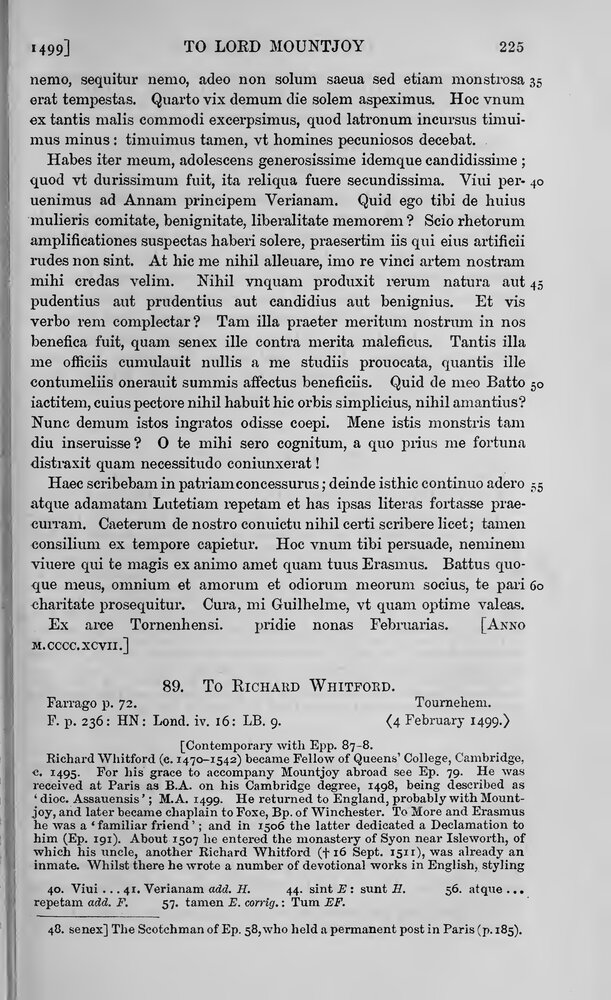
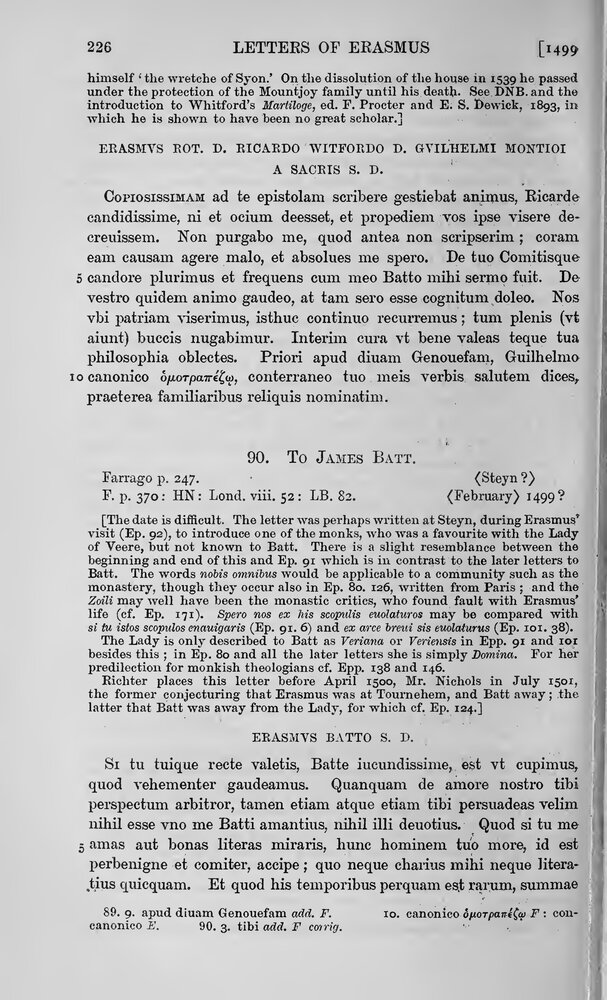
[Contemporary with Epp. 87-8. Tournehem. Richard Whitford (c. 1470-1542) became Fellow of Queens' College, Cambridge, For his grace to accompany Mountjoy abroad see Ep. 79. He was received at Paris as B.A. on his Cambridge degree, 1498, being described as 'dioc. Assauensis'; M.A. 1499. He returned to England, probably with Mountjoy, and later became chaplain to Foxe, Bp. of Winchester. To More and Erasmus he was a 'familiar friend'; and in 1506 the latter dedicated a Declamation to him (Ep. 191). About 1507 he entered the monastery of Syon near Isleworth, of which his uncle, another Richard Whitford († 16 Sept. 1511), was already an inmate. Whilst there he wrote a number of devotional works in English, styling himself 'the wretche of Syon.' On the dissolution of the house in 1539 he passed under the protection of the Mountjoy family until his death. See DNB. and the introduction to Whitford's Martiloge, ed. F. Procter and E. S. Dewick, 1893, in which he is shown to have been no great scholar.]
Erasmus writes to Richard Whitford expressing his desire to write a longer letter but citing lack of time and his plan to visit soon. He mentions conversations about Whitford and Mountjoy's character with his friend Battus, expresses regret at not writing sooner, and promises to explain in person. He asks Whitford to convey greetings to mutual acquaintances and encourages him to enjoy his philosophical studies.
Erasmus of Rotterdam to Richard Whitford, Chaplain to Lord William Mountjoy, Greetings. My mind was most eager to write you a very lengthy letter, most candid Richard, had I not lacked leisure and decided to visit you myself very soon. I shall not excuse myself for not having written before; I prefer to plead that case in person, and I hope you will acquit me. I have had much and frequent conversation with my Battus about your candor and that of the Count. I indeed rejoice at your disposition, but I regret that it was recognized so late. As soon as I have visited my homeland, I will immediately hurry back to you; then we shall chat, as they say, with full cheeks. Meanwhile, take care to keep well and delight yourself with your philosophy. You will give my greetings to the prior at St. Genevieve's, to William the canon, your fellow-countryman and my fellow-soldier, and also to the rest of my friends by name.