

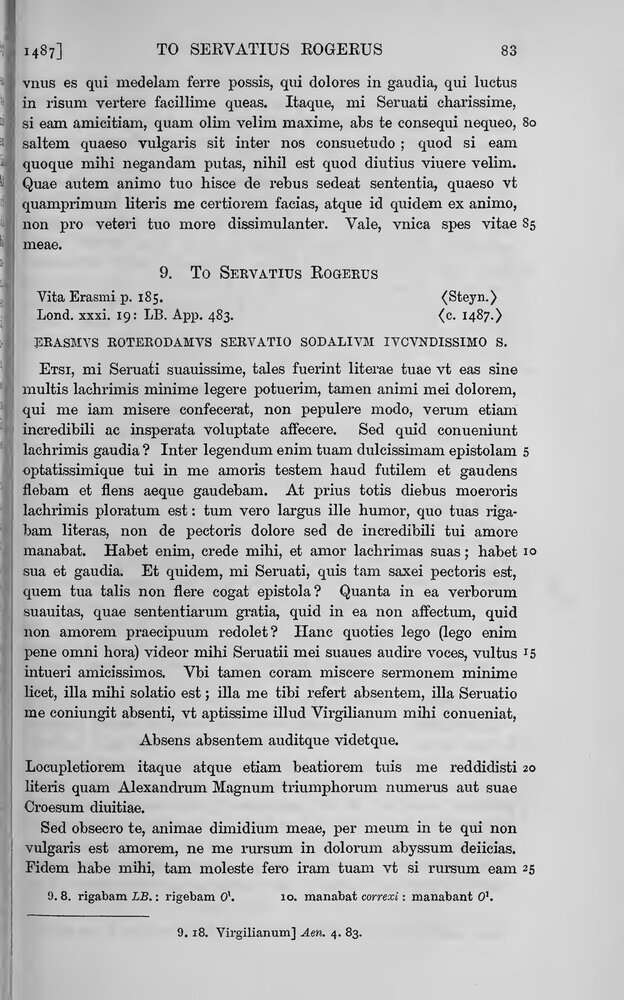
erasmvs roterodamvs servatio sodalivm ivcvndissimo s.


9. to servatius rogerus

c. 1487, Steyn


1
ETSI, mi Seruati suauissime, tales fuerint literae tuae vt eas sine
multis lachrimis minime legere potuerim, tamen animi mei dolorem,
qui me iam misere confecerat, non pepulere modo, verum etiam
incredibili ac insperata voluptate affecere. Sed quid conueniunt
5
lachrimis gaudia? Inter legendum enim tuam dulcissimam epistolam
optatissimique tui in me amoris testem haud futilem et gaudens
flebam et flens aeque gaudebam. At prius totis diebus moeroris
lachrimis ploratum est: tum vero largus ille humor, quo tuas riga-
bam literas, non de pectoris dolore sed de incredibili tui amore
10
manabat. Habet enim, crede mihi, et amor lachrimas suas; habet
sua et gaudia. Et quidem, mi Seruati, quis tam saxei pectoris est,
quem tua talis non flere cogat epistola? Quanta in ea verborum
suauitas, quae sententiarum gratia, quid in ea non affectum, quid
non amorem praecipuum redolet? Hanc quoties lego (lego enim
15
pene omni hora) videor mihi Seruatii mei suaues audire voces, vultus
intueri amicissimos. Vbi tamen coram miscere sermonem minime
licet, illa mihi solatio est; illa me tibi refert absentem, illa Seruatio
me coniungit absenti, vt aptissime illud Virgilianum mihi conueniat,
Absens absentem auditque videtque.
20
Locupletiorem itaque atque etiam beatiorem tuis me reddidisti
literis quam Alexandrum Magnum triumphorum numerus aut suae
Croesum diuitiae.
Sed obsecro te, animae dimidium meae, per meum in te qui non
vulgaris est amorem, ne me rursum in dolorum abyssum deiicias.
25
Fidem habe mihi, tam moleste fero iram tuam vt si rursum eam
intellexero, exanimaueris ilico. Parce quaeso amanti, non es ignarus
meorum morum, ingenium meum non ignoras. Tenerioris animi
sum quam qui tam crudeles ludos totiens perferre possim; atque
etiam, si apertius dicendum est, non est amantis officium amantem
30
laedere, ne ioco quidem. Quod si, vt scribis, hoc prior te laesi
quod simulare et dissimulare te dixerim, cogita quaeso, mi Seruati,
si id tibi tam durum atque acerbum auditu, quanto id mihi acerbius
perferre quotidie abs te. Et quid tam abest a vera amicitia quam
quidquam celare amicum, praesertim quod illius referat nosse?
35
Modo negare, modo asserere atque identidem vertere sermonem,
obsecro te, an non id simulare est ac dissimulare? Age enim, age
mihi vt lubet, tantum quaeso ne his artibus homini tibi amicissimo
illuseris. Vtvt se res habet, plane edicito; pudenti enim animo
nescio an quidquam sit molestius. Quod si hac vna in re te exorare
40
nequeo, et, vt apud Virgilium est,
Misero lachrimae voluuntur inanes,
Mortem oro, taedet coeli conuexa tueri.
Vale, spes mea, vitae solatium vnicum. Fac, amabo, vt tuae
quamprimum ad nos veniant literae.


Associated Sources

2.
'Opus Epistolarum Des. Erasmi Roterodami', ed. P. S. Allen, 11 vols (Oxford: Clarendon Press, 1906), vol. 1, epistle 9.
3.
'The correspondence of Erasmus: letters 1 to 141, 1484 to 1500', tr. R. A. B. Mynors and D. F. S. Thomson, annot. Wallace K. Ferguson, 'Collected Works of Erasmus', ed. A. Dalzell, et al. (Toronto: University of Toronto Press, 1974), vol. 1, epistle 9.
4.
'La Correspondance d'Erasme. Traduite et annotée d'après l'Opus epistolarum de P. S. Allen, H. M. Allen et H. W. Garrod', ed. Alois Gerlo, et al., 12 vols (Brussels: University Press, 1967), vol. 1: 1484–1514, epistle 9.
5.
'De correspondentie van Desiderius Erasmus: Brieven 1–141', tr. M. J. Steens (Rotterdam: Donker, 2004), vol. 1, epistle 9.
Text has not been meticulously cleaned. You will find splits and errors, especially in Greek text. Refer to the originals or other sources for exact wording. Translation is done by AI, so do not regard it as authoritative! See About for more.

Commentary

M.J. Steens

Link to commentary

AI Summary

Erasmus expresses profound emotional turmoil and joy upon receiving Servatius' letter, describing how it moved him to tears of both sorrow and happiness. He pleads with Servatius not to cause him further emotional distress, insisting that true friendship requires honesty and openness rather than concealment. The letter reveals Erasmus' deep emotional vulnerability and his intense desire for authentic, transparent friendship.

Translations

AI Deepseek

Though, my dearest Servatius, your letter was such that I could scarcely read it without many tears, yet it not only did not drive away the grief of my spirit, which had already miserably consumed me, but it even affected me with incredible and unhoped-for pleasure. But how do joys mingle with tears? For while reading your sweetest letter—that not ineffective witness of your most longed-for love for me—I was both weeping for joy and, equally, rejoicing through my tears. But before, whole days had been spent weeping with tears of sorrow; then, however, that abundant moisture with which I drenched your letter flowed not from pain in my breast, but from incredible love for you. For believe me, love too has its tears; it also has its joys. And indeed, my Servatius, who is so stony-hearted that such a letter from you would not compel him to weep? What great sweetness of words is in it, what grace of thought, what does it not smell of, if not affection, if not exceptional love? As often as I read it (for I read it almost every hour), I seem to hear the sweet voice of my Servatius, to behold his most friendly countenance. And when, however, it is not at all permitted for us to converse face-to-face, that letter is my comfort; it brings me, though absent, back to you, it joins me to my absent Servatius, so that that most fitting line from Virgil applies to me: "Absent, he hears and sees the absent one." And so you have rendered me richer and even more blessed by your letters than Alexander the Great by the number of his triumphs or Croesus by his own riches. But I beg you, half of my soul, by my love for you, which is not ordinary, do not cast me back again into the abyss of sorrows. Believe me, I bear your anger so grievously that if I were to perceive it again, you would have slain me instantly. Spare, I pray, one who loves you; you are not ignorant of my character, you do not know not my nature. I am of too tender a spirit to be able to endure such cruel games so many times; and even, if I must speak more plainly, it is not the duty of one who loves to wound the lover, not even in jest. But if, as you write, I offended you first by saying that you pretend and dissemble, consider, I pray, my Servatius, if that is so harsh and bitter for you to hear, how much more bitter it is for me to endure it daily from you. And what is so far from true friendship as to hide anything from a friend, especially something it concerns him to know? Now to deny, now to assert, and repeatedly to turn the conversation—I beg you, is that not to pretend and dissemble? Come now, come, treat me as you please, only I pray you, do not mock a man most devoted to you with these arts. However the matter stands, tell me plainly; for to a modest spirit, I know not if anything is more vexing. But if in this one matter I cannot prevail upon you, and, as in Virgil, "Tears fall in vain for the wretched man," I pray for death; it wearies me to gaze upon the vault of heaven. Farewell, my hope, my only comfort in life. Bring it about, I beg, that your letter come to us as soon as possible.

M.J. Steens